




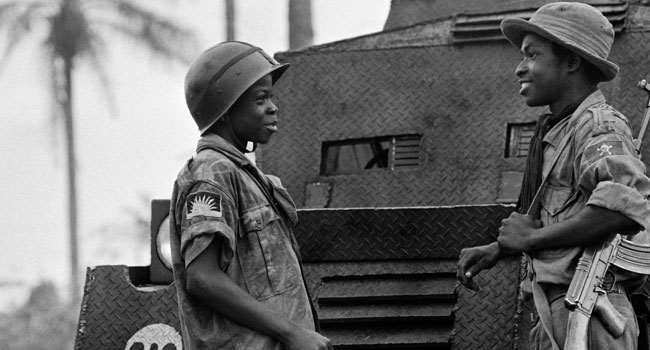
On August 31, 1968, a single photograph from Umuahia shattered any illusion that the Nigerian Civil War was an adult affair. It captured two young Biafran soldiers, Moise, aged 14, and Ferdinand, aged 16, standing in military attire.
This stark image, taken by French photojournalist François Mazure and distributed by Agence France Presse, exposed a brutal truth: Nigeria’s devastating conflict conscripted its youth. The photograph offered undeniable proof that the war’s reach extended to the very young.
Proved Biafra’s War Was devastating
The Nigerian Civil War, raging from July 1967 to January 1970, saw federal troops push deeper into Biafran territory. By 1968, the region was under immense military pressure as Nigerian federal forces advanced. Umuahia, then Biafra’s principal administrative centre after Enugu fell in October 1967, became a critical stronghold.
It was in this grim reality that Mazure documented Moise and Ferdinand, their youth a stark contrast to the uniforms and weaponry they displayed.
Most historical accounts often focus on generals and political leaders, overlooking the widespread involvement of non-adults. Yet, the presence of Moise and Ferdinand, teenagers barely into adolescence, revealed a deeper, more tragic stratum of participation.
By 1968, reports confirmed boys as young as thirteen were being conscripted and forcibly recruited into the Biafran army, sometimes with minimal training. This photograph offers irrefutable proof that children were not just victims, but also unwilling combatants in the fight to preserve Biafra.
The larger political upheavals of the time, such as the 1966 counter-coup, had set Nigeria on this destructive path.
The Nigerian Civil War began in July 1967, following the Eastern Region’s secession as the Republic of Biafra. The conflict grew out of a wider political and constitutional crisis, marked by military coups, ethnic violence, and disputes over national unity. General Yakubu Gowon’s federal government moved decisively to crush the secession, launching military operations to restore control.
This brutal war lasted until January 1970, leaving an indelible mark on Nigeria. Estimates suggest between one and two million people died, primarily from hunger and disease, in southeastern Nigeria. The federal army’s blockade of Biafra’s food supply and medical aid turned hunger into a deliberate weapon, creating one of history’s most profound humanitarian crises. Civilians, particularly children, bore the brunt of this catastrophic strategy.
Mobilising Youth for a Total War Effort
The boys’ ages, 14 and 16, make the image of Moise and Ferdinand particularly poignant. While specific individual stories are often lost to history, veteran accounts corroborate this reality. Gabriel Ukuwagi, for instance, later recalled joining the Biafran army at just 14 in 1967.
Such testimonies confirm that young people’s participation was an integral part of the wider conflict. The photograph itself cannot detail how Moise and Ferdinand were recruited, what duties they performed, or their ultimate fates. However, it unequivocally confirmed the widespread presence of such young people in military service.
The use of child soldiers was not an isolated incident but part of Biafra’s total war effort. Facing overwhelming odds, Biafra mobilised its youth extensively. Children and teenagers were involved in household labour, humanitarian relief, and, critically, underage military service.
Many joined “Boys Companies” or “Boscompi,” which mimicked the regular Biafran army and often fed directly into its ranks. The image of Moise and Ferdinand brought this grim reality into sharp visual focus for the world.
Even earlier, historical photographs from different eras captured unique circumstances, such as the Obi of Aboh photographed far from his kingdom.
Global Witness and the Humanitarian Awakening
The Nigerian Civil War, through powerful imagery, became one of the first conflicts televised globally. Photographs like Mazure’s, and the stark images by British war photographer Don McCullin, profoundly influenced international public opinion. McCullin’s famous photograph of an emaciated albino boy clutching an empty corned beef tin became a symbol of Biafra’s suffering, pressuring governments to act.
This widespread visual documentation led to a significant rise in funding and prominence for international non-governmental organisations. The plight of starving Biafran children became a global cause, directly inspiring the launch of organisations like Médecins Sans Frontières (Doctors Without Borders). The images compelled the world to confront the human cost of conflict, forcing a re-evaluation of neutrality in humanitarian aid.
Preserving Historical Truth Amidst Speculation
Over the years, various unconfirmed claims about the boys’ identities circulated online. Some suggested they were named Udeze and Okonkwo, with assertions that both died at the war front. However, these specific details lack reliable independent confirmation. Responsible historical accounting demands a clear distinction: documented facts from published captions must remain separate from unverified speculation.
The true power of the image rests on what it definitively shows, not on later additions.
Historical photographs require careful treatment. Their captions can be shortened, altered, or detached from their original source, blurring the line between fact and rumour. Unless further evidence emerges, the responsible approach involves retaining the names used in original published captions. Confirming alternative names or fates would require original agency records, contemporary documentation, or reliable testimony from those who knew them.
A Lasting Lesson for Nigeria’s Future
This 1968 photograph from Umuahia ultimately teaches us a profound lesson about the Nigerian Civil War. It forces us to confront the uncomfortable reality that the conflict devoured more than just adult lives; it reached deep into homes and schools, tragically transforming children into soldiers.
The image remains a stark reminder of the war’s pervasive cruelty, its devastating human cost, and its lasting impact on Nigeria’s youth.
For younger generations, this image offers an opportunity to examine the consequences of conflict beyond familiar accounts of political decisions and military campaigns. It highlights the vulnerability of children caught in situations they were unprepared for, often disrupting their education, family life, and future prospects.
The internal struggles that defined this period continued to shape subsequent leadership challenges, such as those faced during Murtala Muhammed’s 1975 appointments. Remembering the war responsibly means acknowledging its suffering without inventing individual tragedies.
