



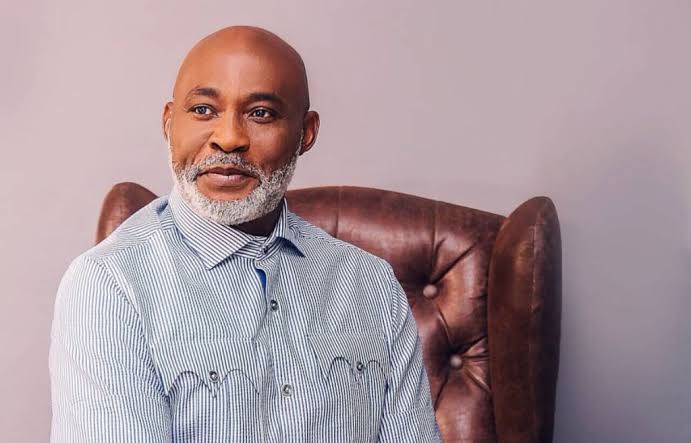
On a July morning in 2026, Richard Eyimofe Evans Mofe-Damijo, known across Nigeria as RMD, turned 65. It was a milestone marking over four decades of a career that has consistently mirrored, and often shaped, the nation’s popular culture. From early television to the rise of Nollywood and even public service, his journey tells a broader Nigerian story.
His public life, stretching across acting, writing, journalism, law, and governance, offers a unique window. It reveals the foundational shifts within Nigerian entertainment, charting its course from state-controlled broadcasts to a globally recognised film industry and beyond. Richard Mofe-Damijo’s story isn’t just about a famous face; it’s about a professional’s continuous adaptation within a changing nation.
Early foundations: a journalist finds his voice
Richard Eyimofe Evans Mofe-Damijo’s origins trace back to July 6, 1961, in the Aladja community of Udu Kingdom, near Warri, Delta State. His early academic pursuits included Midwest College in Warri and Anglican Grammar School, before he enrolled at the University of Benin (UNIBEN) to study Theatre Arts.
Before his face became a fixture on screens nationwide, Mofe-Damijo honed his craft as a writer and journalist. He contributed to publications like Concord Newspapers Metro Magazine, Quality magazine, and The Guardian in the late 1980s. This early immersion in media allowed him to understand storytelling from multiple angles.
His deep engagement with media began even before his acting career fully blossomed. In 1982, Mofe-Damijo made his television debut, a significant step that occurred while he was still actively working as a journalist. This dual path set a precedent for his multifaceted career.
Beyond the stage: law and publishing ventures
Mofe-Damijo’s intellectual curiosity led him back to academia years later. He returned to the University of Lagos (UNILAG) in 1997, pursuing a law degree which he completed in 2004. By 2005, he was called to the Bar, adding legal expertise to his expanding professional portfolio.
His interest in publishing also continued into the 1990s, with work in various print media. He displayed an entrepreneurial spirit beyond acting, aiming to shape narratives both on screen and in print. This focus cemented his role not just as a performer, but as a media intellectual.
Television stardom and a nation’s gaze
The late 1980s marked a pivotal era for Nigerian television drama, a period where national broadcasts truly captured the collective imagination. Mofe-Damijo first gained widespread recognition through the popular soap opera Ripples. This show laid the groundwork for his burgeoning national profile.
However, it was his portrayal of the often complex and morally ambiguous villain, Segun Kadiri, in Amaka Igwe’s acclaimed series Checkmate that truly cemented his status. Broadcast throughout the 1990s, Checkmate became a cultural touchstone, drawing millions of viewers across the country.
The series featured a stellar cast including Ego Boyo, Bob Manuel Udokwu, Norbert Young, and Francis Agu. Mofe-Damijo’s performance as Kadiri showcased his depth as an actor, establishing him as a household name during a formative period for Nigerian entertainment.
This early television dominance reflected a time when channels like Nigerian Television Authority (NTA) were primary cultural conduits. The era saw a burgeoning media landscape, with various publications and broadcast media developments shaping public discourse. The success of these television serials created a cadre of nationally recognised performers, with Mofe-Damijo at the forefront.
Nollywood’s commercial surge and a leading man
The 1990s witnessed a dramatic transformation in Nigerian screen entertainment with the rapid expansion of the home video industry. This new phenomenon, which would later be globally known as Nollywood, created an insatiable demand for content and opened vast new opportunities for actors like Richard Mofe-Damijo.
He seamlessly transitioned from television to film, quickly becoming one of the most recognisable faces of this burgeoning industry. His filmography from this period is extensive, marking his influence on the nascent commercial film scene. These productions, distributed primarily through video, reached audiences far and wide, laying the groundwork for Nollywood’s commercial success.
Pioneering roles and early accolades
Mofe-Damijo wasn’t just an actor in this new era; he was also a pioneer behind the scenes. In 1997, he wrote, produced, and starred in his first film, Out of Bounds. This multi-hyphenate approach highlighted his comprehensive understanding of filmmaking.
His notable early film appearances included Hostages (1997), Diamond Ring (1998), and Scores to Settle (1998). He continued working extensively into the 2000s, featuring in films like Love (2003), The Intruder (2003), and I Will Die For You (2003).
A significant milestone arrived in 2005 at the inaugural African Movie Academy Awards (AMAA). Richard Mofe-Damijo won the award for Best Actor in a Leading Role. While The Mayors (2004), directed by Dickson Iroegbu, was a prominent production at that inaugural edition, the specific film for his award was not cited. This honour solidified his standing as a prominent figure in the rapidly professionalising industry.
Other films from this productive period included Critical Assignment (2004), The Bridesmaid (2005), and Darkest Night (2005). By then, Mofe-Damijo had already cemented his place as one of the most prolific and respected actors in what was fast becoming a cultural phenomenon.
From screen icon to public servant in Delta
Just as his acting career reached new heights, Richard Mofe-Damijo made an unexpected pivot into public service. In 2008, he accepted an appointment as Special Adviser on Culture and Tourism to Delta State Governor Emmanuel Uduaghan. This move demonstrated a willingness to engage with governance and policy-making.
His commitment deepened further when he was appointed Commissioner for Culture and Tourism in Delta State in 2009. He served in this capacity until 2015, a period of six years actively shaping cultural and tourism policy for his home state. This transition highlighted a broader trend of public figures crossing into governmental roles.
His portfolio directly leveraged his deep understanding of the creative industries. During his tenure, Delta State, particularly its capital Asaba, became increasingly connected to Nigerian film production. This symbiotic relationship allowed him to influence policy that supported the very industry he hailed from.
The years spent in government naturally meant a reduction in his screen appearances. For a time, the familiar face of RMD became less ubiquitous in films, as he committed himself to administrative duties. It was a significant shift, signaling a new phase in his diverse career.
Reinventing for a new digital age
After concluding his public service in 2015, Richard Mofe-Damijo made a prominent return to film and television. The entertainment industry he re-entered was dramatically different from the one he had departed years prior, reflecting global shifts in media consumption.
Multiplex cinemas had gained significant traction, altering distribution models and production values. Satellite television had expanded its reach, and digital platforms were beginning to offer new avenues for content delivery. RMD’s return showcased his adaptability to these new industry paradigms.
He quickly re-established his presence, featuring in high-profile productions like Oloibiri (2015), Okafor’s Law (2016), and The Grudge (2016). His roles in The Wedding Party (2016 and 2017) and Chief Daddy (which later had a sequel) brought him to a new generation of cinemagoers. He also returned to television with Africa Magic’s Hush (2016-2017).
New horizons in film and recognition
Even at 65, Richard Mofe-Damijo continues to explore new creative and public roles. He has added executive producer to his prominent credits for films like Radio Voice, demonstrating a continued commitment to shaping projects from behind the camera. He also secured exclusive global deals for both Radio Voice and Revelations, both of which he produced.
His contributions haven’t gone unnoticed, with continuous recognition from leading industry bodies. In June 2016, AMAA honoured him with a Lifetime Achievement Award, celebrating his broader impact on African cinema. This was a decade after his first AMAA Best Actor win.
Further accolades are on the horizon, with the Cultural Icon Award scheduled for the 15th Anniversary Silicon Valley African Film Festival (SVAFF) and the Nigerian Center’s 2026 Honorary Recognition Award on August 3, 2026. These honours underscore his enduring legacy and continued relevance.
Beyond entertainment, Richard Mofe-Damijo remains engaged in public life. The actor who became nationally recognisable through Nigerian television continues to contribute his influence. This illustrates another dimension of his wide-ranging public career.
A lasting legacy across generations
Richard Mofe-Damijo’s career transcends simple celebrity; it offers a compelling narrative of adaptation and enduring relevance. His journey provides a unique lens through which to understand the evolving history of Nigerian media and entertainment. He began in an era of national television, navigated the explosion of home video, and then embraced the complexities of modern cinema and digital platforms.
His longevity illustrates that the foundations of what we now call Nollywood are far broader than just the video boom of the 1990s. They were built on theatre, journalism, television, and the dedicated work of professionals willing to consistently reinvent themselves. RMD’s ability to remain a recognisable and influential figure across these distinct eras speaks volumes about his talent and resilience.
His story is a testament to the dynamic nature of Nigeria itself, a nation constantly reimagining its cultural output and its global identity. As Nigeria continues to assert its creative influence on the world stage, individuals like Richard Mofe-Damijo offer invaluable insights.
They show how persistence, adaptability, and a commitment to craft can not only shape a personal career but also contribute profoundly to a nation’s cultural heritage. What further transformations await both RMD and the industry he helped build.
