




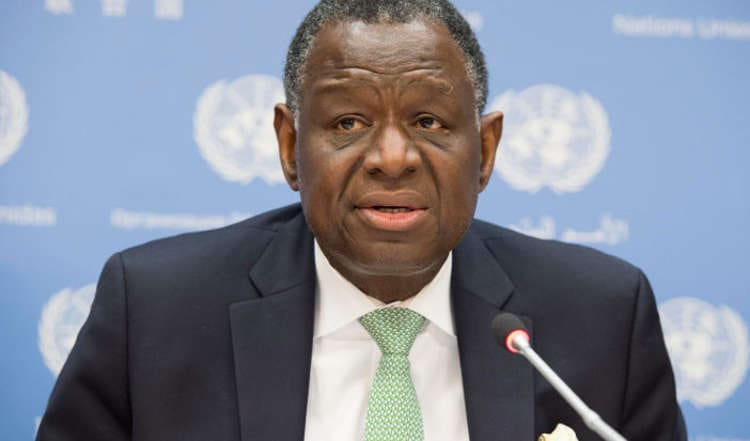
Dr. Babatunde Osotimehin led the UN Population Fund until his death in 2017. Babatunde Osotimehin led the UN Population Fund until his death in 2017.
His appointment on November 19, 2010, by United Nations Secretary-General Ban Ki-moon marked a significant milestone. He formally assumed office on January 1, 2011, serving with the distinguished rank of United Nations Under-Secretary-General.
Population Fund until global health leadership
This leadership position placed him at the forefront of international efforts. He remained in the pivotal role at the UNFPA headquarters in New York until his unexpected passing on June 4, 2017.
Osotimehin’s journey began in Nigeria. Born on February 6, 1949, in Ogun State, he pursued medical studies at the University of Ibadan, completing his degree in 1972.
He continued his advanced training in Britain, earning a doctorate in medicine from the University of Birmingham in 1979. His academic career advanced rapidly upon his return.
By 1980, he was a Professor at the University of Ibadan, later becoming Provost of the university’s College of Medicine in 1990. These roles cemented his reputation within Nigeria’s leading medical institutions.
Shaping Nigeria’s Health Response
Before his international career, Osotimehin played a crucial part in Nigeria’s public health system. He served as Director-General of Nigeria’s national HIV and AIDS coordinating agency from July 2002 until December 2008.
His tenure saw significant developments in the nation’s fight against HIV. During this period, Nigeria expanded its antiretroviral treatment program, bolstered by increased international support.
He navigated a complex network of government bodies, hospitals, and international partners. This experience gave him a deep understanding of national health administration and global cooperation, crucial for his future UN role.
Cabinet Service and International Acclaim
Osotimehin further solidified his national impact by serving as Nigeria’s Federal Minister of Health. Although brief, this cabinet-level experience rounded out a career that already spanned academia and national disease control.
In 2005, Nigeria recognised his extensive public service. He received the national honour of Officer of the Order of the Niger (OON) in December of that year, acknowledging his dedication to the country.
His transition to the UN brought a wealth of knowledge in reproductive health and women’s empowerment. It showcased how Nigerian leadership could influence global policy.
Advocating for Women and Youth Worldwide
As UNFPA Executive Director, Osotimehin championed women, adolescent girls, and young people. He consistently argued that a large youth population represented an opportunity, not merely a burden.
He emphasized that economic benefits, known as the demographic dividend, depended on sustained investments. These investments included healthcare, education, and employment opportunities.
He also focused on adolescent girls, who often faced restricted access to vital services. His work connected population policy directly with broader human development goals.
Upholding the Cairo Conference Vision
Osotimehin’s leadership at UNFPA drew heavily on the 1994 International Conference on Population and Development (ICPD) in Cairo. This conference shifted global population policy away from numerical targets.
Instead, it stressed reproductive health, individual dignity, and women’s empowerment. UNFPA became a key institution for implementing this rights-based approach.
He became a leading advocate for these principles. His public statements consistently linked reproductive health to human rights and educational opportunities, particularly for young people.
Reappointment and an Abrupt End
His impactful first term led to his reappointment for a second four-year term. United Nations Secretary-General Ban Ki-moon confirmed this on August 21, 2014, with the new term starting in January 2015.
His continued leadership coincided with the global shift from the Millennium Development Goals to the Sustainable Development Goals, adopted in 2015. Maternal mortality and reproductive health remained central issues.
Sadly, Osotimehin did not complete his second term. He passed away suddenly at 68 on June 4, 2017, at his New York home, bringing an abrupt end to a remarkable career.
Nigeria’s Enduring Impact on Global Public Health
Babatunde Osotimehin’s career stands as a testament to Nigerian capacity for global leadership. He moved from teaching and research to national public health coordination, then to federal cabinet service, and finally to a top United Nations post.
His tenure at UNFPA saw consistent advocacy for the rights and well-being of women and young people. He highlighted the importance of voluntary family planning and maternal health, crucial for sustainable development.
His professional life placed him at a critical intersection, bridging Nigerian public health challenges with evolving international development debates. It showed how expertise cultivated within Nigeria could impact global policy.
Osotimehin’s trajectory illustrates a powerful truth about Nigeria’s influence. His ability to rise to such a prominent international position, leading a major UN agency, highlights the nation’s rich pool of talent and its potential for global contributions. It is a story not just of one man, but of the broader impact Nigerian professionals can make on the world stage.
His legacy underscores the enduring value of investing in human capital within Nigeria, demonstrating how such investments can yield leadership capable of shaping international agendas and advancing human rights globally. His life reveals a profound connection between national development and global influence.
