




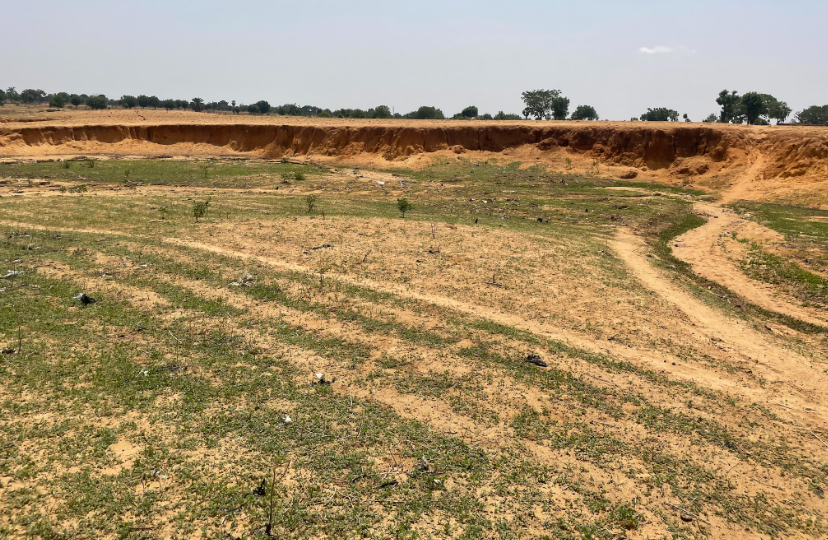
The 2003 downpour in Mesar Tudu, Kano State, marked the beginning of a devastating, long-lasting scar on the land that continues to impact the rural farming community. In Mesar Tudu, a rural farming community in Kano State, residents remember it as the day everything changed.
Water surged through the village, and when it receded, it left a scar on the land that would never heal. That scar has been growing for more than two decades.
Today, that single event has become a slow-motion disaster, a relentless erosion crisis that is swallowing homes, consuming farmlands, and displacing families. For the people of Mesar Tudu, every rainy season is not a promise of harvest, but a threat of erasure. This is the story of a community being carved off the map, one downpour at a time.
How 2003 downpour carved a community
Mesar Tudu sits on a gentle slope about 40 kilometres from Kano’s metropolis. Its geography is its curse. The village lies in a natural basin, receiving immense runoff from the upstream settlements of Bujawa and Kaurawa Yan’Hudu. Its soil, sandy and loose, offers little resistance to the water.
“This place was not like this before. It was a level area,” said Tijjani Bello, a 60-year-old resident who has watched the transformation his entire life. He explains that before 2003, a small dam offered some protection, but it failed. After the pivotal rain of that year, the water had nowhere to go. It gathered with force, tearing through the earth.
“Since that first incident, it has never stopped,” Bello said. The initial trickle became a gully, and the gully became a chasm. What was once a small drainage problem has morphed into an existential threat, creating a landscape of deep gullies and collapsed earth where farms and houses once stood.
This illustrates how environmental factors can forge a crisis, turning seasonal rains into a permanent disaster.
The human cost of a generation of neglect
The story of Mesar Tudu is written on the faces of its residents. Yusuf Abdulwahab, 72, has lost almost everything. A four-acre farm he had cultivated since he was 18 years old, planting maize, millet, and groundnuts, is now gone. It disappeared in stages, consumed by the water over a decade.
“First, it swallowed half of the farm,” he recalled. “I managed the remaining portion for more than 10 years, producing only enough food for my family. But the annual flooding continued until erosion eventually consumed the rest, five years ago.” Now, the erosion is eating at the edges of his house.
With two wives and 15 children, Abdulwahab has no means to relocate. He now rents farmland in a neighbouring village to survive. “I am old now,” he said, his voice quiet. “I do not know what will happen to my family after I die.”
His story is one of many. Yahaya Sa’adu, a 70-year-old father of nine, watched his four-room house collapse piece by piece. He was forced to move his family into a single rented room in another community. Hassan Ahmed, a teacher, lost his home just three months after his wedding, a painful experience from which he says he has not recovered.
Women and children on the front line
For women, who are often at home with young children, the erosion presents a daily, immediate danger. Hafsatu Ado, a mother of five, lives in constant fear. A deep gully has opened directly in front of her house, turning her compound into a death trap during rainfall.
“It does not matter whether the rain is heavy or not. Once it rains, we are in trouble,” she explained. “If I am in the kitchen and my children step outside, they can fall into the hole.” Her sister once fell in and had to be rescued by neighbours.
The danger is not hypothetical. For Sahura Adamu, the crisis became a personal tragedy when her visiting brother fell into an erosion pit and died. “Since losing my brother, I no longer have peace of mind whenever it rains,” she said. “I am always afraid they may wander outside.”
A paper trail of pleas and official silence
The community has not suffered in silence. According to Abdullahi Yusuf, the Mesar Tudu community leader, they have been pleading for help for years. “We have written letters. Government officials have come to see the place. But nothing has been done,” he stated.
The Mesar Tudu Community Development Association, led by chairman Tijjani Muhammad, sent a formal letter to the Gezawa Local Government chairman on December 5, 2024. Another was submitted to the Kano State Watershed, Erosion and Climate Change Management Agency (KN-WECCMA) on March 16, 2026. Reporters were shown copies of the letters, though they lacked official acknowledgement stamps.
Despite these efforts, help has not arrived. The chairman of Gezawa Local Government Area, Muqadas Bala, did not respond to inquiries. More startlingly, officials at KN-WECCMA, the very agency tasked with managing such crises, claimed to have no knowledge of Mesar Tudu’s problem. The disconnect between the community’s documented pleas and the agency’s denial points to a severe breakdown in communication and governance.
Billions budgeted, but none for Mesar Tudu
The lack of response is made more galling by the significant funds allocated to tackle these exact problems. Kano State’s 2026 budget allocated ₦18.4 billion to the Ministry of Environment and Climate Change. Within that, KN-WECCMA itself received ₦2.69 billion, with another ₦500 million approved for erosion control works across the state.
Major projects are underway elsewhere. In 2025, the state awarded an ₦8.5 billion contract for a gully erosion project in the Bulbula and Gayawa areas. These interventions, often supported by the World Bank’s ACReSAL programme, show that the state has the capacity and funding to act. Yet, Mesar Tudu remains an island of neglect.
This gap between available resources and on-the-ground intervention leaves residents feeling abandoned. The Nigerian Meteorological Agency (NiMet) and the National Emergency Management Agency (NEMA) regularly flag Gezawa LGA as a high flood-risk zone.
But these warnings from the federal level have not translated into local protection, mirroring broader challenges sometimes seen in Kano public services. As one farmer named Mansir put it, “We hear alerts every year, but when the rain comes, it still destroys everything.”
An environmental scientist, Nurudeen Muhammed Shehu, warns that without intervention, more homes and farms will be lost within three to five years. The solutions—drainage systems, gully stabilisation, tree planting—are known, but require a political will that has so far been absent.
What the water leaves behind
The erosion has fundamentally re-engineered life in Mesar Tudu. Roads have become impassable for vehicles, with only a single narrow path remaining. Some homes have lost their entrances entirely, forcing neighbours to create new routes through adjoining compounds. The community, once connected, is now fractured.
More than 50 households have been displaced, their residents now tenants in nearby towns. For the farms, the community leader says they can no longer even count the number lost. Before the crisis, residents tried to fight back, pooling money for cement and blocks to build embankments.
“It slowed it for a while, but the water returned stronger,” Abdullahi Yusuf said. “Now there is nothing to stop the water.”
The crisis in Mesar Tudu is more than an environmental story; it is a chronicle of a slow-moving event that has irrevocably altered a community’s destiny. It began with one rain, but it has been sustained by years of institutional failure. For the families who remain, hope is a dwindling resource, washed away with the soil beneath their feet.
“We are not safe anymore,” said Yusuf Abdulwahab, the 72-year-old who has lost his ancestral farm. “Every rainy season, we wait for what will disappear next.” His words hang in the air, a summary of two decades of loss and a fearful question about what the next rain will bring.
