




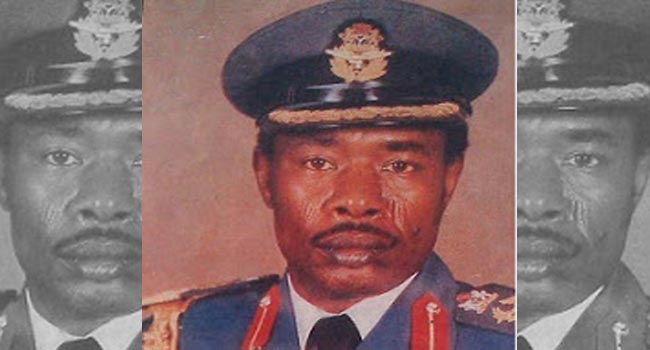
The military officer who helped overthrow General Yakubu Gowon in 1975 later became instrumental in building Nigeria’s modern capital. Air Vice Marshal Hamza Abdullahi, who joined the Nigerian Air Force in 1964, served as Minister of the Federal Capital Territory from 1986 to 1989. This era marked a crucial phase in Abuja’s physical expansion and character.
Abdullahi’s distinguished career spanned military service, state administration, and federal governance during a period of intense political shifts in the 1980s. He had previously held the post of Military Governor of Kano State from 1984 to 1985. His journey reflects the complex interplay between military power and national development.
Hamza Abdullahi bridged coups in military career
Abdullahi’s journey began in January 1964 when he joined the Nigerian Air Force as an Officer-Cadet. He completed an Aircraft Technical Officer’s Course in West Germany from 1964 to 1966. These early experiences provided him with essential technical and security expertise.
He served during the Nigerian Civil War, which began in July 1967. His military service also intersected directly with Nigeria’s volatile political landscape. Historical accounts identify Abdullahi as assisting in the July 29, 1975, coup that brought General Murtala Mohammed to power.
As Air Provost Marshal from 1971 to 1980, Abdullahi was central to military discipline. He later commanded the Ground Training Group in Kaduna until 1984. These roles highlighted his progression within the Nigerian Air Force.
Kano State Governorship
In January 1984, Abdullahi was appointed Military Governor of Kano State. This followed the December 1983 military coup that ousted President Shehu Shagari, ushering in General Muhammadu Buhari’s regime. Abdullahi oversaw state administration and national directives.
His tenure included implementing the War Against Indiscipline (WAI) campaign, launched in 1984. WAI aimed to enforce public order and civic compliance, reflecting the authoritarian tendencies of military rule. It was a defining policy of the Buhari administration.
Abdullahi’s government also revitalized the Expanded Program on Immunization in January 1985. This initiative sought to protect children and pregnant women against preventable diseases. It demonstrated a focus on public health amidst broader national restructuring.
Abdullahi remained governor until August 1985. He participated in the coup that brought General Ibrahim Babangida to power. This marked another significant transition in his career and Nigeria’s political landscape.
The Vision for a New Capital
The idea of relocating Nigeria’s capital from Lagos emerged in 1976 under General Murtala Mohammed. A committee led by Justice Akinola Aguda recommended the new site. Federal Capital Territory Decree No. 6 of 1976 formally established the FCT.
Construction of Abuja’s basic infrastructure began in the early 1980s. This monumental undertaking involved countless planners, engineers, and contractors. Abdullahi inherited a project that already had its legal foundation and a nascent construction program.
His role, therefore, was not in conceiving the capital but in its critical implementation. He was tasked with translating the ambitious vision into tangible progress. This involved coordinating diverse entities and overcoming significant logistical challenges.
Shaping Abuja’s Landscape as FCT Minister
Following the August 1985 government change, Abdullahi initially became Minister of Works and Housing. His most significant federal role started in 1986 as Minister of the Federal Capital Territory (FCT), serving until 1989. He also joined the influential Armed Forces Ruling Council.
During his tenure, he oversaw the construction of Phase 1 of Abuja. This period saw rapid expansion of key districts like Maitama and Asokoro. These areas were designed to accommodate the influx of government officials and infrastructure.
Essential federal facilities, roads, and public buildings took shape under his watch. His ambitious goal was to have 75% of ministries operational in Abuja by 1990. This was the target date for the official transfer of the capital from Lagos.
Abdullahi described Abuja as “a symbol of our unity,” reflecting the national aspirations tied to the new capital. He worked to ensure the successful relocation of the seat of government, a task fraught with administrative and logistical complexities. He faced the monumental challenge of building a modern city from scratch.
The establishment of Abuja as Nigeria’s capital was more than just constructing buildings. It required meticulous planning for essential services, accommodation, and transport links. Abdullahi’s ministry played a crucial role in coordinating these elements. The city’s development was a testament to persistent national effort over many years. Such large-scale projects sometimes attracted unscrupulous characters, adding another layer of complexity to their management.
Military Leadership and Transition
Abdullahi’s military career culminated in October 1988 with his promotion to Air Vice Marshal. This was the third-highest rank in the Nigerian Air Force. He voluntarily retired from the Air Force in December 1988.
Despite leaving active military service, Abdullahi continued as FCT Minister until 1989. This overlap demonstrated the distinct yet interconnected nature of military and political roles during the era. He participated in federal administration for months after his formal military exit.
His career progression, from a young officer to a prominent administrator, mirrored the path of many military figures. They often transitioned from purely military duties to governing roles. This blurred the lines between military and civilian leadership in Nigeria’s history.
Life After Service and Enduring Legacy
After his distinguished public service, Abdullahi moved into the private sector. He served as a director at prominent construction companies, including Julius Berger and Dantata & Sawoe Construction Company. This connected him directly with Nigeria’s ongoing infrastructure development.
Abdullahi died on January 3, 2019, in Germany, at the age of 73. His passing marked the end of a life dedicated to both military service and national development. Some reports state his death occurred on January 2, a minor discrepancy in biographical accounts.
His contributions to Abuja, while part of a larger multi-administration project, were nonetheless pivotal. His leadership during a critical construction phase cemented his place in the city’s history. Abdullahi exemplified a generation of military officers transitioning to key administrative roles. Abdullahi’s career reflects a period where military personnel were central to governance, shaping the very infrastructure of the nation.
His trajectory offers insight into Nigeria’s military era. It showcases how individuals moved between political power and national development efforts. This reveals the structures that shaped the nation’s infrastructure and governance during the 1980s. The challenge of managing rapid urban growth and infrastructure, as Abdullahi faced in Abuja, remains a concern. Even decades later, issues like traffic light failures highlight the need for robust planning.
Abdullahi’s impact on Abuja’s development can be seen today in the city’s foundational districts. While others laid the groundwork, he was critical in its physical manifestation. His legacy underscores the intricate link between leadership and national aspirations during a transformative period in Nigeria.
