




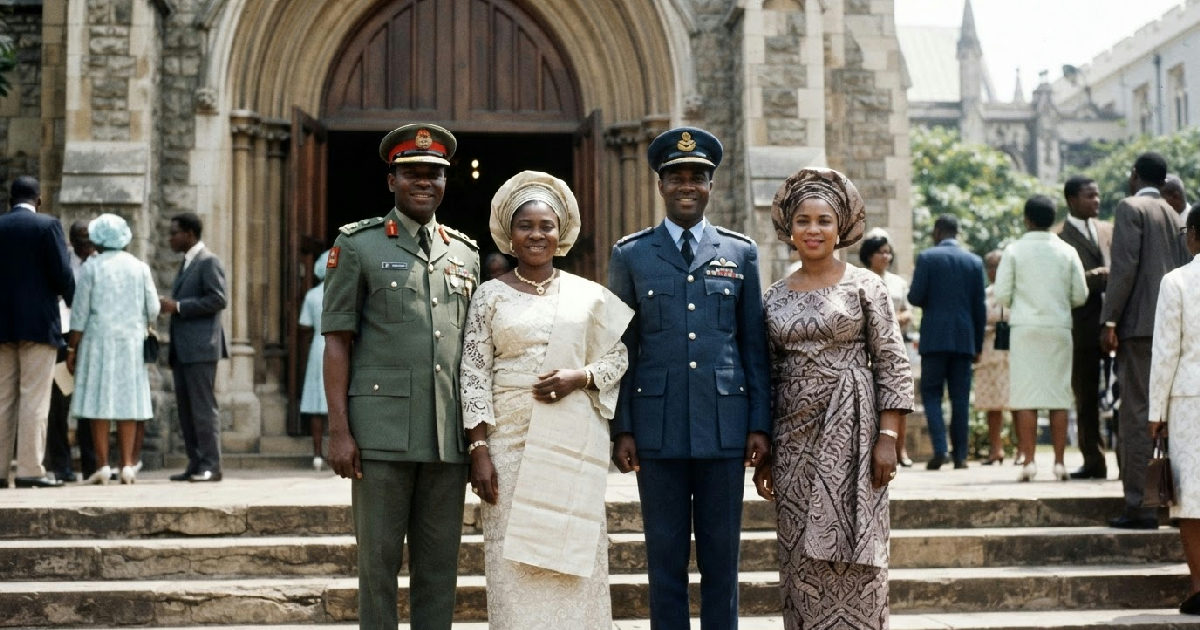
On 19 April 1969, Colonel Mobolaji Olufunso Johnson, the then-Military Governor of Lagos State, and Colonel Shittu Alao, the Chief of the Air Staff, arrived with their wives at Christ Church Cathedral, Marina, Lagos. They were guests at the wedding of Nigeria’s Head of State, Major General Yakubu Gowon, and Victoria Zakari.
This single 1969 wedding photograph captured four individuals whose paths, though converged at this high-profile event during the Nigerian Civil War, would soon diverge dramatically.
Mobolaji Johnson Shittu Alao’s wartime celebration
The image, now a valuable historical record, showcases two senior military officers central to Nigeria’s military administration amid a brutal civil conflict. It also features their wives, Mrs. Funmilayo Johnson and Mrs. Pauline Alao, whose presence highlights the social fabric of the era.
The photograph stands as a poignant snapshot, particularly given Colonel Alao’s unexpected death just six months later, contrasting sharply with Colonel Johnson’s continued public service for many years.
General Yakubu Gowon’s marriage to Victoria Zakari on 19 April 1969 took place against the backdrop of the Nigerian Civil War, which had begun in July 1967. This decision by the Head of State to proceed with a lavish ceremony during such a national crisis sparked considerable public debate.
The conflict had already caused immense suffering, widespread displacement, and significant loss of life across the country.
Despite the controversy, the wedding became a major public spectacle. Dignitaries from across the nation, including senior government officials, military leaders, and religious figures, filled Christ Church Cathedral. Crowds also gathered in the surrounding streets, eager to witness the event, underscoring the curious blend of national tragedy and societal continuity that marked the period.
The event itself brought together a powerful assembly of individuals who were crucial to Nigeria’s military and administrative structures. Among these key figures were Colonel Mobolaji Johnson, then the Governor of Lagos State, and Colonel Shittu Alao, who led the Nigerian Air Force. Their wives, Mrs. Funmilayo Johnson and Mrs. Pauline Alao, accompanied them, their attendance captured in the now-historic photograph.
Colonel Mobolaji Johnson: Architect of Early Lagos
Colonel Mobolaji Olufunso Johnson was a foundational figure in Nigeria’s early post-independence military administration. Born in Lagos on 9 February 1936, he received military training in both Ghana and the United Kingdom before embarking on a career that would place him at the heart of state governance.
His involvement in Lagos administration began after the political turmoil of January 1966. By May 1967, following the creation of the state structure, Johnson was appointed the first Military Governor of Lagos State. This placed him in charge of a rapidly expanding city that served as both Nigeria’s commercial hub and the seat of the Federal Government, a challenging role during wartime.
Johnson governed Lagos throughout the civil war and remained in office until July 1975. His administration confronted the pressing demands of urban growth, developing public services, and building crucial infrastructure for the new state. He oversaw the transformation of Lagos into a significant national administrative and economic center, managing the pressures of an influx of people seeking opportunities.
His presence at Gowon’s wedding was not merely as a guest, but as a testament to his high-ranking position within the military hierarchy and his critical role in managing Nigeria’s most vital urban center. His tenure laid much of the groundwork for modern Lagos.
Later, Johnson retired from the military and entered the business sector, holding leadership roles with companies like Julius Berger Nigeria. He passed away on 30 October 2019.
Colonel Shittu Alao: Leading the Young Air Force
At the time the photograph was taken, Colonel Shittu Alao held an equally pivotal military appointment as the Chief of the Air Staff. He was tasked with leading the nascent Nigerian Air Force during the demanding years of the civil war, a conflict that heavily relied on air superiority.
The Nigerian Air Force, established only in 1964, was still in its formative stages, relying heavily on foreign technical assistance. Alao was part of a select group of Nigerian Army officers seconded to the Air Force, trained to take over leadership from the German personnel who initially helped establish the service.
He underwent a year of intensive training in Germany in 1963, covering various aspects of air force operations.
Upon his return, Alao served as the Senior Air Operations Officer at the Air Force headquarters in Lagos. He assumed leadership of the service from Brigadier George T. Kurubo on 5 August 1967, just as the Civil War intensified. Under his command, the Air Force faced considerable operational pressures, engaging actively in bombing missions.
His leadership was instrumental in developing a distinct Nigerian command structure within the Air Force. He fostered confidence and commitment among his officers while the institution was still building its capacity. The Air Force continued to support federal military operations throughout his tenure, cementing his legacy in its early history.
A Tragic End and Diverging Fates
The 1969 wedding photograph captures a moment of shared purpose, but it tragically preceded a sudden turn of events for Colonel Shittu Alao. Less than six months after the celebratory occasion, on 15 October 1969, Alao died in an aircraft accident near Uzebba, approximately 50 miles northwest of Benin. He was only 32 years old.
The Nigerian Air Force’s historical account details that Alao was flying alone in an L-29 aircraft when he encountered severe weather conditions in the southwestern region of the country. He ran out of fuel while attempting to find a safe landing spot. His attempt at an emergency landing proved fatal when the aircraft struck a tree, ending his promising career abruptly.
His death brought an abrupt end to the service of an officer who had led the Nigerian Air Force during a particularly challenging period of national conflict.
Two days after the accident, on 17 October 1969, Alao was buried in Lagos with full military honours, a somber contrast to the joy of Gowon’s wedding months earlier. Colonel Emmanuel E. Ikwue succeeded him as Chief of the Air Staff later that year.
In stark contrast, Colonel Mobolaji Johnson’s career continued for many years after the wedding. He remained Military Governor of Lagos State until July 1975, retiring from the Nigerian Army to pursue a successful post-military career. This included significant involvement in organizations concerned with conservation and the broader development of Lagos, ultimately contributing to a long and distinguished public life.
The Wives: Unsung Presences in History
The photograph also prominently features Mrs. Funmilayo Johnson, wife of Colonel Mobolaji Johnson, and Mrs. Pauline Alao, wife of Colonel Shittu Alao. While their husbands’ military and administrative careers are well-documented, details about the women’s individual public activities and personal histories are considerably more limited in published records. This disparity is common in historical accounts, which often focus predominantly on men in official positions.
Despite the scarcity of individual biographical information, their identification in the photograph is historically significant. It prevents the image from being reduced solely to a record of two military officers. Instead, it highlights two couples attending a major national occasion, illustrating that the public lives of senior officials frequently involved their families.
Their inclusion serves as a reminder to researchers that historical memory should not be confined only to those who held official titles. The women pictured alongside these officers deserve recognition, even when their personal narratives have not been as extensively documented. Their presence offers a glimpse into the societal expectations and roles of military wives during a tumultuous period in Nigeria’s history.
Without additional family records or archival evidence, attributing achievements or responsibilities beyond their acknowledged presence would be speculative. However, the 1969 wedding photograph ensures that Mrs. Funmilayo Johnson and Mrs. Pauline Alao are part of the visual record of Nigeria’s past, offering a more complete historical perspective of this pivotal moment.
The Enduring Image: A Window into 1969 Nigeria
The 1969 wedding photograph, capturing Colonel Mobolaji Johnson and Colonel Shittu Alao with their wives, is more than a simple souvenir from a social event. It serves as a compelling historical artifact, freezing a specific moment in Nigeria’s past, particularly during the critical period of the Civil War.
It visually documents the convergence of key figures whose lives, and indeed the nation’s trajectory, were poised on the brink of significant change. The decision to hold a national wedding during a period of intense conflict reflects a unique blend of personal continuity and public responsibility.
This image offers a potent reminder of the interwoven nature of personal lives and national events during Nigeria’s formative military era. It showcases the public personas of individuals who shaped early governance and military strategy. The photograph helps us understand the dual narrative of a nation at war and a society striving for normalcy.
Historical photographs often provide insights that written accounts alone cannot convey, capturing nuances of appearance, demeanor, and social interaction.
Ultimately, this single frame from 1969 reveals much about the ambitions that drove figures like Johnson and Alao, the beginnings of institutions they helped build, and the unforeseen twists of fate that could reshape lives in an instant.
It underscores how even in moments of celebration, the undercurrents of national destiny were ever-present, shaping futures both grand and tragically short. The contrast between Johnson’s long and impactful career and Alao’s untimely demise, all linked by this single public appearance, underlines the fragility and resilience of life in that transformative decade.
