




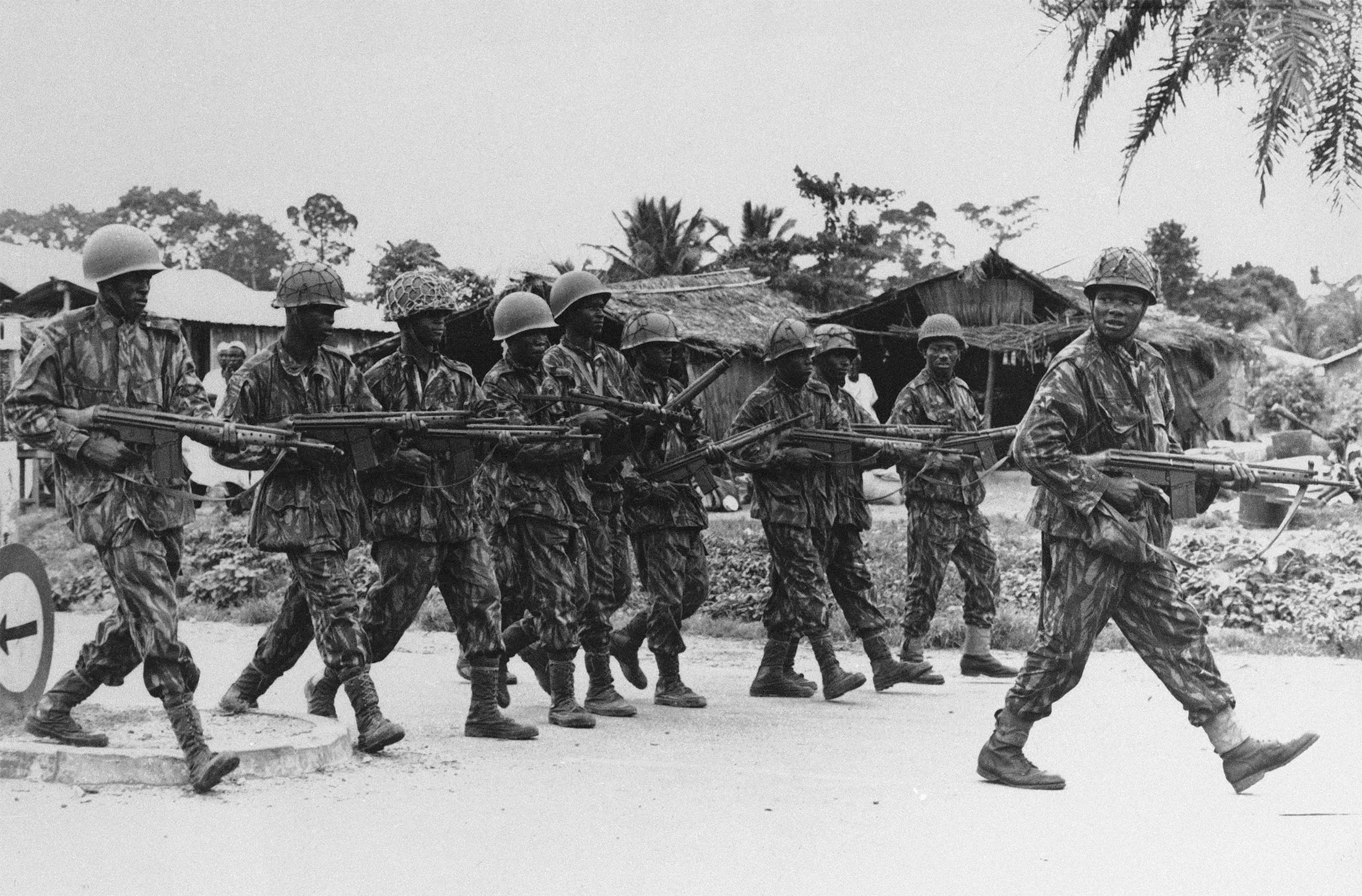
While many Nigerians remember Murtala Mohammed and Benjamin Adekunle as unified, heroic figures of the Federal cause during the 1967-1970 Nigerian Civil War, the true story of their commands was far more complex. These two pivotal generals, leading distinct divisions, navigated fierce internal rivalries, made controversial battlefield decisions, and left behind legacies stained by devastating human costs that are often overlooked in simplified historical accounts.
Mohammed, commanding the Nigerian Army’s Second Division, and Adekunle, leading the formidable Third Marine Commando, were indeed instrumental in rolling back the Biafran advance. However, their methods and personal dynamics paint a picture of a war effort fraught with tension and moral ambiguities, challenging any singular narrative of heroism.
Understanding the Complex Commands of the Nigerian Civil War
Nigeria plunged into civil war in July 1967, a mere seven years after gaining independence. Decades of political competition, contentious elections, and escalating regional tensions had fractured the young nation, culminating in a series of violent military coups in January and July 1966.
This instability, compounded by widespread violence against Eastern Nigerians across the country, eroded trust and pushed the nation to the brink, following the 1966 counter-coup.
By May 1967, Lieutenant-Colonel Chukwuemeka Odumegwu Ojukwu, then military governor of the Eastern Region, declared the Republic of Biafra an independent state. The Federal Military Government swiftly rejected this secession. The ensuing conflict became one of Africa’s most brutal, lasting nearly three years and redefining Nigeria’s national identity.
The Federal Army responded by reorganising its forces into distinct divisions to tackle different fronts. This strategic restructuring placed both Murtala Mohammed and Benjamin Adekunle at the epicentre of Nigeria’s military response. Their actions would profoundly shape the war’s trajectory.
Murtala Mohammed’s Contentious Command
Murtala Ramat Mohammed, born in Kano in 1938, was known for his aggressive and personal leadership style. As General Officer Commanding the Second Division, his initial task in 1967 was to dislodge Biafran forces that had advanced into the Mid-Western Region, threatening key cities like Ibadan and Lagos. His forces successfully recaptured Ore and Benin, halting the Biafran thrust.
Mohammed’s division then moved to capture Asaba in October 1967. This victory, however, remains deeply controversial. From October 5-7, 1967, the Second Infantry Division under Mohammed perpetrated the Asaba massacre, where an estimated 500-800 predominantly Igbo residents were systematically killed.
Reports detail hundreds of innocent males executed, with over 700 men and boys reportedly killed on October 7 alone, followed by months of occupation, destruction, and widespread sexual violence against women.
Mohammed then focused on crossing the River Niger from Asaba to Onitsha, a crucial commercial hub. His initial attempts in late 1967 were disastrous, resulting in substantial Federal casualties due to inadequate preparation and coordination. These costly failures underscored the immense pressures on commanders leading inexperienced troops against determined opposition.
The research does not confirm if this crossing was successful or when Onitsha was captured by his division.
Benjamin Adekunle and the Southern Front
Benjamin Adesanya Maja Adekunle, nicknamed “The Black Scorpion,” became one of the most recognisable Federal commanders due to his flamboyant style and aggressive tactics. Born in 1936, he was tasked in July 1967 with leading a sea-borne assault on Bonny, a critical early victory that secured control of the main river leading to Port Harcourt.
Adekunle then transformed his command, initially the Third Infantry Division, into the famed “3 Marine Commando (3MCDO).”
Adekunle’s forces achieved significant successes along the southern front, capturing key Biafran territories including Escravos, Calabar, and, in May 1968, Port Harcourt. The fall of Port Harcourt was a strategic blow to Biafra, effectively severing its coastal access and vital supply lines to the Atlantic Ocean.
His command was also a vocal proponent of the food blockade against Biafra, a policy that contributed to a severe humanitarian crisis.
Despite his early successes and public persona, Adekunle’s leadership also faced severe scrutiny and controversy within the Federal military. His command was implicated in allegations of abuses against civilians amidst the widespread civilian suffering, displacement, and shortages that characterised the southern theatre.
By May 1969, following Biafran forces recapturing Owerri, Adekunle was controversially removed from his command, replaced by Colonel Olusegun Obasanjo. Reasons for his removal remain debated, ranging from stalled aggressive strategies and personality clashes to political rivalries.
Two Commanders, Distinct Challenges
Although Mohammed and Adekunle served the same Federal government, their divisions operated in different theatres, facing distinct military challenges. Mohammed’s campaign in the Mid-West and around the Niger River corridor involved intense land battles and difficult river crossings.
Adekunle’s operations in the south were defined by amphibious assaults and securing vital port facilities and riverine territories. Their contrasting operational environments contributed to their different reputations: Mohammed for rapid, forceful advances, and Adekunle for his marine commando’s amphibious prowess.
Yet, underlying their commands was a palpable rivalry, particularly between Adekunle and Mohammed. Some historical accounts suggest Adekunle grew increasingly alienated from northern officers, including Mohammed, identifying more strongly with his Yoruba heritage. Comparisons of their commands often highlight the differing levels of civilian casualties, with some sources suggesting Adekunle’s forces had more “humane records” than Mohammed’s, particularly in light of the Asaba massacre.
A notable instance of their friction occurred in August 1967 when Major Jalo’s Unit, originally part of Adekunle’s command, was seconded to Mohammed’s Second Division. This left Adekunle with significantly depleted forces, a decision he vociferously protested to Army Headquarters.
Such incidents reveal the complex power dynamics and operational disagreements that shaped the Federal war effort, even as General Babangida notably married amidst Civil War.
Post-War Trajectories and Lingering Questions
The Nigerian Civil War ended in January 1970, with calls for reconciliation. Both commanders saw their careers diverge dramatically after the conflict. Murtala Mohammed continued his ascent, becoming a Commissioner in the military government before seizing power as Nigeria’s Head of State on July 29, 1975. His brief tenure ended abruptly with his assassination during an abortive coup on February 13, 1976.
Benjamin Adekunle, after his removal from the 3rd Marine Commando in 1969, held other appointments before his compulsory retirement from the army in 1974. He passed away on September 13, 2014, leaving behind a legacy that continues to spark debate over military leadership, the conduct of war, and the protection of civilians.
The intertwined yet often conflicting narratives of Murtala Mohammed and Benjamin Adekunle reveal a crucial truth about Nigeria’s Civil War: it was not a simple tale of heroes and villains. Instead, it was a brutal conflict prosecuted by complex figures whose decisions, rivalries, and human consequences still echo today.
Understanding their nuanced roles offers a deeper insight into the challenges of wartime leadership and the enduring moral questions that persist in Nigerian military history. The conflict also saw a grim human cost, as highlighted by reports that Biafra’s War Was Fought by Children.
