




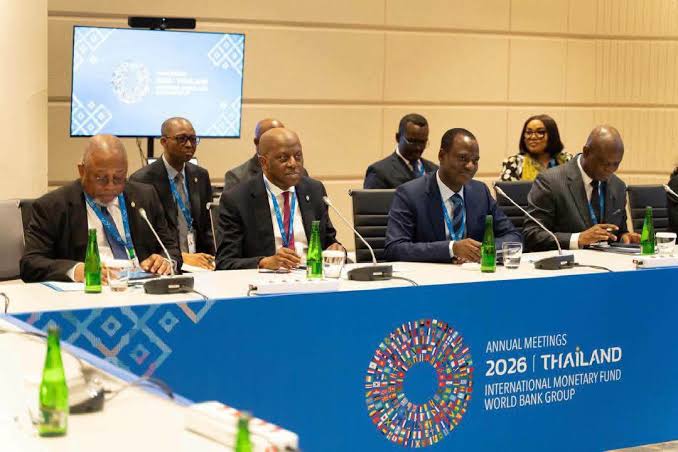
Nigeria’s external reserves soared above $55 billion, an 18-year high, during the 2026 International Monetary Fund (IMF) and World Bank Group Annual Meetings in Bangkok, Thailand. This striking financial milestone underpinned a broader narrative of economic reforms that drew renewed international recognition.
Yet, beneath the accolades, the fundamental question persisted: could this newfound stability genuinely translate into widespread prosperity and improved living standards for millions of Nigerians?
Positive indicators from Nigeria economic reforms discussions
Policymakers, led by Finance Minister Taiwo Oyedele and Central Bank Governor Olayemi Cardoso, used the October 14, 2026 Nigerian Investors’ Forum to highlight these encouraging indicators. They aimed to transform global acknowledgement into tangible investments, more affordable financing, and crucially, new jobs back home. The government pitched its progress, but the road from macroeconomic gains to household well-being remained a complex path.
During the Bangkok meetings, Nigerian officials presented a compelling case for the nation’s economic turnaround. The economy expanded by 4.43 percent year-on-year in the second quarter of 2026. This growth was accompanied by a significant decline in headline inflation for four consecutive months, offering a measure of relief after previous pressures.
The nation’s financial health appeared robust, with external reserves exceeding $55 billion. Furthermore, the tax-to-GDP ratio rose from approximately 7 percent just three years prior to 12.5 percent by the end of 2025, following a GDP rebasing.
Private capital inflows witnessed a dramatic increase, jumping from around $300 million in 2023 to nearly $6 billion in 2026. Federation revenues also quadrupled since 2021, and public debt stood at a manageable 36 percent of GDP.
These figures formed the bedrock of the government’s “Nigeria Rising” campaign, themed “Reformed, Resilient, Ready to Scale.” The central message was clear: policy adjustments were strengthening the economy’s foundational elements and positioning Nigeria as an attractive destination for global investors. However, while essential, these impressive statistics did not automatically guarantee factories, business expansion, or immediate job creation.
The prosperity paradox: Bridging macro and micro gaps
The critical challenge for Nigerian leaders was to bridge the chasm between macroeconomic improvements and tangible benefits for ordinary citizens. Stronger reserves and reduced inflation, while positive, did not inherently generate employment or stimulate widespread entrepreneurial activity. The real test lay in transforming these gains into widespread productivity and a better quality of life.
Achieving this required more than just impressive financial reports. It demanded reliable infrastructure, consistent and predictable policies, and access to affordable financing for businesses. Without these critical components, the potential for sustained growth and improved living standards would remain largely untapped. This was the core tension facing the Nigerian delegation in Bangkok.
International institutions like the IMF and World Bank consistently reiterated this point. They stressed that governments should funnel savings and gains from reforms into targeted support for vulnerable populations. This included direct cash transfers, rather than broad, untargeted subsidies that often disproportionately benefited wealthier segments of society. This approach aimed to protect households during economic adjustments.
Maintaining reforms while expanding such targeted support was deemed essential for Nigeria. It ensured that fiscal savings genuinely improved living standards and sustained public confidence in the ongoing reform program. The focus shifted from mere economic adjustment to ensuring equitable distribution of its benefits across society.
Minister Oyedele echoed this sentiment, underscoring that Nigeria had moved past the initial phase of economic adjustment. The next crucial step was converting the credibility gained through these reforms into actual capital and concrete opportunities for sustained economic growth. Nigeria’s economic leadership often faced this difficult balance.
Project Nigeria: From plans to tangible progress
Beyond broad macroeconomic figures, Nigeria’s pitch in Bangkok zeroed in on specific investment opportunities. At the Nigerian Investors’ Forum, Minister Oyedele unveiled “Project Nigeria,” an ambitious pipeline of 65 bankable projects. These initiatives, valued at approximately $78.5 billion, spanned vital sectors like energy, transport, industry, mining, agriculture, healthcare, and urban services.
He noted that these projects were backed by thorough feasibility studies and structured to encourage private sector participation. Reports indicated that investors from Asia and Europe had already submitted expressions of interest. The project pipeline remained accessible via the Ministry of Finance’s RISC-RED platform, signaling ongoing efforts to attract capital.
However, Oyedele offered a vital caveat: expressions of interest did not equate to secured financing. The true impact of “Project Nigeria” on economic growth depended entirely on whether these proposals reached financial close, entered construction phases, and eventually became operational. The minister emphasized, “These are commitments to work together with us, not announcements of money.”
This distinction was crucial for an economy striving to reduce its reliance on costly borrowing while simultaneously expanding infrastructure and productive capacity. The World Bank Group reaffirmed its backing for Nigeria’s power and infrastructure sectors through guarantees and other financial instruments. The IMF also extended technical assistance in areas like fiscal policy and transparency.
Other partners, including the Japan International Cooperation Agency and the Islamic Development Bank, indicated readiness to broaden sustainable financing.
Global headwinds and Nigeria’s advocacy
Nigeria’s investment drive unfolded against a challenging global economic backdrop. The IMF warned that disruptions in energy markets, elevated borrowing costs, and escalating public debt were severely limiting governments’ capacity to respond to economic shocks. Global public debt reached 94 percent of GDP in 2025, with projections nearing 100 percent by 2029.
The IMF urged governments worldwide to enhance revenue mobilization, pursue credible fiscal consolidation, and safeguard essential expenditures. For Nigeria, this meant improving the quality of public spending and channeling reform-generated savings into crucial services and targeted social protection programs. Such measures, including cash transfers, could help vulnerable households manage rising living costs without resorting to expensive, untargeted subsidies that often reversed reform gains.
Employment represented another pressing concern, particularly with artificial intelligence (AI) rapidly reshaping labor markets. Kristalina Georgieva, the IMF’s managing director, projected that AI could impact about 40 percent of jobs globally, either through productivity enhancements, shifts in job quality, or outright job displacement.
Ajay Banga, President of the World Bank Group, highlighted an impending shortfall of 800 million jobs, as 1.2 billion young people were expected to enter the global labor market over the next 10 to 15 years, while only 400 million new jobs were projected.
For a nation like Nigeria, characterized by its large and youthful population, economic growth had to generate productive employment on a scale sufficient to absorb new labor market entrants. Minister Oyedele advocated for preparing young Nigerians to engage with AI technologies.
He also called for directing investment into job-creating sectors and ensuring that the benefits of technological advancement were shared equitably. Nigeria’s development strategy often needed to account for such global trends.
As chair of the Group of 24 (G-24), which represented developing countries on international monetary and development finance issues, Oyedele also spearheaded calls for systemic reforms to the global financial architecture. He pointed out that developing economies collectively paid approximately $500 billion more annually in borrowing costs compared to advanced economies.
The G-24 championed initiatives for more affordable concessional financing, refined sovereign credit-rating methodologies, enhanced transparency in debt management, and greater representation for developing nations within international financial institutions. This advocacy sought to create a fairer global economic playing field for emerging economies.
Central Bank’s stability stance and new alliances
Complementing the finance ministry’s efforts, Central Bank of Nigeria (CBN) Governor Olayemi Cardoso presented an account focused on monetary stability, banking-sector resilience, and diversified international financial relationships. Headline inflation, which stood at about 34.8 percent at the end of 2024, had significantly decreased to 14.63 percent by September 2026. The nation’s external reserves, as noted, also surpassed the $55 billion mark.
Formal remittance inflows were nearing the CBN’s monthly target of $1 billion, signaling renewed confidence from the diaspora. The Nigerian banking sector demonstrated its robustness by mobilizing N4.65 trillion in fresh capital through its recapitalization drive, with over 70 percent sourced from domestic investors.
Cardoso viewed this strong local participation as a vote of confidence in the sector’s future. This financial strengthening earned recognition, as Fitch Ratings revised Nigeria’s sovereign outlook from stable to positive.
Despite these positive trends, challenges like persistent inflation, expensive credit, and business uncertainty remained. Governor Cardoso highlighted the CBN’s September decision to reduce its monetary policy rate from 26.5 percent to 23 percent, emphasizing a data-driven approach to economic management.
He also engaged with major rating agencies—S&P Global Ratings, Moody’s, and Fitch—to discuss Nigeria’s economic trajectory and its ambition to achieve investment-grade ratings in the medium term. This proactive engagement underscored Nigeria’s commitment to attracting international capital and partnerships.
A significant portion of Cardoso’s agenda involved forging stronger financial connections with Asia. Prior to the Bangkok meetings, he visited Singapore, where he engaged with the Monetary Authority of Singapore and signed a memorandum of understanding with the Global Finance and Technology Network.
He also convened a Nigeria-Asia Financial Connectivity Dialogue, signaling a strategic pivot towards diversifying financial partnerships. In Bangkok, he met with Pan Gongsheng, Governor of the People’s Bank of China, to discuss vital areas such as cross-border payments, settlement arrangements, financial technology, and trade finance. Further discussions were planned for his upcoming visit to Beijing.
The overarching goal was to streamline trade and investment between Nigeria and Asian economies while expanding payment options, aligning with the CBN’s steadfast focus on price stability and financial-system resilience.
The ultimate test: Delivering widespread prosperity
Nigeria departed Bangkok with an enhanced investment proposition, a substantial pipeline of proposed projects, and clear indications of international collaboration. However, a considerable gap still existed between expressed investor interest and the nation’s productive capacity. The meetings powerfully reinforced that macroeconomic stability, while crucial, had to be coupled with policies that genuinely improved livelihoods for all citizens.
Mobilizing actual investment, creating widespread employment, and expanding targeted support for poor and vulnerable households remained paramount. These actions were critical to ensuring that the benefits of reforms extended beyond mere headline indicators and reached every Nigerian. The government’s overarching challenge was no longer solely about convincing the global community of its changing course.
Instead, the government had to demonstrate that these policy shifts could sustain investment, boost productivity, and deliver tangible prosperity within Nigeria. As Minister Oyedele aptly summarized in his closing remarks, “Stability was the first test. Growth that employs our people is the second.”
This statement captured the essence of Nigeria’s ongoing economic journey, marking the transition from foundational reforms to the demanding task of delivering inclusive prosperity. Nigeria’s economic history often highlighted such critical junctures.
