




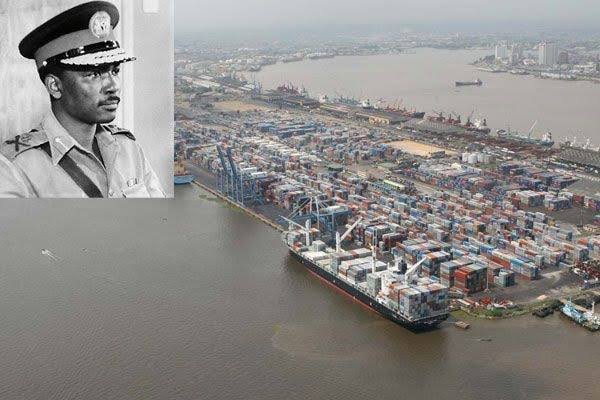
The “Cement Armada” of mid-1975, a fleet of around 400 idle ships off Lagos, was a self-inflicted national crisis that resulted from Nigeria’s plan to rebuild. Hundreds of ships, eventually numbering around 400, sat idle on the water, creating a traffic jam that paralysed Nigeria’s main port.
This was the “Cement Armada,” a self-inflicted national crisis born from the country’s ambitious plan to rebuild itself with newfound oil wealth. The plan to rebuild led to this unprecedented maritime congestion.
Just five years after the Nigerian Civil War ended in 1970, the nation was booming. Soaring petroleum revenues gave General Yakubu Gowon’s military government the funds for a vast development program. New military barracks, roads, and public housing were planned, but these projects required enormous amounts of cement—far more than Nigeria could produce locally.
The plan to rebuild led to a tidal wave of concrete orders
The government’s solution was simple: import it. What followed was a procurement and logistics disaster. The decision created a massive industrial bottleneck that would cripple the economy.
The procurement began in 1974, led by the Federal Ministry of Defence. It needed cement for a major barracks construction program to accommodate armed forces whose size increased after the civil war. Records later showed the ministry’s actual requirement was approximately 2.9 million metric tonnes. Yet, through a cascade of uncoordinated contracts, it became committed to importing roughly 16 million tonnes within a single year.
This was not one isolated procurement contract. It was a massive collection involving numerous suppliers. Other government bodies, including the Federal Housing Authority and the Nigerian National Supply Company, also placed substantial orders. In total, Nigeria signed 109 contracts with 68 different suppliers.
These agreements committed the nation to buying over 16 million metric tonnes of cement, at a cost approaching one billion dollars at the time. A United States Court of Appeals in Texas Trading & Milling Corporation v. Federal Republic of Nigeria later documented this staggering quantity, destined for a port system nowhere near ready.
The port, the contracts, the chaos
The Port of Lagos, Nigeria’s principal maritime gateway, was already struggling with the country’s growing import trade. Its operational capacity for unloading bulk cargo like cement was estimated at just one million metric tonnes per year. Yet, the government had ordered more than sixteen times that amount to arrive within the same timeframe, creating an impossible logistical challenge.
To make matters worse, the contracts contained expensive demurrage clauses. These provisions required Nigeria to pay shipping companies for every day their vessels were kept waiting beyond the allowed unloading period. One contract, cited in American litigation, allowed for fees up to $3,500 per vessel, per day.
This agreement with National American Corporation on 3 April 1975, for 240,000 tonnes of Portland cement valued at $14.4 million, illustrated the extraordinary financial trap. As hundreds of ships queued at sea, unable to unload, Nigeria’s bill for penalties skyrocketed, costing millions for cement it could not even receive.
This congestion also clogged berthing spaces, delaying other vital imports like food and industrial materials, transforming a cement problem into a wider economic bottleneck.
Money, ambition, and a lack of capacity
The cement crisis demonstrated a crucial imbalance within Nigeria’s rapidly developing economy. The oil boom created immense financial opportunities. Money could be obtained faster than projects could be planned. The post-civil war era also fueled a strong political demand for rapid reconstruction across the nation.
Yet, the state institutions responsible for implementing these ambitious programs had not expanded their administrative capacity at the same rate as the country’s spending power.
Contracts were signed faster than goods could be received. Imports were financed faster than the supporting infrastructure could accommodate them. This disconnect between vast financial resources and limited administrative systems became a central problem of the oil boom.
Nigeria had the money to purchase cement, but it lacked the developed systems necessary to manage such a massive procurement program efficiently. This fundamental flaw exposed the vulnerabilities of an underdeveloped bureaucracy struggling with sudden wealth and ambition.
A coup and a reckoning
The Cement Armada became a glaring public symbol of administrative incompetence and waste. It fed into growing discontent with General Gowon’s administration, which was already facing widespread complaints of corruption, accumulation of wealth by officials, inefficiency, and the postponement of a promised return to civilian government.
While not the sole cause, the scandal significantly contributed to the climate that led to the July 29, 1975 military coup.
This brought Brigadier Murtala Muhammed to power, with Brigadier Olusegun Obasanjo as his deputy. The new government immediately sought to project an image of reform and accountability. It established a tribunal of inquiry under Justice M. B. Belgore to investigate the cement deals.
The tribunal, which began public sittings in Lagos on 20 October 1975, heard evidence from numerous witnesses and received 131 exhibits. It examined how orders were made, why quantities became so large, how contracts were handled, and whether officials had personally benefited.
This investigation transformed a logistical failure into a full-blown inquiry into Nigeria’s corruption and accountability, though the historical record shows it was also a case of inadequate coordination and poor planning.
Unloading the Armada: legal battles and lasting lessons
By August 1975, the government moved to prevent the situation from worsening. Nigeria placed restrictions on shipping into Lagos and began notifying suppliers that additional vessels could not proceed without permission. The Federal Military Government also worked to renegotiate contracts and associated letters of credit.
A formal decree on 19 December 1975 solidified restrictions on vessels entering Nigerian ports, but stopping new ships did not eliminate existing contractual obligations or the liabilities from those already in transit.
The crisis did not end when the ships stopped arriving. Its contractual consequences continued for years, leading to foreign suppliers and trading companies bringing claims against Nigeria in international courts.
Major cases included National American Corporation v. Federal Republic of Nigeria (30 March 1979) and Texas Trading & Milling Corporation v. Federal Republic of Nigeria (16 April 1981), both decided by the United States Court of Appeals for the Second Circuit.
These judgments provided unusually detailed accounts of the original procurement program and became important decisions in the development of US law concerning the commercial activities of foreign states. They affirmed the principle that a government entering a commercial contract does not automatically escape its obligations simply by being a sovereign state.
As for the cement itself, not every vessel discharged its cargo. Some departed without unloading, while shipowners exercised liens over others. Subsequent litigation revealed that Nigeria sometimes paid for cement it never ultimately received.
For example, in the National American Corporation case, Nigeria obtained cargoes from only four of twelve vessels involved in that particular dispute, despite payments for others. This meant the country incurred substantial losses and additional liabilities, highlighting the complex and costly unwinding of the original program.
The logistical failure, combined with the legal quagmire, served as a painful reminder of the importance of robust planning in national development.
The armada’s enduring legacy
The Cement Armada left a lasting mark on Nigeria’s political and administrative history. It became synonymous with the final period of Gowon’s government and contributed to a public perception of waste and corruption during the oil boom.
The crisis underscored the danger of making major procurement decisions without matching them to available infrastructure and the consequences of weak coordination among government agencies. It showed how contractual terms could magnify the cost of administrative failure, and how an import-dependent development strategy could overburden a single port.
Most importantly, the episode spurred critical infrastructure development. The congestion at Lagos demonstrated the perils of relying so heavily on one major maritime gateway. The government accelerated the development of Tin Can Island Port in Lagos, which was commissioned on 14 October 1977, significantly expanding Nigeria’s port capacity.
Other ports like Warri and Calabar also received new facilities. The crisis became a historical example of the difficulty of converting oil wealth into effective, sustainable development. It revealed that having the money to buy materials is one thing, but having the planning, coordination, and infrastructure to manage that ambition is another matter entirely.
Nigeria’s journey through this period taught invaluable lessons about the complex interplay between financial resources and administrative capacity.
