




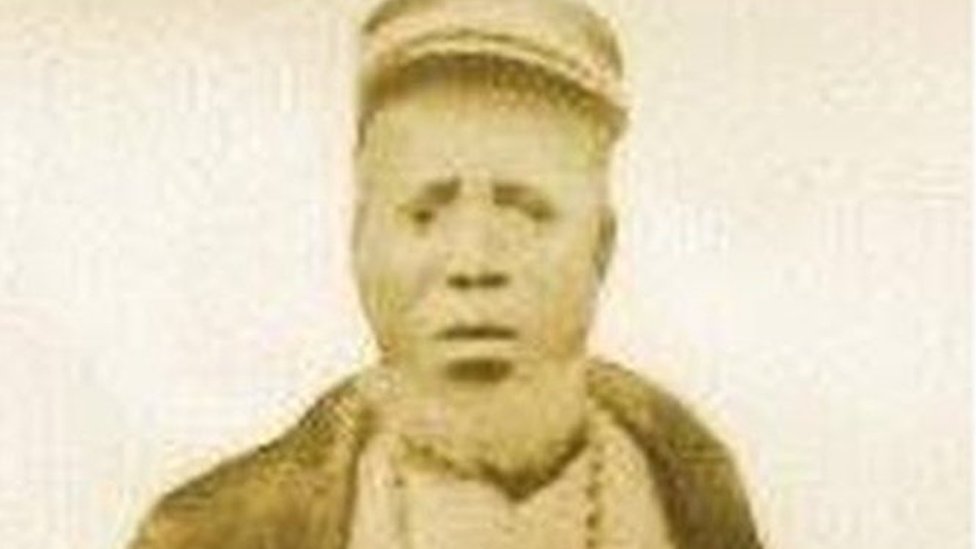
Chief Oshodi Landuji Tapa was a 19th-century warrior who fought the British, made a king, and rose from humble beginnings to become a Lagos power broker.
Yet few know that Oshodi, the chaotic heart of mainland Lagos, was named for a single man: a brilliant 19th-century warrior who fought the British, made a king, and rose from the bleakest of beginnings to become a power broker in his own right. His name was Chief Oshodi Landuji Tapa.
His story began not in Lagos, but in the Nupe country of present-day Niger State. Accounts of his youth are split. One tradition claims he was a prince, sent away after a prophecy foretold his great destiny.
The boy who warrior fought british
A darker version says he was a boy captured in conflict, nearly sold into the transatlantic slave trade before escaping and finding refuge in the palace of Oba Osinlokun of Lagos.
Chief Oshodi Landuji Tapa arrived in Lagos during the reign of Oba Osinlokun, Kosoko’s father, in the early 1800s. The Oba took him in, placing him under the guardianship of Chief Fagbemi. Tapa’s early life was connected to the system of slavery, a common link between West Africa’s interior and coastal trading centers at the time.
However, slavery in 19th-century Lagos was not solely about labor. Enslaved individuals could occupy diverse positions within households and political structures. This nuanced system allowed some palace slaves to ascend to positions of considerable authority, a pathway Oshodi Tapa dramatically exploited.
The Oba later sent Tapa to Brazil, alongside Dada Antonio, to learn Portuguese and acquire commercial and cultural knowledge for trade. This education proved transformative. It equipped him with an understanding of the wider Atlantic world that very few in Lagos possessed.
The story of Nigerian returnees from Brazil was just one part of this complex global trade network. His fluency in Portuguese and grasp of international commerce made him indispensable upon his return.
He rose swiftly, becoming a trading agent for Oba Osinlokun. He also worked as a commission agent and toll collector for European firms like Messrs. G. L. Gaiser. His burgeoning wealth came from flourishing trade with Portuguese merchants. He even held a position of trust, responsible for the king’s wives.
Tapa was no longer merely a palace dependent; he was becoming a power in his own right.
Lagos in a Changing World
Chief Oshodi Landuji Tapa became the indispensable adviser and war captain to Oba Kosoko, a rival claimant to the Lagos throne. This period saw intense political rivalry for control of Lagos. Kosoko, supported by powerful chiefs, merchants, and Muslim communities, represented a formidable challenge to Oba Akitoye, who initially took the throne.
In 1845, Tapa led Kosoko’s forces in the “Salt Water War,” known locally as Ogun Olomiro. This three-week assault successfully drove the reigning Oba Akitoye into exile. Tapa was among the leading military figures who put immense pressure on the royal palace, securing Kosoko’s control of the city. He proved himself a kingmaker and a formidable military strategist, capable of orchestrating complex military operations.
But this victory put him on a collision course with a global superpower. The British Empire, driven by its opposition to the transatlantic slave trade and its desire for legitimate commerce, increasingly eyed Lagos. The city occupied a strategic position on the West African coast, critical for trade in agricultural products.
British merchants sought access, and the existing system, deeply connected to human trafficking, was an obstacle.
Kosoko and Oshodi Tapa resisted British pressure. Their political and economic interests were deeply intertwined with the existing trade networks. This stance placed Tapa directly against a British power increasingly willing to use military force to achieve its objectives. The stage was set for a decisive confrontation that would reshape Lagos forever.
War, Exile, and Diplomacy
In 1851, the political crisis reached its climax. When Kosoko refused British demands to abandon the slave trade, British forces attacked Lagos in late 1851. Oshodi Tapa organized a sophisticated and ferocious defense of the city, fortifying Lagos with stockades and cannons. His defense was described as brilliant and highly sophisticated, leveraging local knowledge of the waterways and streets.
Despite the tenacity of Kosoko’s supporters, British naval artillery and superior military resources eventually overwhelmed Lagos’s defenders. After the fierce fighting, Kosoko was forced out of Lagos, and Oshodi Tapa went with him into exile in Epe. This defeat dramatically altered the city’s political map, restoring Akitoye to the throne and establishing Kosoko and his followers in their new home.
But for Tapa, this was not the end. It was the start of a new chapter where his influence would shift from purely military to diplomatic. Epe became the center of Kosoko’s remaining power, a vibrant community of chiefs, traders, and families who had followed their Oba into exile.
Tapa expanded his commercial influence within the lagoon’s trading networks, recognizing its importance as a highway for goods and information.
Tapa became instrumental in negotiating the Treaty of Epe, signed on September 28, 1854, between Kosoko and British Consul Benjamin Campbell. This agreement reduced the immediate threat of further conflict and formalized Kosoko’s renunciation of his claim to the Lagos throne.
The warrior had skillfully transitioned into a diplomat, helping to secure a future for his people and Kosoko himself. His ability to adapt ensured his continued relevance.
From Adversary to Ally: A New Lagos
The political situation shifted again after Britain formally annexed Lagos in 1861. Kosoko eventually reached an accommodation with the new colonial authorities. In 1862, he returned to Lagos, and Oshodi Tapa returned with him. But this was a vastly different city.
The authority of the traditional ruler was significantly diminished, and British officials now held substantial power. Tapa’s life reflected the refashioned power structures of colonial Lagos.
In a stunning twist, the man who had fought the British became a trusted ally of the new colonial government. Governor John Hawley Glover, a key figure in the project to reshape the city, understood the need for local expertise. He valued Tapa’s immense influence and network, consulting him before implementing new public projects.
Tapa, with his deep knowledge of Lagos communities, became an emissary for Glover’s administration.
Governor Glover presented Tapa with a sword from Edward Cardwell, the Secretary of State for Colonies, which was inscribed: “presented by the Government of Queen Victoria to Chief Tapa in commemoration of the loyal services rendered by him to the Government of Lagos.”
Tapa expertly pivoted his business from human trafficking to legitimate trade in palm oil, cotton, and ivory. He worked closely with European firms, such as the German trading company O’Swald, which conducted all its Lagos business through him. This adaptation to the changing economic environment ensured his continued wealth and influence.
He demonstrated a profound pragmatism, surviving and thriving even as the world he knew transformed around him.
Chief Oshodi Landuji Tapa died on July 2, 1868, leaving behind 46 surviving children. He was buried at the center of Oshodi Street in Epetedo, Lagos, where a monument now stands. His life spanned a monumental period: from a powerful African trading kingdom to a British colonial possession.
He had lived through a violent succession struggle, fought a global power, and then became a crucial intermediary within the new order.
A Name That Endures
So how did his name end up on the mainland? The Oshodi that millions of Lagosians know today is not Epetedo, nor even the part of Lagos Island where Chief Oshodi Landuji Tapa spent his later years. The famous modern district of Oshodi, a bustling transportation hub, is on the mainland, far from his burial site.
This association emerged from a later settlement connected to his followers and his name. Over time, the name traveled, evolving from a personal identity and a specific community to represent an entirely different part of Lagos. It became a landmark, a memorial hiding in plain sight.
Every bus conductor calling out “Oshodi,” every commuter rushing through the area, and every trader doing business there is, unknowingly, repeating the name of a man who survived and shaped 19th-century Lagos.
Chief Oshodi Tapa’s journey reveals the profound fluidity of power and identity in Nigerian history. A slave boy became a chief, a warrior became a diplomat, and an enemy of the British became their ally. His life is a testament to human adaptability amidst dramatic historical upheaval.
And a name that once signified a specific individual, a warrior-merchant, and a power broker now simply means “next stop.” He died in 1868, but Lagos never stopped saying his name.
