




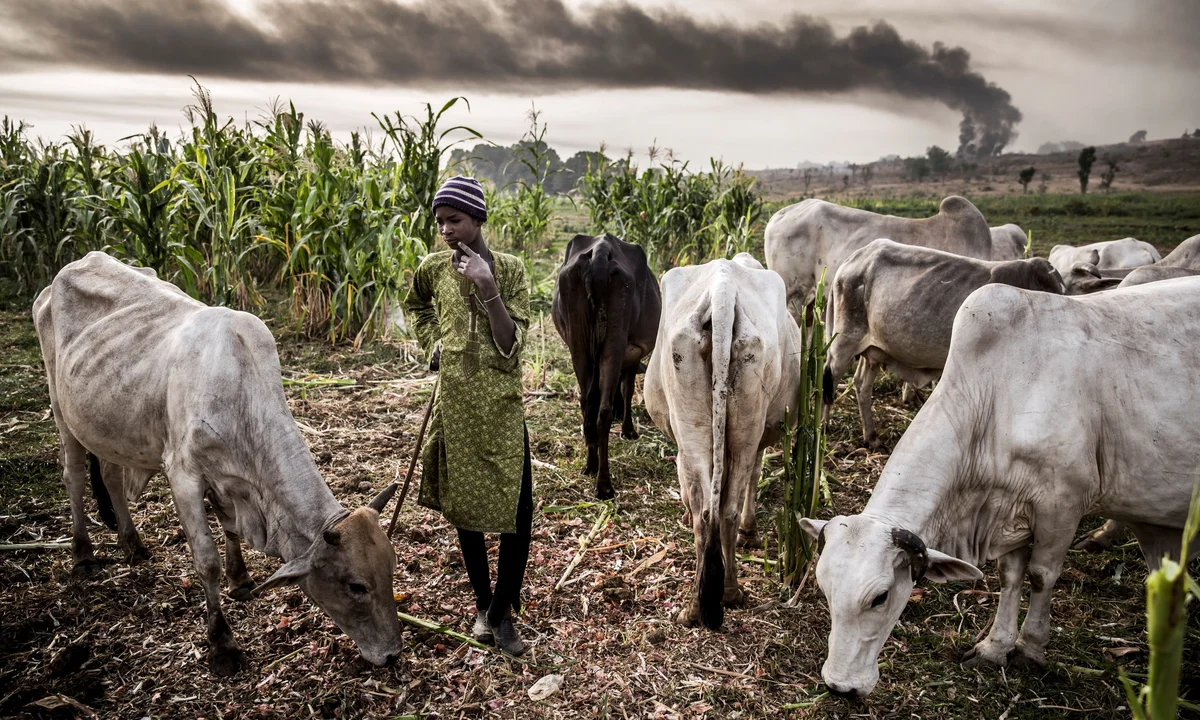
In a plenary hall in Ulaanbaatar, Mongolia, thousands of miles from the scorched farmlands of Nigeria’s middle belt, a quiet but urgent warning was issued in August 2026. As global leaders gathered for the 17th Conference of the Parties (COP17), Joseph Onoja, the Director-General of the Nigerian Conservation Foundation (NCF), stepped forward to highlight the escalating farmer-herder conflicts Nigeria is experiencing.
He was not there to speak of abstract environmentalism, but of a crisis of blood and soil unfolding back home.
Understanding farmer-herder conflicts in Nigeria
Onoja’s message was stark: the violent, years-long clashes between farmers and herders, a conflict that has claimed more lives than the Boko Haram insurgency, cannot be understood without first understanding Nigeria’s dying land.
It was a moment that attempted to reframe a crisis often mired in politics and ethnicity as something more fundamental: a desperate struggle for survival on a shrinking patch of viable earth. The country has already made a pledge to heal its land, but the action on the ground tells a different story.
For years, the narrative surrounding Nigeria’s farmer-herder conflicts has been dominated by talk of ancient ethnic rivalries and political conspiracies. But according to Onoja, speaking to Premium Times on the event’s sidelines, this misses the point entirely. “Forget the conspiracy theories and look at the root cause,” he urged. “One of the drivers is migration, and land degradation contributes to that migration.”
His argument traces the crisis back to the relentless march of climate change across the Sahel. Rising temperatures and unpredictable rainfall have decimated traditional grazing lands in the north, forcing pastoralists on a desperate southward journey in search of pasture and water for their cattle.
This mass movement, a direct consequence of environmental collapse, is pushing them into regions and farmlands historically cultivated by settled communities, sparking a brutal competition for resources.
The scale of the environmental decay is staggering. According to a 2022 report by the Food and Agriculture Organization (FAO), Nigeria is losing between 350,000 and 400,000 hectares of forest cover every single year. This isn’t just a loss of trees; it’s the erosion of the very foundation that sustains rural livelihoods, turning once-productive rangelands into dust and accelerating the desert’s creep southwards.
This environmental pressure cooker inevitably explodes into violence. The United Nations has tracked the crisis, noting that these disputes have displaced hundreds of thousands of people and deepened instability across the nation.
Onoja’s intervention at a global climate conference was a deliberate attempt to connect the dots for an international audience: the headlines of violence in Benue, Plateau, and Nasarawa states have their origins in the silent death of the land hundreds of kilometres north.
The widening gap between need and naira
The core of the problem, Onoja argued, is a profound and persistent disconnect between the scale of the crisis and the resources allocated to fight it. “No, we are not doing enough. As a country, we need to do more,” he stated bluntly. The numbers back him up.
While the budget for the Federal Ministry of Environment has increased in recent years, rising from ₦46.17 billion in 2021 to ₦86.44 billion in 2023, it remains a fraction of what’s needed.
Onoja insists that environmental spending shouldn’t be seen as a peripheral concern but as a foundational investment in national security and economic stability.
“If you look at it properly, the Federal Ministry of Environment should be one of the most funded ministries because its mandate provides the foundation upon which many other sectors depend,” he explained. Without healthy land, there is no food security; without stable resources, there is no peace.
It is a reality that has seen many efforts by a private group backing agriculture struggle against ecological headwinds.
This is not just about planting trees. It’s about restoring ecosystems that support agriculture, provide clean water, and prevent the very resource scarcity that drives conflict.
With approximately half of Nigeria’s landmass affected by degradation, impacting the lives of over 40 million citizens, the current level of investment is like trying to put out a wildfire with a water pistol.
The consequences of this underfunding are felt not just in the environment but in the rising human cost of instability and the deepening economic hardship that follows.
A history of neglected warnings
The warnings from Onoja and the NCF are not new. For decades, environmental experts in Nigeria have cautioned successive governments about the dangers of desertification, deforestation, and soil erosion. Nigeria has long been a signatory to international conventions on climate change, biodiversity, and desertification, yet domestic policy and funding have seldom matched its international commitments.
The country has a formal commitment to achieving Land Degradation Neutrality (LDN), a state where the amount and quality of land resources remain stable or increase. But this goal is undermined by a lack of synergy between government agencies and, most critically, a budget that treats the environment as a secondary portfolio rather than a primary pillar of the state’s survival.
This history of neglect has created a vicious cycle. As the land degrades, communities become poorer and more vulnerable, which in turn leads to more unsustainable practices like illegal logging for charcoal, further accelerating the degradation. It is this cycle that the NCF aims to break, but it cannot do it alone.
A $1.3 billion question hanging over nigeria
Perhaps the most critical part of Onoja’s message from Mongolia was not the problem, but the potential solution. He pointed to the announcement at COP17 of $1.3 billion in new financing available for nations to combat land degradation. For Nigeria, this presents both a lifeline and a profound challenge. The money is there, but accessing it is not a given.
“The question is: what are you going to use it for?” Onoja asked. This is the crux of the issue. International funders require clear, coherent, and large-scale plans, not just piecemeal projects. It is a question Nigeria must answer with a credible strategy if it hopes to tap into these crucial funds.
Without a plan, the money will flow elsewhere, and Nigeria will be left to face its environmental collapse alone.
In anticipation of this moment, the NCF has developed its own answer: the “Green Recovery Nigeria” initiative. This flagship project is designed to be the very kind of comprehensive, ambitious plan that international partners look for. It aims to galvanize a nationwide effort to restore Nigeria’s vast, degraded landscapes, particularly its lost forests.
Onoja describes it as an “all-encompassing” framework. “By restoring our landscape, you promote biodiversity, climate action and other environmental objectives,” he explained. The initiative is not just about environmentalism for its own sake; it’s a strategic proposal to tackle the root causes of insecurity, poverty, and instability through ecological restoration. It is, in essence, a blueprint for peace, written in the language of conservation.
What happens after the speeches?
As the delegates of COP17 packed their bags and left Mongolia, the echo of Joseph Onoja’s warning returned to Nigeria. A clear link has been drawn on a global stage between the nation’s dwindling forests, its expanding deserts, and the violent conflicts tearing at its social fabric. An opportunity, in the form of $1.3 billion, has been presented.
The critical question now is what happens next. Will Onoja’s plea from a distant conference hall be heard in the corridors of power in Abuja? Will the Federal Government elevate the Ministry of Environment, empowering it with the budget and the authority to implement a plan on the scale of the Green Recovery Nigeria initiative?
Or will the warning fade, another missed opportunity in a long history of them?
The path forward requires more than speeches. It demands political will, a radical reordering of national priorities, and a genuine recognition that the health of Nigeria’s land and the peace of its people are two sides of the same coin. The land is waiting. The conflicts continue to burn. And the world has asked Nigeria what it plans to do about it.
