




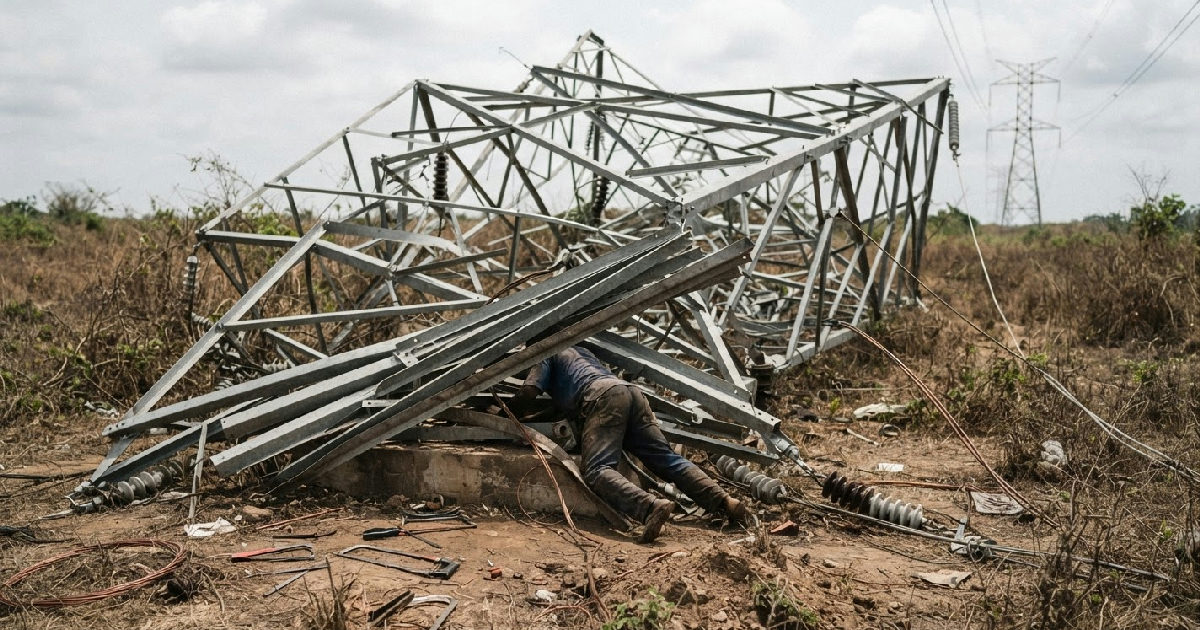
A man was found dead on Saturday, August 8, 2026, in Delta State, becoming a victim of power infrastructure vandalism.
This stark image emerged after an intensive patrol by the Transmission Company of Nigeria (TCN)’s Delta Sub-Region, Lines Maintenance Department (LMD), following an earth fault that tripped the critical Ughelli-Benin 330kV transmission line.
the grim discovery in Delta State
The TCN linesmen traced the fault to Tower 101, a vital node on the Ughelli-Benin 330kV transmission line, which had buckled under the weight of its own destruction. Ndidi Mbah, TCN’s General Manager for Public Relations, confirmed the incident, detailing how the deceased individual was found trapped between the twisted metal members of the fallen structure.
Further inspection of the site revealed a disturbing pattern: Tower 101 on the adjacent Ughelli-Sapele 330kV transmission line had also been extensively vandalised. Miraculously, this second tower remained standing, a precarious testament to the relentless assault on Nigeria’s power grid.
The Transmission Company of Nigeria swiftly condemned the act, issuing a public statement from Abuja that appealed to host communities and the wider public. They urged vigilance and immediate reporting of any suspicious activities around critical power installations.
For TCN, this incident wasn’t just a fatality; it represented a tragic culmination of a systemic issue. They framed the fight against power infrastructure vandalism as a civic responsibility, warning that continued sabotage would ultimately plunge everyone into darkness.
a persistent assault on the power grid
This incident in Delta State is not an isolated event. It is a recurring scene in a long-running drama of sabotage and decay that plagues Nigeria’s electricity transmission system. The collapsed Tower 101 joins a growing list of casualties in what often feels like an unwinnable war against economic desperation and criminal enterprise.
Only a few months prior, in March 2026, Tower T99 along the same Ughelli–Benin 330kV line collapsed at Coconut Village in Effurun Local Government Area, near Warri. Vandals had meticulously removed critical structural components, leading to its collapse and a temporary disruption in electricity evacuation from Transcorp Power Plc.
Nearby towers T100 and T101 were also targeted during that March incident. They had been significantly vandalised but, unlike their unfortunate neighbour, managed to remain upright. This demonstrated the sheer scale and systematic nature of the attacks.
The scale of the problem expanded even further in November 2025. Vandals launched coordinated attacks on transmission towers in the Okada and Ofosu Communities, disrupting both the 330kV Benin-Egbin and Benin-Omotosho transmission lines. These incidents alone affected a staggering 31 towers, a devastating blow to the nation’s power backbone.
The human cost of this destructive behaviour isn’t new either. In July 2023, a man died of electrocution while attempting to vandalise a transformer in Ogbe Quarters, Ute-Okpu community, in Delta State’s Ike North-East Local Government Area. These tragedies underscore the profound dangers inherent in tampering with live electrical infrastructure.
the lure of scrap metal and its cost
The relentless targeting of transmission towers often stems from the lucrative illegal trade in scrap metal. Copper cables, steel components, and other valuable materials fetch decent prices in illicit markets, creating a powerful economic incentive for vandals.
This desperate pursuit of quick cash, however, comes at an incalculable cost. Every vandalised tower damages national assets and incurs substantial repair and replacement costs for the nation. More critically, it means prolonged power outages for communities, disrupting businesses, education, and daily life.
The ripple effect is profound. Small businesses lose income, hospitals struggle to maintain essential services, and homes are plunged into darkness. This short-sighted destruction for immediate personal gain undermines the very fabric of communal well-being and national progress.
TCN’s mandate and an unwinnable war
The Transmission Company of Nigeria was born out of the ambitious power sector reforms of 2005. It emerged from the unbundling of the defunct National Electric Power, with a clear mandate to manage Nigeria’s high-voltage electricity transmission network.
Its creation was meant to streamline operations and improve efficiency in power delivery across the vast nation. TCN is responsible for evacuating bulk power from generation companies and wheeling it to distribution companies for onward supply to consumers.
This critical task involves maintaining thousands of kilometres of transmission lines and hundreds of towers, often traversing remote and challenging terrains. But the sheer scale of this infrastructure also makes it incredibly vulnerable to sustained attacks.
TCN finds itself in a perpetual state of defence against those who seek to dismantle the very system it strives to maintain. Its repeated appeals to the public and host communities highlight the difficulty of securing such widespread assets without broad public cooperation.
The company often reiterates that protecting power infrastructure is not just their duty; it is a collective civic responsibility. Yet, this plea often falls on deaf ears, or into ears deafened by the immediate, desperate needs of survival.
security versus community engagement
The problem presents a complex dilemma: should the focus be on enhanced security measures, like deploying more armed personnel to guard remote towers, or on deeper community engagement to foster a sense of ownership and protection?
Both approaches face significant challenges. Deploying enough security to cover every vulnerable point is logistically and financially daunting. Relying solely on community goodwill, however, ignores the economic pressures that drive some residents to participate in or condone these acts.
A sustainable solution likely lies in a nuanced blend of both strategies, alongside addressing the underlying socio-economic factors. Without reducing the perceived benefit of vandalism for individuals, the battle to secure Nigeria’s grid will continue to be an uphill one.
the ripple effect: beyond a single death
The death of a suspected vandal in Delta State, while tragic for the individual involved, speaks to a much larger systemic failure. Each act of power infrastructure vandalism triggers a cascade of negative consequences that reverberate throughout the Nigerian economy and society.
Persistent power outages stunt economic growth, making it difficult for businesses to operate efficiently, deterring potential investors, and stifling industrial development. This directly impacts job creation and the overall prosperity of the nation.
Beyond the economic cost, there’s the erosion of public trust in institutions responsible for providing basic services. When the lights consistently go out due to sabotage, it fuels cynicism and despair among citizens, undermining confidence in governance.
The resources TCN expends on repairing and replacing vandalised infrastructure are funds diverted from crucial upgrades and expansion projects. This perpetuates a cycle of reactive maintenance rather than proactive development, leaving Nigeria’s power system in a constant state of fragility.
what this incident reveals about Nigeria’s path forward
The collapsed tower in Delta State, and the life lost beneath it, offers a stark snapshot of Nigeria’s ongoing struggle to build and maintain robust national systems. It forces a difficult question: how can a nation truly ascend when its fundamental infrastructure remains so vulnerable to internal threats?
The persistent problem of power infrastructure vandalism highlights the deep-seated challenges in securing national assets, fostering collective responsibility, and tackling economic disparity. It’s a battle not just against criminals, but against the conditions that breed such destructive acts.
As Nigeria moves forward, the ability to protect its critical systems will be a defining factor in its developmental trajectory. Can the country overcome the cycle of destruction and rebuild a power grid that genuinely serves its people?
The answer lies not just in technology or security, but in addressing the complex interplay of economic hardship, community engagement, and a renewed commitment to the common good.
