




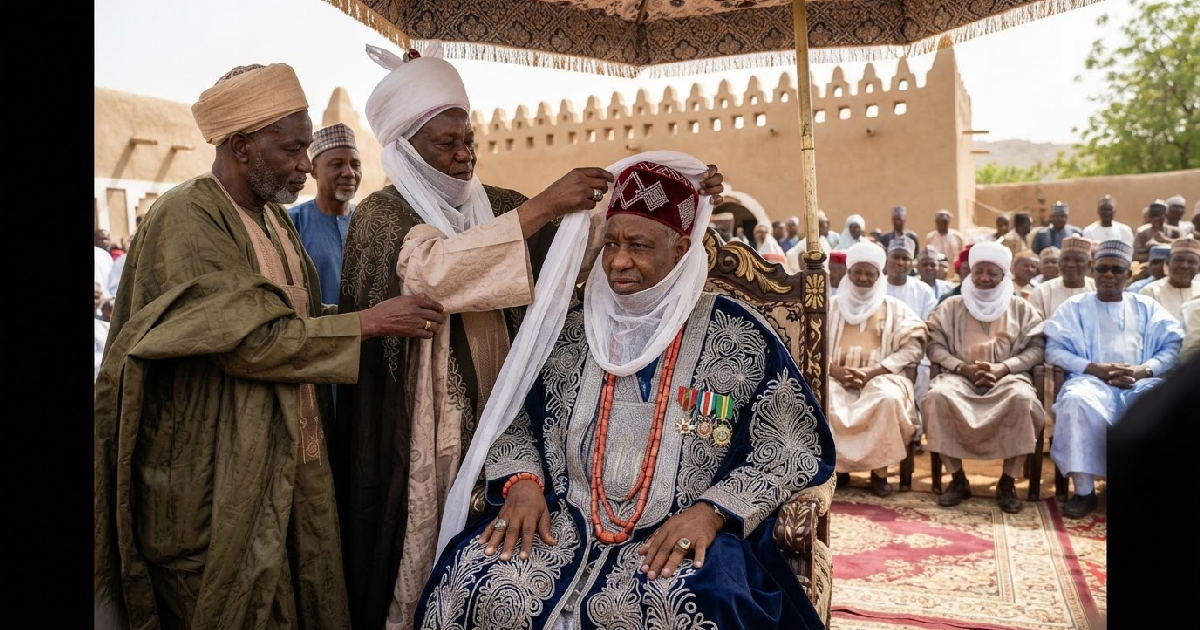
In 1996, the ancient town of Zuru, now part of Kebbi State, vibrated with the rhythms of tradition. Muhammadu Sani Sami, a man whose military career had taken him from battlefields to state governance, was formally turbaned as Sami Gomo II, the 11th Emir of Zuru. This moment marked a profound transition, illustrating how individuals often bridge disparate worlds to shape Nigeria’s evolving identity.
His journey, which concluded with his passing in August 2025 at the age of 81, offers a unique window into the multifaceted nature of leadership in post-independence Nigeria. It reveals the pathways through which military command could intertwine with political administration and, eventually, with the deeply rooted customary authority of a traditional emirate.
From Zuru royal lineage to military ambition
Muhammadu Sani Sami was born on 24 October 1943, in Zuru, into a family with deep roots in the local royal establishment. His father, Sami Daudu, held significant traditional positions, but his premature death in 1945 left two-year-old Sami largely in the care of his mother, Hafsatu.
His early education combined Qur’anic instruction with formal schooling in Zuru, Kontagora, and later at Provincial Secondary School, Bida, which became Government College, Bida. Young Sami excelled in science and initially envisioned a career in medicine.
But the currents of a newly independent Nigeria were strong, pushing many into public service. A nationwide campaign actively encouraged educated young men to join the armed forces, presenting military careers as a vital means of building the nation’s fledgling institutions. This recruitment drive shifted Sami’s trajectory.
Cadet to civil war veteran: a soldier’s formative years
In December 1962, Muhammadu Sani Sami embraced military cadet training, entering an institution undergoing a dramatic transformation from colonial command to national control. This decision placed him at the heart of Nigeria’s nation-building efforts.
After initial instruction in Nigeria, he was selected for further training at the prestigious Mons Officer Cadet School in Aldershot, England, a rigorous environment that prepared officers for service across the Commonwealth. This elite training underlined the high hopes placed on Nigeria’s first generation of indigenous military leaders.
On 25 July 1963, Sami received his commission as a second lieutenant. He joined an officer corps that would soon grapple with immense political instability, including the military coups of 1966 and the subsequent Nigerian Civil War.
Serving throughout the conflict from 1967 to 1970, Sami bore witness to, and participated in, the most destructive internal conflict in Nigerian history. The experience forged a generation of military leaders, imbuing them with a deep understanding of the nation’s fragilities and the heavy cost of disunity.
Rising through the ranks: command and governance
After the Civil War, Muhammadu Sani Sami continued his climb through the Nigerian Army’s hierarchy, taking on diverse command, staff, and administrative appointments. His postings included the esteemed Brigade of Guards, the Nigerian Army School of Infantry, the 82 Division, and the 1 Mechanised Division, alongside responsibilities at the Joint Headquarters.
One notable incident in 1979 saw him receive direct instructions from Muhammadu Buhari, then a senior military commander, to repel Chadian military forces who had encroached upon Nigerian territory in the Borno area. This demonstrated the practical, frontline responsibilities Sami was entrusted with.
The 1970s and 1980s were a period when Nigeria’s military was not confined to national defense; senior officers frequently transitioned into political leadership. This political environment paved the way for Sami’s most significant administrative role outside the purely military sphere.
Governing Bauchi State under military rule
Following the military coup of 31 December 1983, which overthrew President Shehu Shagari, Major-General Muhammadu Buhari assumed leadership. In January 1984, Buhari appointed Sami as the Military Governor of Bauchi State.
The Bauchi State he governed was considerably larger than its present form, encompassing the territory that would later become Gombe State in 1996. His tenure lasted until August 1985, operating within the highly centralized command structure of the Buhari administration.
Governors like Sami were appointed, not elected, reflecting the suspension of political parties and civilian democratic institutions. During his time, Sami focused on stability, community development, and upgrading medical facilities within the state. His administration also launched the “Back to Land” programme, an agricultural initiative aimed at boosting food production amidst falling public revenue and economic difficulties.
He actively engaged with social issues, warning against open-air religious preaching in October 1984 and addressing concerns about church demolitions necessitated by a new ring road project, assuring that land was allocated for a new Catholic church. This era of military governance profoundly influenced the shifting economic tides and administrative structures across the nation.
Retirement and a return to Zuru’s call
Muhammadu Sani Sami’s tenure as Bauchi State governor ended in August 1985, when Major-General Ibrahim Babangida’s coup brought an end to the Buhari regime. Sami returned to senior Army responsibilities, serving at the Nigerian Army School of Infantry and later as the General Officer Commanding the 1 Mechanised Division in 1988.
These were top-tier positions, signifying his ascent to the upper echelons of military command. But after nearly 28 years of service, Sami chose voluntary retirement, leaving the Nigerian Army as a Major General on 3 September 1990.
He then transitioned into private business in Kaduna, a common path for many retired senior officers. His commercial ventures proved successful, but the lure of his homeland remained strong. Members of the Zuru community eventually persuaded him to return and accept traditional leadership responsibilities.
His military career had equipped him with administrative experience and a disciplined approach. However, the authority he was now poised to assume was fundamentally different, rooted not in military hierarchy but in custom and community. The broader trajectory of power in Nigeria has long been shaped by such transitions.
The 11th Emir of Zuru: Bridging two worlds
In 1995, Muhammadu Sani Sami officially succeeded the late Emir Usman Danga as the 11th Emir of Zuru. His formal turbaning in 1996 cemented his new identity as Sami Gomo II, embarking on what would be nearly three decades of traditional rule.
This transformation from Major General to emir represented a striking shift. A military commander’s authority stems from rank, national law, and a clear chain of command. An emir’s influence, however, flows from customary institutions, local history, and a deep understanding of community dynamics.
As emir, Sami became a crucial intermediary. He navigated the complex relationships between local communities, elected governments, religious leaders, and security institutions, leveraging his extensive administrative background in this new context. His presence highlighted the enduring relevance of traditional rulers in Nigeria’s hybrid governance system.
Culture, community, and addressing insecurity
Sami Gomo II’s reign became closely intertwined with the promotion of Zuru’s rich cultural identity. He championed the Uhola cultural and agricultural festival, one of the Zuru people’s most significant annual celebrations. The festival, showcasing cultural performances, traditional displays, and communal activities, gained wider prominence under his patronage.
His involvement underscored the broader responsibility of Nigerian traditional rulers as custodians of local heritage. Though emirs hold no constitutional governance power, they often play influential roles in preserving traditions, fostering community development, and representing their people before state authorities.
This also included practical advice, like his 2019 encouragement for retired service personnel to engage in farming, a clear echo of his military past and “Back to Land” initiative.
The emirate, however, was not immune to the security challenges plaguing north-western Nigeria. By August 2020, insecurity, including banditry and communal conflict, had begun to affect areas historically known for coexistence. At a major security meeting in Zuru, Sami Gomo II candidly acknowledged these new tensions.
He appealed for dialogue, reconciliation, and cooperation, rejecting the easy path of blame. Sami recommended forming a peace and reconciliation committee and urged all parties to collaborate with security agencies. He also forcefully warned against religious intolerance and hate speech, emphasizing peaceful coexistence.
His interventions demonstrated the practical, essential role traditional rulers could play when formal government and security institutions needed local knowledge, trust, and community participation. This blending of traditional and modern approaches reflects broader patterns within Nigeria’s corporate landscape and public service.
A legacy of interwoven leadership
Muhammadu Sani Sami died during the night of 16 August 2025, in a London hospital, bringing to an end a life that profoundly mirrored Nigeria’s post-independence trajectory. His remains were returned to Nigeria and buried in Zuru on Friday, 22 August 2025, with Vice-President Kashim Shettima leading the Federal Government delegation.
President Bola Tinubu, Vice-President Shettima, the Kebbi State Government, military authorities, and traditional rulers all issued tributes, recognizing his distinguished service. The succession moved swiftly, with Kebbi State Governor Nasir Idris approving the appointment of Sanusi Mika’ilu Sami as the new Emir of Zuru on 28 August 2025, continuing the Sami family’s connection to the throne.
Muhammadu Sani Sami’s story is a compelling narrative of how a single individual could navigate and shape the intersections of military power, governmental authority, and traditional leadership. What his life reveals is not just the adaptability of a remarkable man, but the enduring and often complex interplay between Nigeria’s modern and traditional institutions.
His journey prompts us to consider how these disparate forms of authority continue to define and challenge Nigeria today. How does the legacy of individuals like Sami Gomo II continue to inform our understanding of leadership and community in a nation still balancing its past with its aspirations for the future?
