




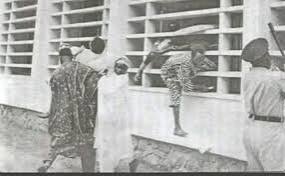
The Western House Incident
On May 25, 1962, a member of the Western House of Assembly grabbed the ceremonial mace and broke it over the Speaker’s head.
The image of elected officials brawling in parliament captured the reality that lay beneath the hopeful veneer of Nigeria’s independence. The country did not fall into chaos overnight. It was a slow, cumulative descent, driven by a political structure that made losing power seem like a death sentence.
The Context
At independence in 1960, Nigeria was a federation of three powerful regions, each dominated by a single political party. The Northern People’s Congress (NPC) controlled the vast Northern Region, the National Council of Nigeria and the Cameroons (NCNC) held the Eastern Region, and the Action Group (AG) governed the Western Region.
This structure was a direct legacy of colonial blueprints that had locked regional rivalry into the nation’s politics.
The Northern Region was geographically and demographically larger than the two southern regions combined, giving the NPC a dominant position in the federal parliament. The federal government, led by Prime Minister Sir Abubakar Tafawa Balewa of the NPC, was a coalition with the NCNC. Chief Obafemi Awolowo’s Action Group formed the official opposition.
This arrangement turned politics into a battlefield for regional supremacy. Control of the government wasn’t just about policy; it was about control over everything: public sector jobs, development projects, state corporations, and all the resources of a modern state. Losing an election meant losing access to this patronage, effectively cutting off a whole region and its political class from the spoils of power.
The Crises
The pursuit of regional dominance meant that political leaders viewed every electoral contest as a battle for existential survival. This atmosphere naturally bred a series of escalating crises, each one further eroding the fragile public trust in the country’s nascent democratic institutions.
The stakes were simply too high for political actors to adhere strictly to constitutional norms when their very access to power and resources was on the line.
Consequently, the rules of the political game became secondary to the imperative of political survival. This fundamental shift pushed Nigeria inexorably toward a profound descent into chaos, where the formal structures of democracy began to buckle under the weight of unrelenting regional and factional strife.
Each successive crisis did not merely stand in isolation; instead, it exacerbated underlying tensions, creating a dangerous feedback loop of instability and distrust that threatened to unravel the entire fabric of the young nation.
The Western Region Crisis of 1962
The first major crack appeared within the Action Group. A bitter ideological and personal feud between party leader Chief Obafemi Awolowo and the Western Region’s Premier, Chief Samuel Ladoke Akintola, tore the party apart. Awolowo accused Akintola of betraying the party’s principles by seeking closer ties with the federal NPC-NCNC government.
The dispute spilled onto the floor of the Western House of Assembly. On May 25, 1962, an attempt to pass a vote of no confidence in Premier Akintola resulted in the violent brawl that saw the police fire teargas into the chamber.
Citing the breakdown of order, Prime Minister Balewa’s federal government declared a state of emergency in the region on May 29, suspending the regional government and appointing an Administrator. For the AG, this felt less like peacekeeping and more like a federal power grab to cripple a rival.
The crisis established a dangerous precedent: regional political disputes could be resolved by federal intervention, and a state of emergency could be used as a political weapon. It also led to the trial and imprisonment of Chief Awolowo for treasonable felony in 1963, a move that further poisoned the political atmosphere.
The Census Controversy of 1962-1963
Nothing revealed the depth of regional mistrust more than the national census. Population figures were the foundation of political power, determining parliamentary representation and the allocation of federal resources. In Nigeria’s intensely regionalised system, the census was not a simple headcount; it was a political battle for dominance.
A census conducted in 1962 reportedly showed that the southern regions now had a larger combined population than the North, challenging the basis of Northern political supremacy. The results were immediately rejected by the Northern establishment and, amid fierce controversy, Prime Minister Balewa cancelled them in January 1963.
A new census was held in November 1963. This time, the results swung the other way, giving the Northern Region a population of nearly 30 million out of a national total of 55.6 million, preserving its majority. Leaders in the Eastern Region, particularly, cried foul, accusing the North of inflating its numbers.
The Eastern government took the federal government to court to nullify the results but lost. The trust was gone; even the basic act of counting citizens had become an exercise in political warfare.
The Federal Election and ‘Operation Wetie’
By the 1964 federal election, the political landscape had consolidated into two massive, hostile alliances. The Nigerian National Alliance (NNA) comprised the NPC and Akintola’s new party, the Nigerian National Democratic Party (NNDP). Facing them was the United Progressive Grand Alliance (UPGA), which included the NCNC, the remnants of the Action Group, and minority parties.
The campaign was vicious. Candidates were intimidated, obstructed from filing nomination papers, and in many constituencies, NNA candidates were declared elected unopposed. Believing the election was already rigged, the UPGA called for a nationwide boycott.
The boycott was effective in the East but less so elsewhere, leading to a constitutional crisis where President Nnamdi Azikiwe (from the East) was reluctant to reappoint Balewa (from the North) as Prime Minister.
The final and most brutal chapter of the First Republic’s collapse played out in the Western Region during its regional election on October 11, 1965. The election pitted Akintola’s NNDP against the UPGA. The vote was openly and violently rigged. When official results declared Akintola’s party the winner, the region exploded.
The ensuing violence was known as “Operation Wetie,” a Yoruba phrase meaning “to drench.” Political opponents and their property were drenched in petrol and set on fire. Arson, looting, and murder became common as rival gangs and party supporters engaged in retaliatory attacks. For months, law and order completely broke down, claiming an estimated 2,000 to 4,000 lives.
The Consequence
By late 1965, every institution meant to manage political conflict was compromised. The census was a joke. Elections were a sham. The police and courts were seen as tools of the ruling party. For opposition groups, it seemed impossible to win power through the ballot box. For governing parties, losing power was an existential threat to be avoided at any cost.
Coercion and violence had replaced debate and compromise. This was the environment into which a group of young army majors launched Nigeria’s first military coup on January 15, 1966. The soldiers killed Prime Minister Balewa, Northern Premier Sir Ahmadu Bello, Western Premier Akintola, and other senior officials and military officers.
The coup ended Nigeria’s first experiment with democracy. The system had not been destroyed by the soldiers; it had already collapsed from within.
The Insight
The tragic downfall of Nigeria’s First Republic offers a stark lesson in the perils of a political system where competition becomes a zero-sum struggle for absolute survival.
When electoral victory translates into unbridled control over all state resources and patronage, while defeat signifies total exclusion from power and its attendant benefits, the fundamental incentive for political actors to adhere to democratic rules and norms inevitably vanishes.
This creates an environment where compromise is seen as weakness, and adherence to principle becomes a luxury.
Moreover, the strength and resilience of any democratic institution are fundamentally contingent upon the trust and willingness of political actors to uphold them.
Yet, when these very institutions – such as elections, the judiciary, or even the census – are perceived and utilized as mere weapons in a fierce struggle for regional dominance, their legitimacy crumbles. This erosion of institutional trust not only undermined the First Republic but also established a challenging legacy.
The critical need to foster genuine trust and to institutionalize a political culture where electoral defeat does not equate to existential ruin remains a formidable obstacle, still influencing efforts towards overhauling Nigeria’s public sector and political landscape even in the present day.
Frequently Asked Questions
- What was Nigeria’s First Republic?
- Nigeria’s First Republic refers to the period between its independence in 1960 and the first military coup in January 1966. It was a parliamentary federal republic governed under a constitution that divided power between a federal government and three (later four) powerful regions.
- What caused the collapse of Nigeria’s First Republic?
- The collapse was primarily caused by intense regional rivalry and a “winner-takes-all” political system where control of government meant control over all resources. This led to a series of escalating crises, including the Western Region Crisis, the Census Controversy, and the violent 1964-1965 elections, which systematically eroded trust in democratic institutions and paved the way for military intervention.
- What was “Operation Wetie”?
- “Operation Wetie” was a term used to describe the widespread violence and lawlessness that erupted in Nigeria’s Western Region following the rigged regional election of October 1965. It involved arson, looting, and murder, with political opponents often “drenched” in petrol and set alight, leading to significant loss of life and a complete breakdown of order.
- Who were some key figures during Nigeria’s First Republic?
- Prominent figures included Prime Minister Sir Abubakar Tafawa Balewa (NPC), Chief Obafemi Awolowo (AG leader), Chief Samuel Ladoke Akintola (Premier of the Western Region), and President Nnamdi Azikiwe (NCNC leader). Their interactions and rivalries played a significant role in the era’s political dynamics.
- How did the 1962-1963 census contribute to the crises?
- The census was critical because population figures determined parliamentary representation and the allocation of federal resources. The disputed results of both the 1962 and 1963 censuses fueled intense regional mistrust and accusations of manipulation, undermining the legitimacy of a fundamental state function and deepening political divisions.
