




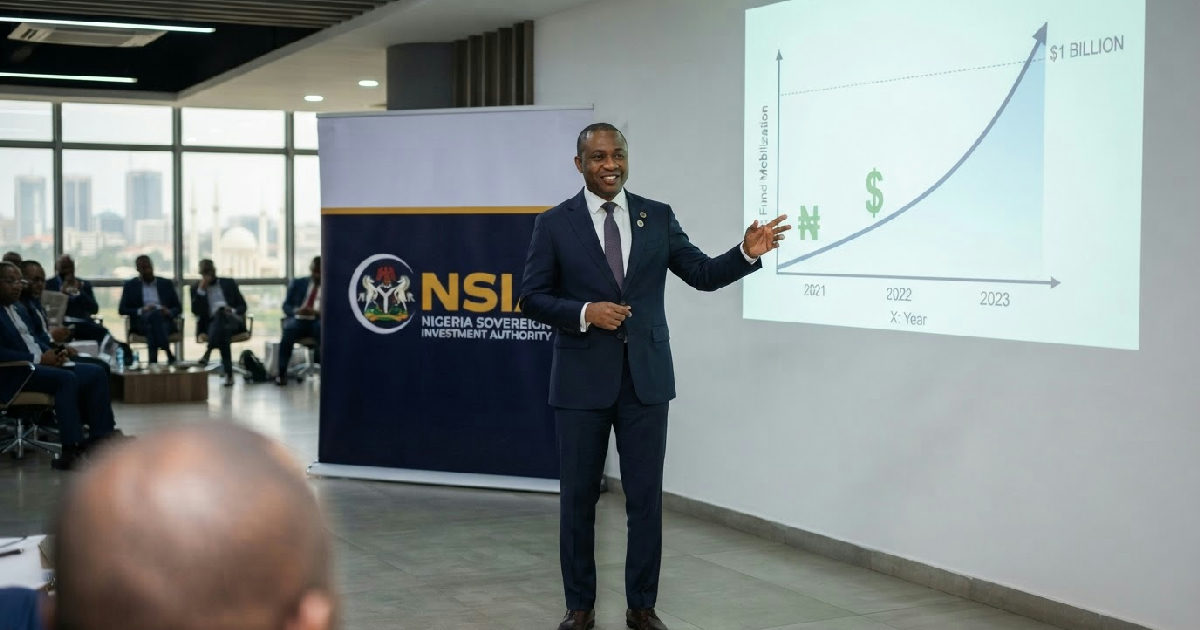
The Nigeria Sovereign Investment Authority (NSIA) mobilised $1 billion in third-party capital by 2023.
Aminu Umar-Sadiq, the Managing Director and Chief Executive Officer of NSIA, heralded this capital mobilisation as a clear testament to the authority’s expanding influence and strategic investment approach. He underscored the NSIA’s commitment to catalysing further investments and generating employment opportunities across key sectors of the Nigerian economy.
Sovereign Investment Authority establishment
The Nigeria Sovereign Investment Authority was established by the NSIA Act in 2011, commencing operations in October 2012. It began with an initial seed capital of US$1 billion. The fund’s primary mandate was to manage Nigeria’s sovereign wealth, ensuring fiscal support, long-term savings, and critical domestic infrastructure investment.
This foundational structure aimed to insulate the national economy from commodity price volatility while securing future prosperity. The NSIA represented a strategic move to manage oil revenues more prudently than past administrations had done. Its creation marked a new era of fiscal responsibility.
NSIA’s evolving investment strategy
The NSIA’s strategic shift towards attracting external capital marked a pivotal development in its operational history. By 2023, the fund’s total assets had soared to $2.512 billion, a substantial leap from its original $1 billion seed capital. This growth underscored a deliberate strategy to diversify funding sources beyond government allocations.
The mobilisation of an additional $1 billion in third-party funds was not an isolated event; it built on a consistent trajectory. Between 2016 and 2020, for instance, the NSIA received an additional $750 million in capital injections. This consistent growth trajectory saw the NSIA’s net asset value climb to $3.4 billion over 13 years, reflecting a compound annual growth rate of 10.7%.
Impact on Nigerian infrastructure and economy
The influx of third-party capital had direct and tangible benefits for Nigeria’s economy. Over $500 million of the NSIA’s funds were channeled into domestic infrastructure projects. These investments spanned critical sectors such as power, healthcare, and agriculture, areas vital for national development and economic diversification.
The NSIA also played a crucial role in shaping Nigeria’s financial market ecosystem, contributing to the co-development of more than 10 institutions and platforms. This collaborative effort aimed to enhance the efficiency and reach of financial services, supporting broader economic growth.
For instance, the Authority invested ₦10 billion into a Construction Finance Warehouse Facility (CFWF) with InfraCredit, providing critical construction finance for eligible greenfield infrastructure projects. Lagos real estate, for example, benefited from similar strategic financial injections, underscoring the fund’s pervasive influence.
Balancing mandates amidst economic shifts
The NSIA was designed with a dual mandate. It had to provide fiscal support during economic downturns while simultaneously saving for future generations. This balancing act was put to the test several times since its inception. Managing these divergent objectives required careful financial stewardship and strategic planning.
For example, in 2020, the Federal Government of Nigeria withdrew US$150 million from the NSIA to support its economic management strategy. This action highlighted the Stabilisation Fund’s crucial role as a national buffer during periods of distress. The fund acted precisely as intended, providing liquidity when needed most.
Fiscal resilience and future generations fund
Beyond direct infrastructure, the NSIA maintained its foundational commitment to Nigeria’s long-term financial health through its three distinct sub-funds. The Stabilisation Fund offered essential fiscal support to the government during periods of economic hardship, acting as a crucial buffer.
The Future Generations Fund, with an investment horizon exceeding 20 years, was meticulously designed as a long-term savings vehicle. It safeguarded wealth for future Nigerians, insulating national assets from short-term market volatility and ensuring sustained prosperity. This careful balancing act helped avoid Nigeria’s energy crisis from deepening further during challenging times, showcasing proactive fiscal management.
Driving sustainable development and climate action
Recognizing the global shift towards sustainability, the NSIA integrated environmental, social, and governance (ESG) frameworks into its operations. This commitment extended to green investment initiatives, aligning Nigeria’s development goals with global climate action. In 2023, the NSIA also received an additional capital contribution of $45.6 million from the Federation following the implementation of the Petroleum Industry Act (PIA), further bolstering its capacity.
The authority aimed to scale up concessional and blended finance for renewable energy, low-carbon infrastructure, and climate resilience projects. Partnerships with entities like the Green Climate Fund (GCF) were central to these efforts. Planned initiatives included financing facilities for solar mini-grids and green housing, as well as programs supporting sustainable land management for smallholder farmers.
Such efforts complemented broader national drives, including efforts to solve Nigeria’s logistics crisis, by building resilient infrastructure.
Remarkable financial performance in 2023
The financial performance of the NSIA in 2023 underscored its operational effectiveness. Operating income surged by 1,064% to ₦1.17 trillion, a dramatic increase from ₦101.1 billion in 2022. Operating profits similarly grew by 1,094%, reaching ₦1.176 trillion from ₦98 billion the previous year.
The total comprehensive income for 2023 stood at ₦1.184 trillion, a significant leap from ₦96.9 billion in 2022. This impressive profitability translated into a Return on Equity that rose to 10.5% from 7.2% in 2024, and a Return on Assets that increased to 9.9% from 7.1%.
These figures firmly established the NSIA as a powerhouse in managing Nigeria’s sovereign wealth, proving its capacity to generate substantial returns while driving national development.
A blueprint for enduring prosperity
The NSIA’s consistent growth and strategic capital mobilisation painted a picture of Nigeria’s evolving financial landscape. Its ability to attract significant third-party investment solidified its role as a key driver of economic development. The authority demonstrated that prudent management could transform national assets into engines of growth.
The success of the NSIA offered a crucial blueprint for Nigeria’s long-term financial stability. It proved that strategic public investment, when combined with effective private sector partnerships, could yield substantial returns and create lasting impact across diverse sectors. This approach was shaping Nigeria’s economic future for generations to come.
