




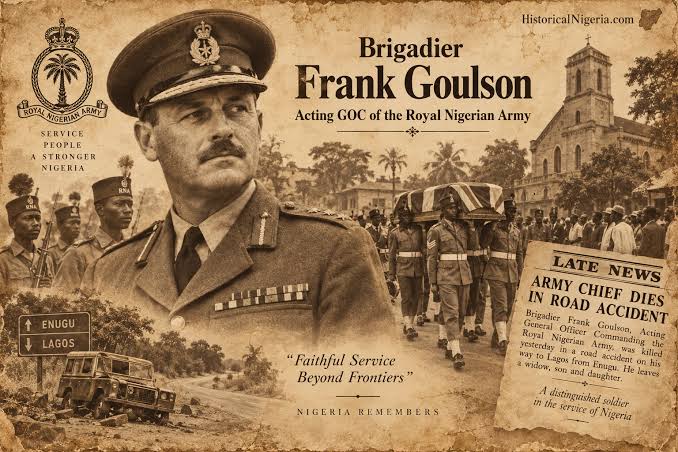
A British Brigadier, holding interim command of independent Nigeria’s fledgling army, didn’t fall in a political coup or a heated skirmish. Brigadier Frank Job Goulson, 48, died on March 11, 1962, in a simple road accident between Enugu and Lagos.
His unexpected demise, less than two years after Nigeria’s independence, ripped away a curtain many preferred to keep drawn. It starkly exposed the lingering, intricate threads of colonial influence that still bound the nation’s most critical institutions, particularly its military. This period saw the foundations laid by colonial institutions continue to shape the country.
British general’s car crash reshapes a nation
Goulson’s military career began in 1935, taking him far beyond Britain. He received a commission in the Lincolnshire Regiment, embarking on a military path that spanned decades and continents. He became an officer whose service reflected a long career within the British Army.
He served during the Second World War, with his postings including service in Europe and Asia. His responsibilities during the war included commanding West African soldiers, bringing him into direct contact with military personnel from Britain’s West African territories.
Goulson held the Distinguished Service Order (DSO) and was an Officer of the Order of the British Empire (OBE). His career reflected an officer whose military service extended from before the Second World War into the post-war years, culminating in involvement with the Nigerian Army after independence.
Independence, But Not Yet Command
Nigeria had declared independence on October 1, 1960. Many imagined this meant a swift, clean break from British influence across all sectors. However, the reality was a slow, carefully negotiated transition, especially within the military structure.
Senior command positions within the Royal Nigerian Army remained largely in British hands. Major-General Norman Leslie Foster, for instance, continued as General Officer Commanding (GOC) even after independence. This continued reliance highlighted the practical challenges of building a fully indigenous command structure from scratch, as explored in historical military narratives.
It was into this delicate period that Brigadier Frank Job Goulson stepped. He assumed the GOC role on an interim basis, bridging the gap between Foster and the incoming Major-General Christopher Earle Welby-Everard. His appointment, though temporary, underscored the significant presence of British officers in post-independence Nigerian military leadership.
The Fatal Journey and its Unseen Impact
On Sunday, March 11, 1962, Goulson embarked on a journey that would abruptly end his career and life. He was travelling from Enugu, then the capital of Nigeria’s Eastern Region, to Lagos, the federal capital and a vital hub for government and military administration. It was a routine trip connecting two key Nigerian cities.
Somewhere along that route, Goulson was involved in a fatal road accident. The details of the crash itself remain largely unpublicised, a stark, sudden end for a man whose career spanned operational command and senior staff appointments. He was pronounced dead at 48.
His death, recorded in the June 1962 edition of The Poacher, the regimental journal of the 2nd East Anglian Regiment, was a personal tragedy. But its timing transformed it into something more: an unexpected mirror reflecting the state of Nigeria’s military autonomy and its ongoing transition.
The Lingering Shadow of Empire
Goulson’s death occurred just weeks before Major-General Christopher Earle Welby-Everard was officially to assume command in April 1962. Welby-Everard, another British officer, succeeded Goulson in the General Officer Commanding position, continuing the pattern of British leadership in the Nigerian Army.
This progression—from Major-General Norman Foster, through Goulson’s brief interim, to Major-General Christopher Earle Welby-Everard—illustrates the continued involvement of British officers in the leadership of the Nigerian Army during the early independence period. The transition to a fully indigenous command was still incomplete when Goulson died.
The ‘twist’ in Goulson’s story isn’t a grand conspiracy or a hidden agenda. It’s the mundane nature of his end. A man with significant military experience was taken by a common accident, yet this event highlighted an uncomfortable truth.
Nigeria, despite its independence, still relied heavily on its former colonisers to lead its most vital defence institution years after declaring itself free. This period also coincided with significant First Republic crises that added to the nation’s foundational challenges.
His death, an unforeseen consequence of a routine journey, served as an accidental punctuation mark in Nigeria’s journey towards true military independence. It was a reminder that the path from colonial subject to sovereign nation was often far less direct than official narratives suggested, fraught with lingering dependencies and the silent echoes of an empire not quite ready to let go.
The Learning: Not a Clean Break
Goulson’s story serves as a potent reminder that independence, for many nations, is rarely a clean, immediate break from the past. The infrastructure of power, the systems, and often the personnel, of the former colonial ruler can persist for years, even decades.
True sovereignty is built brick by painstaking brick. The echoes of empire can linger in the most unexpected corners, influencing a nation’s trajectory long after the flags have changed.
