




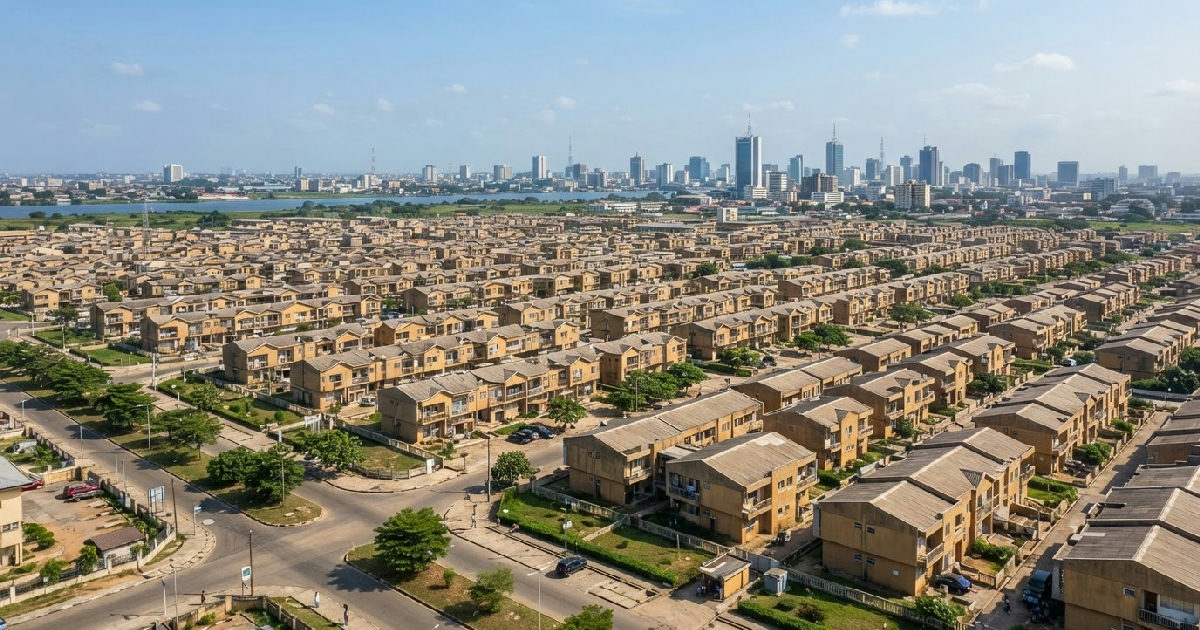
In the mid-1970s, Nigeria embarked on an ambitious project to create Festac Town for the Second World Black and African Festival of Arts and Culture, known as FESTAC ’77. This monumental undertaking demonstrated how Nigeria built a dedicated city to host a global cultural event of unprecedented scale.
The vision for Festac Town went far beyond temporary accommodation; it was a bold statement of national capability and a practical solution to urbanisation challenges. Its rapid development between 1974 and 1976, fuelled by Nigeria’s burgeoning oil revenues, converged master planning, extensive housing construction, and major infrastructure works into a coherent system that would endure long after the festival’s final curtain call.
How Nigeria built FESTAC ’77’s vision
The journey to FESTAC ’77 began over a decade earlier with the First World Festival of Negro Arts, held in Dakar, Senegal, in 1966. Nigeria, led by then-Head of State General Yakubu Gowon, accepted the invitation to host the next edition, initially slated for 1970. But the brutal Nigerian Civil War, which raged from 1967 until January 1970, forced a significant postponement.
Once the conflict ended, preparations resumed, but the sheer scale of the proposed international gathering quickly became apparent. Organising a festival meant to unite participants from 56 African nations and countries of the African Diaspora required more than just venues for performances and exhibitions.
It demanded comprehensive accommodation, robust transport systems, and a vast supporting infrastructure – a logistical puzzle that ultimately necessitated building an entire city from scratch. To understand the economic context that made such large-scale national projects possible, one might look at Nigeria’s post-war pivot for Nigerian industry.
The path to 1977 wasn’t smooth. Proposed dates shifted multiple times, and political turmoil cast a shadow over preparations. In July 1975, General Gowon was ousted while attending an Organisation of African Unity summit in Kampala. His successor, General Murtala Muhammed, reviewed major government programmes, including the festival.
Then, after Muhammed’s assassination in February 1976, Lieutenant-General Olusegun Obasanjo stepped in, ensuring the continuity of the project and its ambitious timetable.
From swamp to city: master planning Festac Town
The decisive phase of Festac Town’s construction kicked off in the mid-1970s. Initial groundwork, primarily sandfilling the expansive swampy land, began in late 1972, laying the foundation for what would become a modern residential hub. Real construction work, including essential roads and drainage systems, commenced in 1974.
A pivotal moment came in 1974 when the Federal Republic of Nigeria entrusted the Festac Town project to Doxiadis Associates. This international planning and consulting firm, known for its association with Greek urban planner Constantinos A. Doxiadis, developed a master plan that envisioned much more than a temporary camp.
Their design integrated housing, roads, public facilities, and a complete infrastructure, ensuring the settlement would function as a viable community long after the festival concluded.
The Federal Housing Authority (FHA), established under Decree No. 40 of 1973, took the lead role in implementing this ambitious vision. The FHA’s mandate covered housing programmes and urban development activities, making it the ideal body to oversee the transformation of Festac Town into a lasting residential solution for Lagos.
It was a clear demonstration of how government entities were being shaped to tackle national development challenges.
A monumental build under pressure
The scale of Festac Town was truly immense. The ultimate plan projected a settlement covering approximately 1,770 hectares, designed to accommodate around 120,000 people across seven residential communities, with a long-term capacity of about 24,000 dwelling units.
Phase One, a crucial step completed before the festival, spanned roughly 460 hectares, encompassing three residential communities and aiming to house approximately 55,000 individuals in nearly 11,000 dwelling units.
To meet this unprecedented demand, the project marshalled an army of builders. More than 40 contractors worked simultaneously across some 70 different sites, focusing on housing and associated services. Meanwhile, 14 major contractors tackled the extensive infrastructure, which included arterial roads, pedestrian walkways, bicycle lanes, and complex underground drainage systems. This rapid construction reflected the era’s state-sponsored economic development, bolstered by substantial oil revenues.
Festac Town was designed as a self-sufficient urban settlement, replete with every conceivable amenity. It featured electrical generators, police and fire stations, supermarkets, banks, health centres, public restrooms, and postal services.
Schools, playgrounds, parks, and shopping complexes were integrated into its efficient grid network of seven major avenues, from 1st to 7th, showcasing a modern urban planning philosophy. The challenges of building and maintaining such extensive systems for public services remain relevant today.
Beyond temporary housing: a permanent residential model
The dual objectives for Festac Town were always clear: immediate accommodation for FESTAC ’77 participants and a lasting contribution to Nigeria’s housing stock. This long-term vision profoundly influenced the estate’s design and character. The 5,088 contemporary dwelling units ready for FESTAC ’77, for instance, were not merely temporary barracks but homes constructed with future families in mind.
After the festival, the houses that temporarily hosted artists, dignitaries, and delegations from across Africa and the diaspora were transitioned into permanent residences. The streets, meticulously planned and built for the extraordinary cultural gathering, became ordinary routes for daily life, leading to homes, schools, markets, and workplaces.
This transformation underlined the Federal Government’s commitment to addressing the intense housing pressure in metropolitan Lagos, using the festival as a catalyst for broader urban development.
The Federal Housing Authority played a crucial role in managing this transition. Its founding in 1973 positioned it perfectly to integrate Festac Town into Nigeria’s national housing programme.
The project served as a model township, demonstrating how large-scale, planned communities could ease the burdens of rapid urbanisation and provide quality living spaces for thousands of Nigerians. It was an ambitious system designed to outlast the event that spawned it.
The 1976 sprint to the finish
The year 1976 proved to be the decisive period for Festac Town construction. With the opening of FESTAC ’77 looming, the immense programme of housing and infrastructure development had to reach a functional stage. By the end of that year, Phase One of the project was completed, a remarkable feat considering the swampy terrain and the intricate planning involved.
The timetable was exceptionally demanding. In just over two years, the project moved from significant planning to large-scale construction, all while Nigeria simultaneously prepared other vital infrastructure for the festival. Festac Town was just one component of a much larger national effort. Lagos was abuzz, preparing venues for performances, exhibitions, conferences, and coordinating the movement of an estimated 16,000 to 17,000 participants.
When FESTAC ’77 finally opened its doors on January 15, 1977, running until February 12, 1977, Festac Town stood as one of the most tangible symbols of Nigeria’s preparation and cultural aspiration. The housing estate not only accommodated its international guests but also showcased a burgeoning nation’s capacity for grand-scale organisation and modern development.
The total cost of hosting the festival was a staggering $400 million, an amount roughly equivalent to $2 billion today.
Festac Town’s lasting imprint on Nigerian urban development
To call Festac Town merely a “festival village” would diminish its historical resonance and the lasting impact it had on Nigeria’s urban landscape. It was a complex system born from the confluence of cultural diplomacy, national prestige, and practical housing policy.
Nigeria used FESTAC ’77 to project itself as a powerful centre of Black and African cultural life, an ambition backed by significant investment in tangible infrastructure designed for long-term utility.
The settlement thus belongs to two intertwined narratives. One is the story of FESTAC ’77 itself, a vibrant international celebration of arts and culture. The other, perhaps more enduring, is the history of Lagos’s physical expansion, particularly the planned residential development stretching westwards along the Lagos-Badagry corridor.
Festac Town became an enduring legacy because its structures continued to serve, develop, and reshape urban life for generations, embodying the aspirations of a nation in its oil boom era.
This blend of cultural ambition and systematic planning provides a lens through which to understand the country’s trajectory during the 1970s.
The military administrations of the time, including those of General Yakubu Gowon, General Murtala Muhammed, and Lieutenant-General Olusegun Obasanjo, were central to shaping these grand national projects, often playing a direct role in civilian development.
These ambitious undertakings, while aiming for progress, also shaped the systems that would later confront the nation with challenges, from urbanisation pressures to broader issues of economic hardship.
Today, Festac Town continues to evolve, a living record of a pivotal moment when Nigeria built not just a festival city, but a permanent community envisioned for the future. Its existence today serves as a constant reminder of how grand cultural ambitions can intersect with practical urban planning, leaving behind a tangible legacy that shapes the everyday lives of thousands.
