




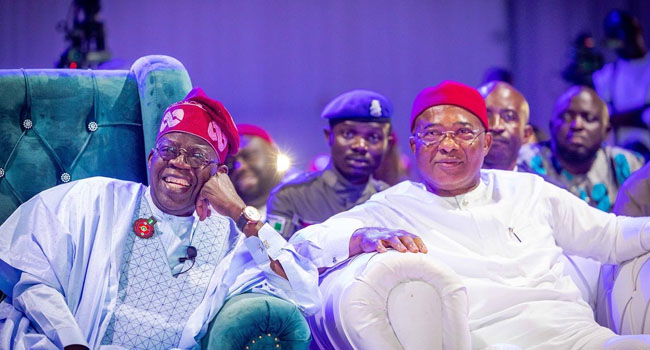
The chandeliers in the Government House in Owerri glimmered as Imo State Governor Hope Uzodimma took the stage on Friday, July 17, 2026, to announce a significant surge in the state’s internally generated revenue.
Uzodimma, who also chairs the influential Progressive Governors’ Forum, painted a picture of a state transformed. He argued that policies like the controversial removal of the fuel subsidy had not only bolstered state allocations but also unlocked a wave of internal revenue generation previously thought impossible. It was a narrative of fiscal resuscitation, squarely crediting the presidency’s agenda for Imo’s newfound financial vigour.
Imo State’s bold revenue claims emerge
Governor Hope Uzodimma didn’t just stop at the N6 billion figure. He offered a broader vision of progress, directly tying it to the “Renewed Hope Agenda” championed by President Bola Ahmed Tinubu. He insisted the projects visible across Imo State were only feasible because of these reform policies.
But a closer look at the governor’s own statements reveals a slight, yet critical, nuance. Another report from the same event quoted Uzodimma stating the IGR had risen from less than N400 million monthly in 2020 to “nearly N3 billion.” This difference of N3 billion leaves an immediate question mark over the precise scale of the claimed success.
The weight of history on Nigeria’s state finances
Nigeria’s states have long grappled with fiscal autonomy, often reliant on federal allocations. The clamour for increased internally generated revenue isn’t new; it’s a constant refrain from governors seeking to fund ambitious development projects without being tethered to Abuja’s purse strings. Every administration, it seems, promises a pathway to financial independence, yet the structural challenges persist.
The current push, framed by President Bola Ahmed Tinubu’s reforms, harks back to earlier periods of economic restructuring. These past efforts, from the Structural Adjustment Programme of the 1980s to the reforms under President Olusegun Obasanjo, aimed to re-engineer Nigeria’s economic base. The goal was always to reduce reliance on oil revenue and empower states to drive their own growth.
Tinubu’s economic blueprint and state allocations
The removal of the petrol subsidy was undoubtedly President Bola Ahmed Tinubu’s most significant and immediate economic policy decision. While it inflicted hardship on many Nigerians, state governors quickly saw an increase in their monthly allocations from the Federation Account. This freed-up capital, Uzodimma suggests, is the engine behind Imo’s reported IGR boom.
This policy, alongside other fiscal adjustments under the Renewed Hope Agenda, places a new onus on states to optimise their revenue collection mechanisms. It challenges them to translate increased federal funds into sustainable internal growth. The theory is that less dependence on a single commodity makes state finances more resilient.
Unpacking Imo’s actual revenue reality
While Governor Hope Uzodimma’s N6 billion monthly IGR claim garners headlines, official data paints a more detailed, and perhaps more realistic, picture. The Imo State Internal Revenue Service (ISIRS) reported a record N43 billion in IGR for the entire year 2025. This achievement surpassed their N42 billion target for that year.
Delving into the monthly breakdown, ISIRS figures showed collections jumping from N3.5 billion in January 2025 to over N4.5 billion by December of the same year. This consistent growth was attributed to a mix of policy reforms, the adoption of digital platforms, robust taxpayer awareness campaigns, and disciplined revenue enforcement.
The ISIRS Executive Chairman, Justice Okoye, represented by Chinwe Jude-Ibemere, confirmed 2025 was an all-time high.
Beyond the balance sheet: infrastructure and energy
Uzodimma’s narrative of transformation extended beyond revenue figures. He claimed the state’s debt profile, once over N280 billion in 2020, had sharply fallen to less than N90 billion today. This dramatic reduction, if independently verified, would represent a significant fiscal achievement for the state. Such improvements are often critical for attracting further investment.
The governor also highlighted extensive road construction, stating that intra-state travel times had been slashed from typical two to three-hour journeys to under 45 minutes. Furthermore, the Orashi Power Plant received a significant boost, advancing electricity generation, transmission, and distribution within Imo State.
Uzodimma assured that the plant would expand its reach to additional Local Government Areas before the year’s end. Reliable power is a consistent factor in boosting economic activity and attracting investment.
A leader’s legacy: the Lee Kuan Yew parallel
Perhaps the boldest assertion from Governor Hope Uzodimma was his comparison of President Bola Ahmed Tinubu to Lee Kuan Yew, Singapore’s revered founding father. Uzodimma noted that both leaders came to power amidst strong opposition but emerged as benchmarks for quality leadership and development.
This parallel attempts to elevate Tinubu’s reform agenda to a transformational level, echoing Singapore’s remarkable journey from a small island nation to a global economic powerhouse.
Lee Kuan Yew’s legacy was built on stringent fiscal discipline, aggressive anti-corruption drives, and a long-term vision for economic diversification. The comparison, while aspirational, places a heavy expectation on President Tinubu’s administration to deliver similarly profound and lasting structural changes. It suggests a future where Nigeria, like Singapore, overcomes its initial challenges to achieve sustained prosperity.
For a country like Nigeria, where political transitions often bring policy shifts, stability and consistent vision are crucial. Uzodimma’s analogy underscores a desire for decisive leadership that can steer the nation through its economic turbulence. It’s a call for the kind of long-term planning that transcends immediate political cycles.
The road ahead for state economic autonomy
The true measure of these reforms won’t just be in headline-grabbing numbers, but in their tangible impact on the lives of ordinary citizens. An increase in state revenue must translate into improved public services, better infrastructure, and enhanced economic opportunities.
The reported figures, even with their discrepancies, signal a renewed focus on states generating their own wealth, rather than relying solely on federal allocations. This shift marks a critical juncture in Nigeria’s fiscal federalism.
Yet, the path to genuine economic autonomy for states is paved with challenges. Sustaining IGR growth requires not just policy directives from the top, but deep institutional reforms, transparency in collection, and a fundamental change in taxpayer attitudes. It requires governors to act with the same fiscal discipline and foresight that Uzodimma claims for Imo State.
The question for Imo, and indeed for all Nigerian states, isn’t just whether they can increase their revenue today. It’s whether they can build robust, diversified economic bases that resist the familiar boom-and-bust cycles.
This is the historical pattern that Nigeria has struggled to break, and it’s the challenge that every administration, including President Bola Ahmed Tinubu’s, must confront. The past is not just prologue; it is the very ground upon which the future is being built.
