



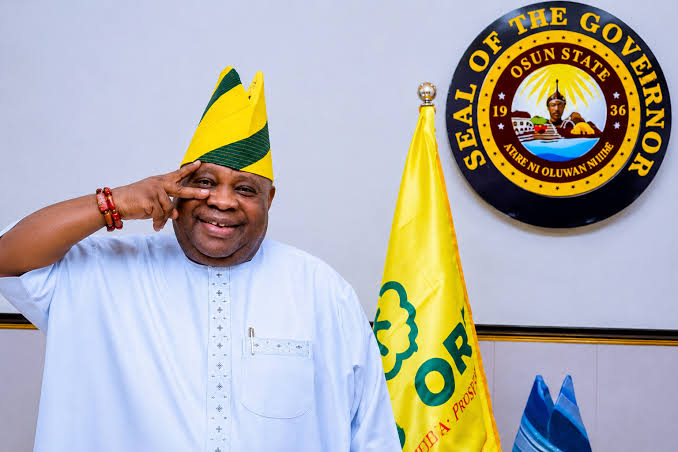
On Sunday morning, August 16, 2026, the Independent National Electoral Commission (INEC) declared Governor Ademola Adeleke the winner of the hotly contested Osun gubernatorial election. Contesting under the Accord Party, Adeleke secured 511,067 votes. He defeated his main challenger, Bola Oyebamiji of the All Progressives Congress (APC), who polled 444,815 votes.
This victory extends Adeleke’s tenure in the Government House in Osogbo. In 2022, he originally claimed office by defeating Gboyega Oyetola under the Peoples Democratic Party (PDP) banner. His move to the Accord Party in November 2025 reshaped the state’s political balance before this Saturday vote.
How the Osun gubernatorial election redefined party politics
Adeleke’s defection from the PDP to the Accord Party on November 6, 2025, surprised many political observers. Internal friction within the PDP threatened his re-election ambitions. To safeguard his campaign, he migrated to a new platform and pulled his entire political structure with him.
All 25 members of the Osun State House of Assembly defected alongside the governor. Eight federal lawmakers representing constituencies in the state also joined his new party. This unified movement showed how political structures can shift rapidly, much like how influential Nigerian dynasties consolidate their regional influence.
The APC opposition tried to portray Adeleke as an isolated politician who abandoned his base. Led by former governor Gboyega Oyetola, now the Minister of Marine and Blue Economy, they attempted to capitalize on the disruption. Yet, Adeleke proved that his personal brand superseded party affiliations.
Adeleke won in 19 of the 30 local government areas, while the APC candidate won in 11. This outcome shows how deeply embedded his coalition was at the grassroots level. He expanded his previous winning margin of 28,344 votes from 2022 to a comfortable 66,252 votes.
Improving workers welfare became a shield against opposition critics
A critical factor in Adeleke’s appeal was his administration’s focus on clearing outstanding financial obligations. For years, public servants in the state endured inconsistent payments. Under former governor Rauf Aregbesola, the government paid modulated salaries to high-grade workers during a severe fiscal crisis.
While Gboyega Oyetola restored full monthly salaries in 2018, deep-seated pension liabilities remained unresolved. Upon taking office in November 2022, Adeleke targeted these outstanding debts directly. His administration declared it had paid nearly N100 billion in inherited pension obligations to retirees.
The government also cleared seven months of half-salary arrears and paid N1.69 billion in inherited cooperative deductions. Trade unions took notice of these developments. During the 2025 Workers’ Day celebration, Osun NLC chairman Christopher Arapasopo formally endorsed Adeleke’s bid for a second term.
The administration also implemented a N75,000 minimum wage ahead of many other states. Opposition spokesman Felix Morka described the governor’s record as lacklustre, citing issues in health and education. However, the direct financial relief felt by civil servants insulated Adeleke from these campaign attacks.
Engaging traditional communities and surviving religious tensions
Adeleke’s campaign style relies heavily on direct, informal engagement with the public. He is known for dancing at community events, church services, and mosque gatherings. While opponents ridiculed this behavior as unserious, it built a unique bond of accessibility with ordinary citizens.
This personal approach faced severe tests on religious grounds. Several Muslim groups accused Adeleke of marginalizing them and fielding a politically unbalanced ticket. In June 2026, the League of Alfas endorsed the APC candidate, criticizing Adeleke’s religious stance.
In July, APC deputy governorship candidate Benjamin Adereti publicly called Adeleke a religious hypocrite. Adeleke’s supporters quickly countered by highlighting the construction of an Osun Hajj camp. They also pointed to the appointment of multiple Muslim officials to senior government roles.
The governor also maintained a strong presence at traditional events across the state. His willingness to celebrate local heritage helped him maintain broad cultural appeal. This deep respect for regional heritage is why indigenous cultural celebrations resonate so strongly with local communities.
Resisting federal pressure and the impact of presidential neutrality
Adeleke successfully framed his re-election campaign as a local defense against external political forces. With high-profile APC leaders backing Oyebamiji, the contest was expected to draw heavy federal intervention. Ten days before the election, the Economic and Financial Crimes Commission (EFCC) froze a key state salary account.
The commission claimed it was investigating the handling of N11 billion in public funds. Adeleke’s administration immediately condemned the freeze as a politically motivated action. President Bola Tinubu subsequently intervened, directing the EFCC to vacate the court order to prevent electoral interference.
Tensions rose further in July when police arrested Osun’s Secretary to the State Government, Teslim Igbalaye. Authorities recovered N4.81 million and several voter cards during a raid on his residence. Adeleke’s campaign rejected the allegations, using the incident to rally voters against federal pressure.
This narrative of resistance resonated with voters who preferred local autonomy over external dictate. Surprisingly, President Tinubu remained physically absent from the APC’s major campaigns in Osun. Vice President Kashim Shettima also did not attend, signaling a level of presidential neutrality.
This hands-off approach weakened the APC candidate’s claim of being the president’s anointed choice. Adeleke had previously endorsed Tinubu’s own re-election bid, calling him a leader of the South-west. This strategic alignment neutralized some of the partisan friction usually expected in such contests.
Youth mobilization and the powerful influence of David Adeleke
The governor possessed a significant advantage in his nephew, the globally recognized musician David Adeleke, known as Davido. In May 2026, Davido took a two-month break from his music career. He assumed the role of chairman of the Imole Youth Campaign Mobilisation Team.
Davido formally joined the Accord Party and actively campaigned on the ground. He used his massive social media platforms to reach younger voters who are typically disengaged from formal politics. During one campaign appearance in Ede, he urged supporters to mobilise for his uncle and said Adeleke had performed and deserved another term.
This celebrity involvement transformed standard political rallies into cultural events, much like how local community festivals bring diverse groups together. Former presidential spokesman Denge Onoh later remarked that Davido’s role was crucial for youth engagement. It helped bridge the gap between traditional structures and younger citizens.
The election results suggest that Adeleke’s appeal was not confined to his traditional strongholds. By making gains across other parts of the state, his campaign secured a decisive victory. His ability to draw diverse coalitions ensured his victory across 19 local governments.
By defeating a major party while running under a newly adopted banner, Adeleke has redrawn the boundaries of regional state politics. As the dust settles over Osogbo, a deeper question remains: has Osun witnessed the rise of a personalized dynasty, or has it found a blueprint for resisting national party machinery?
