




A 25-year-old Nigerian soldier arrived at the African Medical Centre of Excellence (AMCE) in Abuja, a quadriplegic. A virus had ravaged his body, leaving him unable to move or even breathe on his own. Weeks later, he walked out, moving his arms and feet, speaking.
This remarkable recovery is a testament to the vision of Brian Deavers and his commitment to advanced medical care in Nigeria.
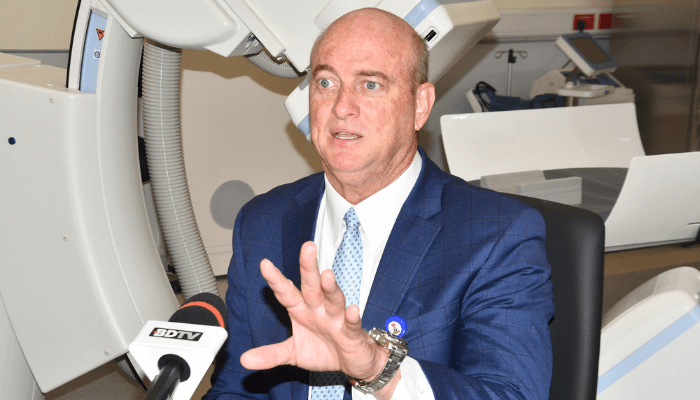
It was one of several stories the centre’s CEO, Brian Deaver, calls “miracles,” including a man who had an 11-hour surgery for an aortic dissection so critical that a single pothole on the road could have killed him. He went home just days later.
The vision of Brian Deavers
These moments are more than just medical victories. They are the first returns on a quiet, audacious bet: that the solution to Nigeria’s chronic brain drain and billion-dollar medical tourism problem isn’t pleading with doctors to stay, but building an institution so advanced they are compelled to return.
Brian Deaver, an American from Texas, now heads one of Nigeria’s most ambitious healthcare projects. The vision for the African Medical Centre of Excellence (AMCE), backed by Afreximbank, was born from a stark reality. Nigerians spend over $1 billion annually on medical tourism for the very specialities AMCE now offers: oncology, cardiovascular care, and haematology.
Meanwhile, the country’s own medical talent has been steadily flowing out to Europe and North America.
The traditional narrative is that Nigerian professionals leave for better pay. But Deaver and his team discovered a different truth by engaging directly with the diaspora. Many weren’t leaving for money, but for experience. They sought access to the latest equipment, advanced clinical techniques, and a dynamic research environment—opportunities they felt were absent at home.
The experience for many Nigerians abroad has often been one of seeking opportunities unavailable locally.
AMCE was designed to fill this void. The goal wasn’t to replicate what other Nigerian hospitals were already doing, but to target the specific, complex gaps in care that forced patients and professionals to look overseas. It was an attempt to build a powerful magnet for talent and capital right in the heart of Nigeria.
What they did
In just eight months of full operation, the $250 million facility has begun to prove its case with hard numbers. AMCE has treated nearly 6,000 patients and conducted around 40,000 laboratory tests. The demand for its core services—cancer treatment, heart surgery, and blood disorder therapies like bone marrow transplants—has surged, confirming the initial analysis of where Nigeria’s healthcare gaps were most acute.
To deliver this care, AMCE invested between $45 and $50 million in equipment that is unique in the region. The centre is days away from commissioning a PET scanner, which, combined with its on-site cyclotron for producing radiopharmaceuticals, allows for remarkably detailed cancer detection.
“We have equipment here that does not exist anywhere else in Nigeria, or West Africa for that matter,” Deaver notes. This includes AI-assisted radiation systems that can target a tumour with pinpoint accuracy, pausing the beam as a patient breathes to protect healthy tissue.
This investment in technology became the foundation for its most critical mission: reversing the brain drain. For every advertised role, AMCE received as many as 1,000 applications. This allowed them to be selective, with a conscious strategy to hire Nigerians back from abroad to avoid poaching from other local hospitals.
Their chief nursing officer was recruited after 20 years in the UK’s National Health Service (NHS). Networking events held at the Royal College of Surgeons in London were so oversubscribed that staff had to usher attendees out hours after the scheduled end.
What it cost or earned
The cost of this ambition is high. Competing with US and UK-level salaries and investing in cutting-edge technology means a high operational budget. Yet, the returns are already manifesting in ways that transcend the balance sheet. Anecdotally, the centre is already stemming the tide of medical tourism.
Patients with procedures scheduled in Egypt, India, and Europe are cancelling those plans to receive treatment in Abuja. The impact of such choices mirrors how other sectors saw transformation when a bold local player emerged, much like how Globacom revolutionised Nigerian telecoms.
The facility is now attracting patients not just from Nigeria, but from Ghana, Liberia, Cameroon, and even the US, UK, and Canada. This influx inverts the decades-long trend of healthcare capital flowing out of Nigeria.
Deaver sees an opportunity in the long wait times for cancer care in the US, positioning AMCE as an immediate, high-quality alternative. “When it comes to cancer, time is precious,” he says. “We’re ready for you today. Don’t wait.”
This success has triggered a new wave of investment. The seven-storey building is already nearing capacity, with staff having to park on the street to save space for patients. Plans are underway for a second, identical hospital tower on the same site.
Three other buildings are currently under construction behind it: a 104-unit housing complex for employees, a 100-room hotel for patients’ families, and a dedicated four-storey research and clinical trials centre.
This model is now set for continental expansion. The Abuja centre is the first of at least five planned by Afreximbank. The next two are confirmed for Cameroon and Tanzania. The fact that South Africa, a nation with some of Africa’s largest hospitals, has expressed interest in hosting an AMCE speaks volumes about the power of the model Deaver is building.
The insight
For decades, Nigeria has wrestled with the seemingly intractable problems of brain drain and capital flight in its healthcare sector. The story of AMCE offers a powerful, actionable insight: the most effective way to solve a talent exodus is not to build walls, but to build magnets. Deaver’s strategy demonstrates that a deep, focused investment in excellence creates its own gravitational pull.
Professionals do not leave their home simply for a paycheque; they leave in search of a platform for their ambition. By providing world-class tools, a commitment to research, and a partnership with global leaders like King’s College Hospital, AMCE has built that platform in Abuja.
This approach has proven more persuasive than any appeal to patriotism. The challenge, much like efforts to reform other sectors, requires a clear vision and execution, an area where political will is often key.
The centre’s early success shows that Nigeria’s most significant healthcare gaps are also its most promising investment opportunities. Addressing them doesn’t just save lives; it repatriates human capital, retains domestic spending, and builds an economic ecosystem around advanced knowledge. AMCE is proving that if you build a system worthy of Nigeria’s best talent, they will not only stay—they will come home.
