




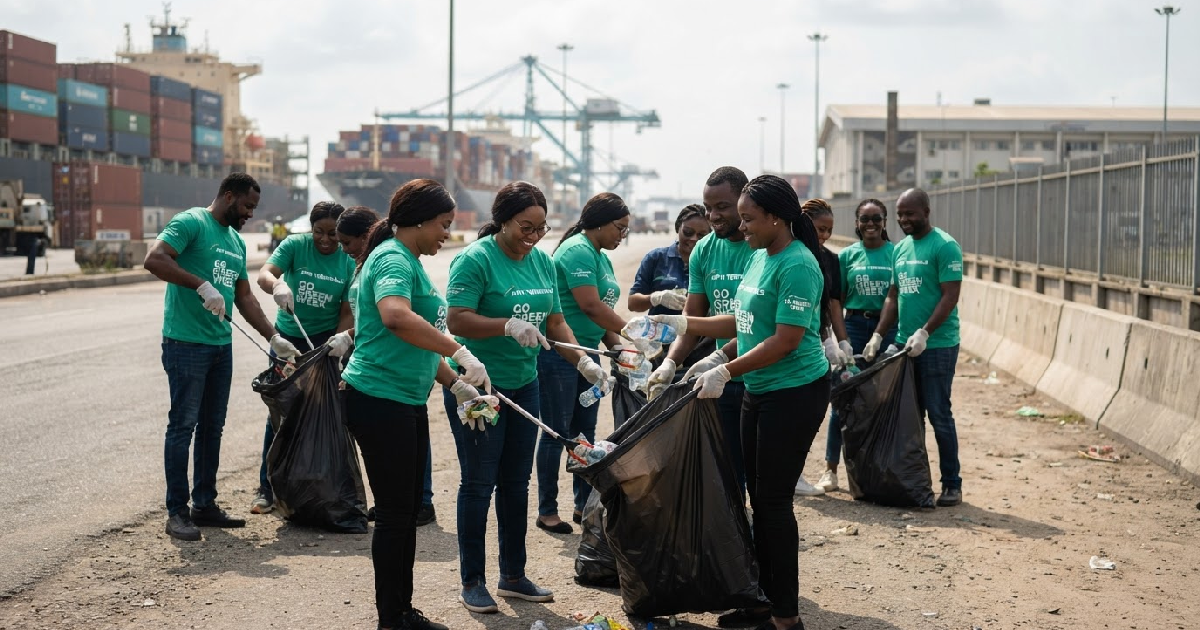
APM Terminals Apapa Go Green Week saw employees and the Nigerian Ports Authority conduct a large-scale clean-up of Lagos Port Complex corridors on Friday.
The initiative, which stretched from Finger Jetty through the common user road to Eko Support Services, the NPA Roundabout, Adekunle Road, and the main gate of APM Terminals Apapa, is more than just a single-day event. It’s a visible manifestation of a deeper, systemic commitment to environmental stewardship, aiming to transform the port environment and bolster the resilience of Nigeria’s supply chain.
The enduring challenge of Nigeria’s port environment
For decades, Nigeria’s ports, particularly Apapa, have grappled with a persistent battle against environmental degradation and congestion. The sheer volume of waste—from plastic packaging to discarded timber—not only creates an unsightly landscape but also poses significant operational hurdles, impacting the smooth movement of goods and people.
This accumulation of debris isn’t merely an aesthetic problem; it directly impedes the efficiency of one of West Africa’s busiest maritime gateways. It creates health hazards for workers and nearby communities, while also undermining efforts to project Nigeria as a modern, efficient trading nation.
A collective push for cleaner port corridors
The recent clean-up saw a convergence of effort between APM Terminals Apapa and the Nigerian Ports Authority. Felix Ugwuagbo, the Health, Safety and Environment (HSE) Manager at APM Terminals Apapa, stressed that the exercise extended the company’s environmental efforts beyond its immediate terminal boundaries.
“A clean port is a safer, healthier and more efficient port,” Ugwuagbo explained, “and that directly supports trade, protects the wellbeing of workers and strengthens the resilience of Nigeria’s supply chain.” His words underscore the interconnectedness of environmental health and economic vitality.
Umar Ibrahim, Assistant Manager for NPA Environment at the Lagos Port Complex Apapa, echoed this sentiment. He highlighted that effective waste management is paramount for maintaining safe and efficient port operations. Ibrahim noted that “prompt waste removal helps reduce environmental hazards, improves air quality and contributes to safer, more efficient port operations.”
Shaping a system of maritime sustainability
This clean-up is a concrete piece of a much larger, global puzzle: APM Terminals’ ambitious strategy to achieve net-zero operations across all its terminals worldwide by 2040. This target is buttressed by an interim goal to cut Scope 1 and 2 emissions by 65% by 2030 from a 2022 baseline.
The company, a unit of Danish shipping giant Maersk and a key global port operator since its founding in 2001, is integrating these principles into its local operations.
Kamal Alhraishat, Managing Director of APM Terminals Apapa, framed the Go Green Week as an “important platform for raising environmental awareness and encouraging collective action within the port community.” He emphasised that sustainability isn’t just a corporate buzzword but a fundamental part of how the business operates daily.
Beyond the physical waste removal, the Go Green Week also included other systemic interventions. More than 25 bags of frangipani plants and Pride of Barbados seeds were planted to foster green spaces and boost biodiversity within the terminal facility.
The week also featured environmental awareness sessions, an environmental town hall for employees focused on waste management, and the launch of a solar-powered recycling hub in partnership with GIVO Africa.
The economics of a cleaner maritime gateway
The state of a port directly influences its economic performance. A cluttered, polluted environment creates bottlenecks, slows down cargo handling, and can deter international trade partners. Conversely, a clean, well-managed port signals efficiency and reliability, drawing more business and investment.
The improvements resulting from efforts like the Apapa clean-up cascade through the entire logistics chain. Faster vessel turnaround times, reduced health risks for dockworkers, and a more pleasant working environment all contribute to increased productivity. This, in turn, can lower operational costs for businesses and ultimately benefit consumers through more efficient import and export processes.
Considering Apapa’s role as a major entry point for goods into Nigeria, ensuring its operational excellence and environmental integrity is an economic imperative. The port’s historical struggles with gridlock and pollution have significantly impacted the Nigerian economy, making every step towards systemic improvement critically important.
Beyond the clean-up: a vision for net-zero operations
APM Terminals’ efforts in Apapa are directly tied to its broader global decarbonisation strategy. This strategy rests on three core pillars: significantly reducing fuel and electricity consumption, systematically replacing fossil-fuel-driven equipment with electrified alternatives, and thoroughly decarbonising the energy supply through increased reliance on renewable electricity, on-site solar solutions, and low-emission fuels.
This long-term vision positions APM Terminals Apapa not just as a clean-up participant but as a driving force in the transformation of Nigeria’s maritime sector. Achieving net-zero operations by 2040 means a complete overhaul of energy systems, logistics, and operational practices. It requires substantial investment and a fundamental shift in how port activities are conducted.
For Nigeria, this commitment by a major international operator like APM Terminals sets a precedent. It pushes the conversation towards more sustainable practices across the entire port ecosystem, from shipping lines to clearing agents and regulatory bodies. The move signifies an acknowledgement that environmental responsibility and operational efficiency are two sides of the same coin.
Learning from integrated infrastructure management
The methodical approach taken by APM Terminals in integrating environmental clean-ups with broader sustainability goals offers insights into managing complex public infrastructure. This mirrors the kind of integrated planning seen in other parts of Nigeria, where coordinated efforts are yielding visible results in improving public amenities and services.
Just as a well-maintained road network underpins regional development, so too does a clean and efficient port underpin national trade. The challenges and solutions for managing such vast, interconnected systems often share common threads, highlighting the importance of strategic, long-term vision, much like the state infrastructure development efforts seen elsewhere.
