




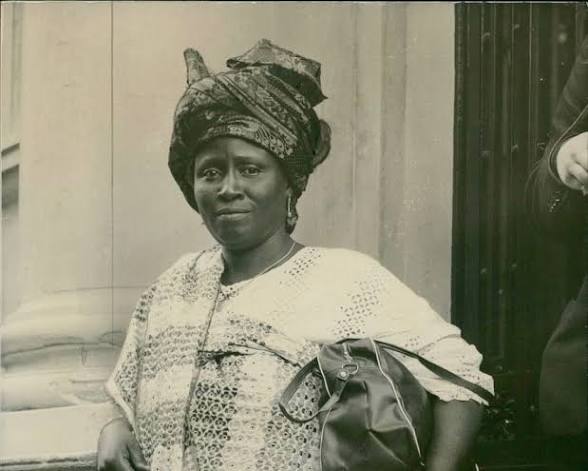
On July 30, 1953, outside Carlton House Terrace in London, a defining moment in Nigeria’s path to self-governance unfolded. Amidst the predominantly male delegation negotiating the nation’s constitutional future, Tanimowo Ogunlesi stood apart. As the sole woman advising the powerful Action Group, her presence underscored a unique path to political influence.
Her journey to that London photograph was not through traditional political ascent. It began quietly, in classrooms and women’s associations, far from the formal corridors of colonial power. Ogunlesi’s story reveals how foundational work in social welfare and education can profoundly shape a nation’s political trajectory, providing a crucial insight into how real influence often blossoms from the ground up.
Teacher Who Built Nigeria’s Early Path
Gladys Tanimowo Ogunlesi, born Gladys Okusanya on December 1, 1908, in Iperu, in present-day Ogun State, came of age during a period of expanding, yet unequal, educational opportunities. Her schooling, like many of her generation, was within the mission school network, which was slowly nurturing a new class of educated Nigerians.
She attended Saint James Primary School in Iperu and Kudeti Girls’ School in Ibadan, subsequently training as a teacher at the United Missionary College. By 1934, she was teaching at the CMS Girls’ Seminary in Lagos, the same year she married J. S. Ogunlesi, also an educationist.
For women in colonial Nigeria, teaching was more than a profession; it was a critical role in advancing female education at a time when opportunities for girls lagged behind those for boys. These early experiences provided Ogunlesi with a deep understanding of the systemic barriers facing young Nigerian women.
From Social Need to Political Action
Her return to Nigeria in 1947, following further studies in Britain, coincided with rising demand for education and persistent access inequalities. Children in rural areas, especially girls, faced significant hurdles. The lack of safe and affordable accommodation often meant formal education was simply out of reach, regardless of a girl’s academic ability or a family’s willingness to support her schooling.
Ogunlesi’s response was remarkably practical. She established the Women’s Improvement Society (WIS) in Ibadan in 1947, directly addressing women’s welfare and girls’ education. This was followed in 1948 by the founding of the Children’s Home School in Ibadan, initially operating from her own residence. This pioneering institution served as both a school and a boarding facility, breaking down critical barriers for girls from distant towns.
The Children’s Home School quickly became more than just a classroom. It symbolized a holistic approach to education, recognizing that learning required not just instruction but also a safe environment and a place to stay. This ground-level institution-building laid the foundation for her broader political engagement, demonstrating a tangible model for empowerment.
Her method of tackling educational disparity provided a practical example of how social challenges could be overcome through direct action, setting the stage for a more direct engagement with colonial institutions.
Entering the Political Arena
The late 1940s and early 1950s marked a period of intense political transformation in Nigeria. Nationalist movements gained momentum, political parties like the Action Group were forming, and constitutional reforms were expanding Nigerian participation in governance. Women were central to this dynamic, organizing through various associations, from market groups to professional networks.
Ogunlesi became a founding figure in the women’s section of Obafemi Awolowo’s Action Group. This was a strategic move; political parties needed to extend their reach beyond male leadership, and women’s organizations offered a crucial conduit to communities and households. Her involvement placed her squarely at the intersection of education, women’s advocacy, and emerging party politics, expanding her activism beyond Ibadan to Nigeria’s constitutional future.
Her role was not merely symbolic. She became an adviser to the Action Group contingent at the Nigerian Constitutional Conference in London in July 1953. The official British parliamentary record from July 27, 1953, lists her among the advisers, distinguishing her from the principal delegates. This position, as the only woman among the Action Group advisers, highlights the depth of her influence within the delegation.
Her participation ensured that women’s concerns, particularly regarding education and political rights, were represented at the highest levels of national deliberation. The iconic photograph of her in Nigerian dress outside Carlton House Terrace on July 30, 1953, captured this powerful moment: a Nigerian woman in the British capital, actively shaping the future of her nation.
This public presence, rooted in years of dedicated work, illustrated the growing international reach of Nigerian women’s activism. It connected local concerns with global dialogues on women’s rights. For instance, in 1954, she represented the Women’s Improvement Society at an International Alliance of Women conference in Copenhagen, demonstrating the evolving nature of Nigerian identity abroad.
A Lasting Legacy of Women’s Empowerment
Ogunlesi’s influence extended to unifying disparate women’s groups across Nigeria. Recognizing the need for a coordinated national platform, she became instrumental in the development of the National Council of Women’s Societies (NCWS). This umbrella organisation emerged in 1958 as a national platform for women’s organisations, with Kofoworola Ademola serving as its first president. Ogunlesi later became president of the organisation herself in 1959.
This development was a critical shift, transforming fragmented local efforts into a powerful, coordinated national movement capable of advocating for women’s political representation and voting rights. Her work ensured that even as Nigeria transitioned to independence on October 1, 1960, the institutional framework for women’s collective action was firmly in place.
Her commitment to education also endured beyond the political upheavals of the First Republic and the onset of military rule. In February 1966, she founded Christ’s High School in Ibadan, a secondary school offshoot of her initial Children’s Home School. This resilience underscores a profound truth: while political offices are transient, institutions that serve fundamental societal needs, like education, often provide a more enduring legacy.
Tanimowo Ogunlesi’s life, which spanned from her birth in 1908 to her passing in 2002, mirrored the vast transformations of Nigeria itself. She lived through colonial rule, the nationalist struggle, independence, and military regimes, consistently adapting her strategies but never wavering from her core commitment to women and girls.
The Insight: Groundwork Transforms Governance
Tanimowo Ogunlesi’s career offers a clear insight into how governance is truly shaped. Her story teaches us that profound political change isn’t solely forged in constitutional debates or parliamentary chambers. It is often built brick by brick, in the foundational work of educating a population and organizing communities to address their own needs.
By focusing on girls’ education and social welfare, Ogunlesi empowered a generation, providing them with the tools necessary for future political participation. Her activism demonstrates that preparing citizens to engage meaningfully in society—especially those historically marginalized—is a potent form of governance itself. This long-term investment in human capacity ultimately exerts more lasting influence on a nation’s trajectory than any single political negotiation or policy pronouncement.
