




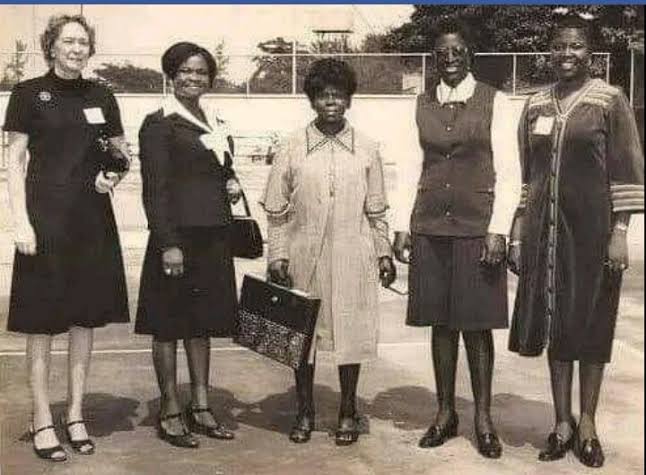
On 12 April 1995, Rosaline Ajoke Omotosho(Middle) made history, becoming Nigeria’s first female Chief Judge when she assumed the top judicial office in Lagos State. Yet, her story is far more than a single groundbreaking appointment; it is a five-decade narrative woven into the very fabric of Nigeria’s evolving legal and administrative landscape.
Her path to the pinnacle of the Lagos judiciary began not with a sudden ascent, but with a patient, methodical progression through various levels of government service and legal practice, shaping institutions as much as she was shaped by them.
Rosaline Omotosho’s Journey From Clerk to Legal Pioneer
Omotosho’s professional life started in an unexpected place, far removed from the marbled halls of justice. In 1949, she joined the Lagos Health Department as a clerk. This was a critical era, with Nigeria still under British colonial rule and Lagos serving as a bustling hub of both administration and commerce.
For a young woman seeking a professional career at that time, government employment offered one of the few established avenues into administrative work. Omotosho remained in this clerical role until 1953, laying the foundational administrative experience that would underpin her later legal career.
From Colonial Service to Independent Bar
Several years after her initial government service, Rosaline Omotosho made the pivotal decision to pursue law. She travelled to London, immersing herself in legal studies at Gray’s Inn between 1957 and 1959. This period marked a crucial personal transformation, equipping her with the formal legal qualifications needed for her ambitions.
She was called to the English Bar on 7 February 1961, and just four months later, on 15 June 1961, she was enrolled as a legal practitioner in Nigeria. Her return coincided with a momentous period in the nation’s history, as Nigeria had gained its independence on 1 October 1960.
She was stepping into a country just beginning to forge its own legal identity, though still heavily influenced by colonial institutions.
The legal system she encountered still bore strong British imprints, but a new generation of Nigerian lawyers was actively integrating into the newly independent state’s institutions. Omotosho quickly became a part of this emerging legal framework, not just observing it, but actively contributing to its shape.
Building a Career in Federal Justice
Upon her return to Nigeria, Omotosho briefly practiced with the law firm Burke and Impey. However, her true calling seemed to lie in public service. In September 1961, she joined the Federal Ministry of Justice as a Pupil Crown Counsel, marking the beginning of an extensive tenure in government legal work.
Her progression within the Ministry was steady and deliberate. She was appointed State Counsel in 1963, rising to Senior Legal Assistant by 1965, and then State Counsel Grade I in 1966. These roles gave her an intimate understanding of the legislative and administrative machinery of government, which was undergoing significant changes during this period, including the tumultuous era of Nigeria’s First Republic.
As the years passed, her responsibilities broadened, leaning more towards administrative oversight. In 1968, she served as Acting Deputy Administrator General, and later as Acting Registrar of Commercial Legislation. By 1976, her dedication and expertise earned her the position of Director of Commercial Law.
This phase of her career reveals a critical aspect of her development. Long before she ascended to the bench, Omotosho was deeply embedded in the intricate legal apparatus of the government. Her work involved crafting legislation, managing administrative processes, and interpreting the legal frameworks governing commercial affairs.
She wasn’t merely learning to argue cases; she was becoming an integral part of the system she would eventually be tasked with overseeing.
The High Court and Historic Appointment
On 6 March 1978, Rosaline Omotosho’s career took another significant turn with her appointment to the High Court of Lagos State. By this point, women were gradually making inroads into Nigeria’s judiciary; Justice Modupe Oladunni Omo Eboh had become Nigeria’s first female High Court judge in 1969, and Justice D.E.A. Oguntoye was the first woman appointed to the Lagos State High Court.
However, Omotosho’s eventual achievement would distinguish itself not by being the first woman to become a judge, but by being the first to lead a Nigerian state judiciary.
For nearly two decades, she served diligently as a High Court judge, presiding over cases in a Lagos that was rapidly expanding as a commercial and administrative epicentre.
The city’s courts navigated a complex array of disputes involving property, business, family matters, and government affairs, providing her with invaluable, practical experience within the institution she was destined to lead.
The culmination of her decades-long journey arrived on 12 April 1995, when Rosaline Omotosho was appointed Chief Judge of Lagos State, succeeding Justice Ligali Ayorinde.
This appointment was more than a ceremonial elevation; the Chief Judge was not only responsible for judicial duties but also for the critical administration and leadership of the state’s High Court.
She reached this pinnacle after decades of rigorous dedication to her profession and the public service, a period that included navigating the political shifts and military leadership that defined much of Nigeria’s post-independence history.
A Short Tenure, A Lasting Impact
Despite the historical significance of her appointment, Rosaline Omotosho’s tenure as Chief Judge was remarkably brief. She left office on 27 February 1996, less than a year after taking the oath, succeeded by Justice Olusola Olatunde Thomas. Her short period in the role did not, however, diminish the monumental impact of her achievement.
The barrier had been broken. A woman had occupied the highest judicial office in a Nigerian state, irrevocably changing the perception of who could hold such a position. The office could never again claim it had not been held by a woman, establishing a new precedent for future generations of female legal professionals.
Moreover, during her historic, albeit brief, time as Chief Judge in 1995, Omotosho was associated with an important, lesser-known project: the nascent efforts of the Negotiation and Conflict Management Group (NCMG). This initiative brought together lawyers and professionals keen on developing alternative dispute resolution methods like negotiation, mediation, and arbitration, proposing a different route for settling conflicts outside conventional courtrooms.
She was part of the NCMG’s early Board of Governors, alongside prominent legal and professional figures such as Justice Kayode Eso, Gamaliel Onosode, Arthur Mbanefo, Tunji Olurin, Itse Sagay, and Isabella Okagbue.
While she did not establish the Lagos Multi-Door Courthouse herself—that institution was eventually created in 2002 under Chief Judge Ibitola Sotuminu—her involvement signified her forward-thinking approach to justice.
It underscored her commitment to improving the legal system, even in the final months of her career, by exploring mechanisms that could make justice more accessible and efficient for all.
A Legacy Beyond a Single Title
Sadly, Rosaline Omotosho did not live to see the full fruition of the alternative dispute resolution movement she had been part of. She passed away on 1 July 1999, almost three years before the Lagos Multi-Door Courthouse was officially established.
Her death came mere weeks after Nigeria’s return to democratic rule on 29 May 1999, marking the close of a professional life that had spanned colonial administration, the early years of independence, periods of both civilian and military governments, and the dawn of the Fourth Republic.
More than a decade after her passing, Lagos State formally recognized her enduring contributions. In 2015, a courthouse in Ikeja was named the Rosaline Omotosho Courthouse, a fitting tribute to a career so deeply intertwined with the Lagos judiciary. But the building’s name, while honouring her, only captures a fraction of her journey.
It hints at her importance but does not reveal the almost fifty years of dedicated service: her beginnings as a clerk in 1949, her legal education in Britain before independence, her long and impactful years in the Federal Ministry of Justice, or her nearly two decades on the Lagos High Court bench before becoming Chief Judge.
And it certainly doesn’t convey her quiet advocacy for alternative dispute resolution during her historic year in leadership.
Insight: The Enduring Power of Sustained Dedication
Rosaline Omotosho’s life demonstrates that true influence and leadership are rarely the product of a single event or a fleeting moment of recognition. Her story, often simplified to the singular fact of being Nigeria’s first female Chief Judge, is actually a powerful testament to the value of sustained dedication.
She didn’t just break a barrier; she built a foundation of experience, expertise, and institutional knowledge over nearly half a century. Her journey illustrates how deeply embedded contributions—the quiet work of administration, the patient climb through legal ranks, the consistent engagement with evolving legal frameworks—are often the real engines of lasting change.
Her career shows that monumental achievements are frequently the natural outcome of a persistent commitment to craft and public service. It teaches us that enduring leadership emerges from a deep understanding forged through decades of work. This commitment to the long game, even more than her historic “first,” is the profound learning her legacy offers to Nigeria today.
