



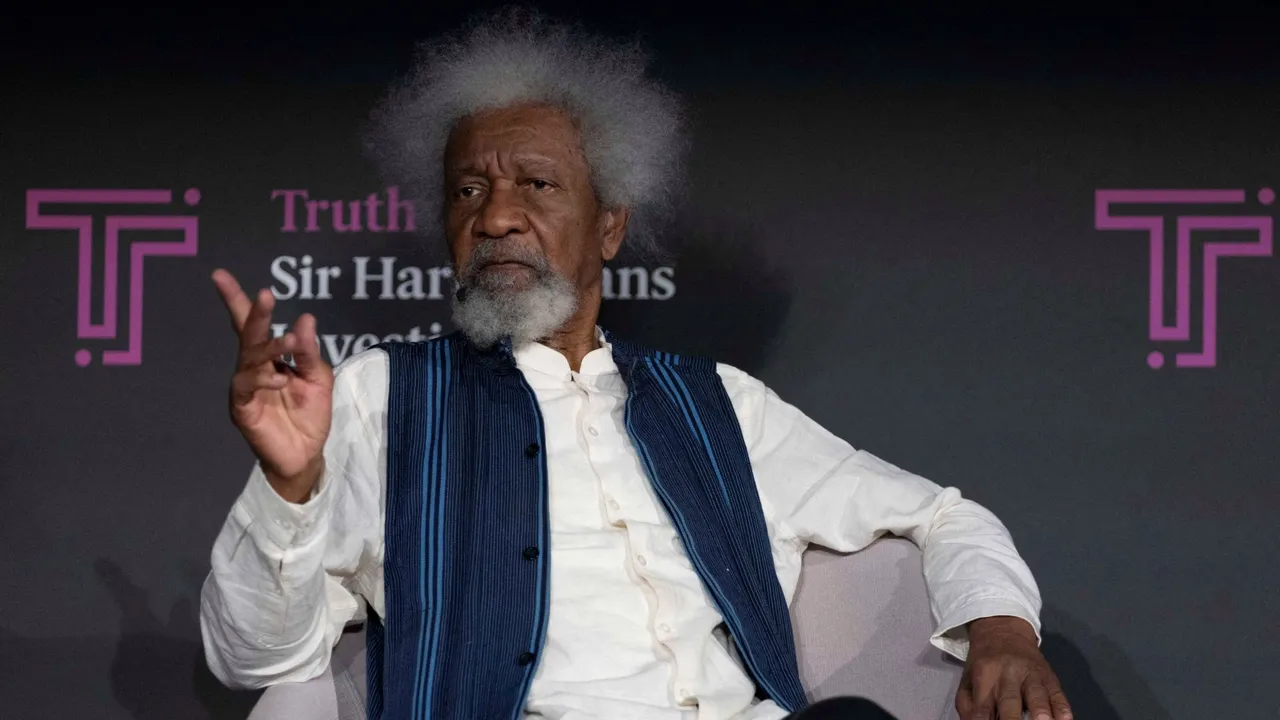
The air hung thick with expectation at Kongi’s Harvest Gallery in Lagos, a scene now overshadowed by the news that Nobel laureate Wole Soyinka has had his US visa revoked.
The notification from the US consulate in Lagos arrived just days before, on October 23, 2025. It was, as Soyinka wryly dubbed it, a “rather curious love letter from an embassy,” instructing him to surrender his passport for the physical annulment of his visa.
Wole Soyinka’s US visa revocation sparks debate
This seemingly personal slight against a global icon quickly exploded into a broader debate about American immigration policies, affecting everyone from celebrated academics to hopeful fans eager to attend the 2026 World Cup.
US authorities offered a reason as vague as it was unsettling: “the emergence of new information” or “additional information became available” after the visa’s initial issuance. This opaque explanation left a void that Wole Soyinka himself was quick to fill with his sharp, characteristic wit and pointed speculation.
He suggested the decision stemmed directly from his unvarnished criticisms of the US administration, particularly his comparison of then-President Trump to the notorious Ugandan dictator, Idi Amin. “When I called Donald Trump ‘Idi Amin in white face,’ I thought I was paying him a compliment,” Soyinka quipped, his words slicing through diplomatic niceties and laying bare the raw political tension.
The letter from the consulate, later seen by Agence France-Presse, cited US State Department regulations that grant consular officers wide discretion. These rules permit officials to revoke a nonimmigrant visa “at any time, in his or her discretion.” It’s a legal power that offers little solace or clarity when applied to such a high-profile case.
For his part, Soyinka remains unfazed. “I want to assure the consulate … that I’m very content with the revocation of my visa,” he told the news conference. He made it clear he wouldn’t be applying for a new one, saying simply, “there’s nothing I’m looking for there. Nothing.”
The ghost of Trump’s America
This isn’t Soyinka’s first public act of defiance concerning US immigration policy. Back in 2016 or 2017, following Donald Trump’s election, the author famously destroyed his US Green Card, which had granted him permanent residency. He declared then that he was “no longer part of the society” as a resident.
He humorously explained that his green card “had an accident” and “fell between a pair of scissors.” That symbolic gesture served as a powerful protest against the immigration policies championed by the Trump administration, foreshadowing the current confrontation over his Wole Soyinka visa status.
Echoes of a lifelong battle for freedom
Wole Soyinka’s life has been a relentless pursuit of truth and justice, a legacy that began long before his 1986 Nobel Prize in Literature, making him the first African recipient. His sharp intellect and unwavering voice have consistently challenged tyranny, whether at home or abroad.
During the brutal Nigerian Civil War from 1967 to 1969, Soyinka was imprisoned for 22 months for daring to appeal for a ceasefire. His harrowing experience behind bars became the raw material for his autobiographical work, “The Man Died: Prison Notes,” a searing indictment of state power.
He’s been a constant thorn in the side of corrupt governments, criticizing Nigerian administrations and dictators like Sani Abacha with equal ferocity. His academic career has seen him hold prestigious visiting professorships at institutions like Harvard and Cornell, making him a bridge between African intellectual thought and Western academia.
When cultural exchange clashes with policy
Soyinka views the visa cancellation as far more than a personal inconvenience. “This is not merely personal; rather, it strikes at the core of freedom of movement and open cultural communication between nations,” he stressed. He warned that “such restrictive measures could jeopardize the future of international academic and cultural cooperation.”
He spoke not just for himself, but for the voiceless. “This is not about me,” he insisted, recalling the plight of others. “When we see people being picked off the street – people being hauled up and they disappear for a month … old women, children being separated. So that’s really what concerns me.”
World Cup visa hurdles and a wider pattern
This incident with a literary icon isn’t an isolated one; it slots into a growing pattern of US visa complications, particularly for Africans. Many across the continent have voiced frustration over difficulties securing visas for various purposes, including fans and delegations hoping to attend the 2026 World Cup.
The obstacles faced by prospective World Cup attendees, especially those from African nations, have drawn significant international criticism. It’s a stark reminder that bureaucratic hurdles, or perceived systemic bias, can impact everything from cultural exchange to international sporting events, cutting off opportunities and fostering resentment.
For many, this isn’t just about football tickets; it’s about perceived discrimination and the constant, disheartening bureaucratic walls. The challenges faced by individuals seeking US entry extend beyond high-profile figures, touching ordinary citizens who simply want to travel, study, or support their national teams.
A familiar bureaucratic wall
When asked for clarification, the US embassy in Abuja, Nigeria, reverted to the standard diplomatic line. They stated they couldn’t comment on individual cases, citing confidentiality rules. This official silence, while predictable, often leaves a vacuum for speculation and only deepens public frustration.
It’s a recurring pattern where a lack of transparency fuels concerns about arbitrary decisions, creating an environment of uncertainty for those seeking entry to the United States. This opacity only serves to reinforce the narrative of a system that can be difficult to understand or influence.
The unchanging fight for dignity
Soyinka, ever the artist, even quipped about penning a play about Donald Trump, much like he did with Idi Amin, turning political adversity into creative fuel. His refusal to chase a new visa underscores a profound message: dignity and principled stand often outweigh personal convenience.
His defiant spirit against the US visa revocation is more than a personal act; it’s a historical echo. For generations of Nigerians and Africans, the struggle against external forces dictating movement, expression, and autonomy has been a constant.
The form changes – from colonial powers to Cold War politics, to modern immigration policies – but the fundamental fight for dignity remains. The past, as Soyinka’s current crisis shows, is not merely history; it is a living, breathing force in every headline, challenging us to look deeper than the surface of today’s news.
