




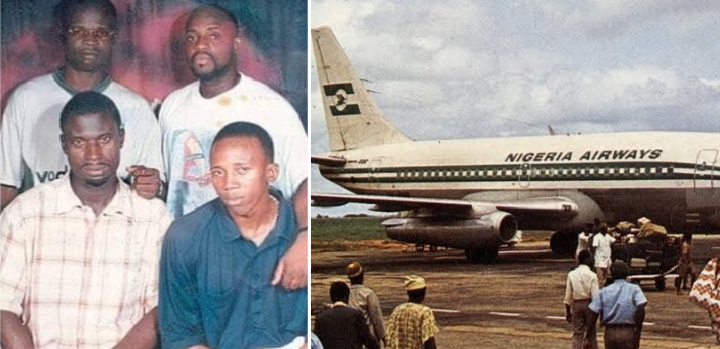
On October 25, 1993, four young Nigerians seized control of Nigeria Airways Flight WT470 during its routine journey from Lagos to Abuja, turning the flight into an international crisis.
Richard Ajibola Ogunderu, then just 19, along with Kabir Adenuga, Kenny Rasaq Lawal, and Benneth Oluwadaisi, boarded the Airbus A310, named Rima River, at Murtala Muhammed Airport. Their objective was clear: use the aircraft as a dramatic stage to force global attention onto Nigeria’s deepening political turmoil.
Nigeria Airways Flight and June 12 discontent
Nigeria in 1993 was a nation gripped by political uncertainty, reeling from the annulment of the June 12 presidential election. Moshood Abiola was widely believed to have won that election, but the military regime under General Ibrahim Babangida nullified the results, plunging the country into a crisis.
Babangida eventually stepped down in August, yielding to an Interim National Government led by Ernest Shonekan. Yet, this transition offered little stability; military influence remained pervasive, and public discontent simmered, particularly among younger Nigerians who felt disenfranchised.
The hijackers saw an extreme act as their only recourse to amplify their voices. They believed ordinary political pressure was failing, so they opted for a highly visible stunt designed to capture international headlines and highlight the injustice of the annulled election and other national grievances. Their destination was not Abuja, but Frankfurt, Germany, a symbol of European democracy and media attention.
The Decision: Petrol as a Pervasive Threat
The hijackers’ plan hinged on a calculated psychological advantage rather than brute force. They boarded Flight WT470 with an array of items: lighters, tear gas, jackknives, and what Richard Ogunderu later described as toy guns. These imitation firearms served to establish immediate control, creating the impression of armed authority among unsuspecting passengers and crew.
However, the actual power of their threat resided in the containers of petrol they had smuggled onto the aircraft. While a passenger might, in extreme circumstances, doubt the authenticity of a gun, the flammable liquid left no room for uncertainty. Everyone on board understood the catastrophic potential if that petrol was ignited within the confined space of the aircraft cabin.
This stark contrast between a reportedly fake weapon and a very real, common substance formed the crux of their strategy. The guns created initial fear, but the petrol provided a tangible, immediate consequence, turning the aircraft into a pressure cooker where the threat of fire became the ultimate deterrent.
The very ordinariness of petrol, an everyday item for Nigerians, transformed into a potent instrument of leverage. It was not advanced military technology or explosive devices; it was fuel, weaponized by its context and the hijackers’ willingness to threaten its use. This simple material gave them immense psychological control over hundreds of lives.
The ability to transport such prohibited materials through airport security at Murtala Muhammed Airport also exposed critical vulnerabilities. Ogunderu’s later accounts detailed how they concealed these items, pointing to significant weaknesses in screening procedures of the era. The incident laid bare how a lack of stringent security could render even a modern aircraft highly susceptible to low-tech threats.
The Consequence: A Standoff in Niamey
The immediate fallout of the hijacking was a terrifying standoff. The hijackers' primary leverage—the threat of immolating the aircraft—ensured that their demands had to be taken seriously. Authorities were not merely negotiating for the escape of four individuals; they were working to prevent the destruction of a passenger jet and the loss of all on board.
Paradoxically, the hijackers soon faced their own fuel problem. Flight WT470, a domestic route, lacked the aviation fuel necessary to reach Frankfurt. This forced them to seek a refuelling stop, leading the aircraft to land at Diori Hamani International Airport in Niamey, Niger. This unexpected diversion profoundly altered the dynamics of the crisis.
Once on the ground in Niamey, the hijackers’ mobility vanished. The aircraft was now stationary, surrounded by Nigerien authorities who had time to strategize and prepare a response. This change in location allowed for negotiations to commence, and many passengers, including Chinese Vice President Rong Yiren, were gradually released, though a smaller group remained captive.
The longer the crisis dragged on, the more precarious the hijackers’ position became. Their initial goal of reaching Europe was thwarted, and their control over the situation steadily eroded. Yet, the threat of petrol remained potent, making a prolonged wait by authorities incredibly risky. The cabin remained a vessel of potential disaster, with the remaining hostages acutely aware of the danger.
The standoff lasted approximately four days. On 28 October 1993, Nigerien security forces moved in, storming the aircraft. The operation ended the hijacking, with the four men captured, though Ogunderu sustained injuries. Tragically, assistant purser Ethelbert Nwanze Igwe was killed during the rescue operation, a grim reminder of the real human cost.
This violent conclusion underscored that even an unignited fuel threat could escalate to deadly force. The crisis itself, fueled by the petrol’s potential, necessitated an armed intervention, demonstrating how perceived catastrophe can drive real-world, tragic outcomes. This mirrors how broader political instability, such as that stemming from the annulment of Nigeria’s elections, often creates conditions where extreme actions become possible.
The Lingering Shadow: Security Failures and Political Aftermath
The incident shone a harsh light on glaring inadequacies in airport security at the time. The ease with which the hijackers, young and seemingly unsophisticated, managed to smuggle flammable liquids and other prohibited items onto a commercial flight was astonishing. This failure allowed an ordinary substance to become an extraordinary weapon, bypassing the very systems designed to protect air travel.
For the hijackers, the consequences were years of imprisonment in Niger. They would not return to Nigeria until 2002, spending more than nine years behind bars. By then, the political landscape they had sought to influence had been utterly transformed, a stark illustration of how individual acts, however dramatic, can be dwarfed by the currents of national history.
Weeks after the hijacking, General Sani Abacha seized power in Nigeria, establishing a military dictatorship that lasted until his death in 1998. Moshood Abiola, whose democratic mandate had been the hijackers’ rallying cry, died in custody in 1998 without ever claiming his victory. Nigeria eventually returned to civilian rule in 1999, but the nation’s political trajectory had been irrevocably altered.
The hijackers returned home to a Nigeria vastly different from the one they had left. Their drastic measure to highlight the June 12 injustice ultimately contributed to a period of intense military rule, rather than immediate democratic resolution. It proved how acts of rebellion, even those born of genuine grievance, can sometimes lead to unforeseen and undesired political outcomes.
The ability of a few individuals to disrupt national and international operations by exploiting security gaps remains a critical lesson. This episode, alongside other instances where public discontent was weaponized, offers a powerful perspective on how vulnerabilities in a system can be magnified by seemingly small, yet strategically deployed, elements.
Consider the impact of figures like the preacher Maitatsine, whose influence stemmed from similar social disaffection.
Insight: The Potency of Perceived Catastrophe
The Nigeria Airways Flight WT470 hijacking of 1993 provides a piercing insight into the psychology of fear and the true nature of leverage in conflict. It was not the toy guns, which were reportedly fake, but the very real petrol that gave the hijackers their terrifying power.
The guns created an initial illusion of force; the petrol presented a concrete, catastrophic potential that no one could ignore.
This incident teaches that the potency of a threat often lies not in its immediate physical power, but in the perceived consequences of its deployment. The confined space of an aircraft amplified the danger of petrol, transforming an ordinary substance into an ultimate bargaining chip. It became a silent weapon, constantly signaling the possibility of unimaginable destruction.
This dynamic extends beyond a single hijacking. In governance, genuine insight comes from understanding how perceived vulnerabilities and the specter of severe outcomes can be manipulated to control populations or achieve political ends. Governments themselves often rely on demonstrating the catastrophic consequences of dissent or instability to maintain order.
The Flight WT470 crisis demonstrates that true power can reside in the potential for disaster, making the psychological impact of a threat more formidable than overt displays of force. In Nigeria today, this lesson resonates in how various groups or individuals leverage perceived societal weaknesses, whether economic, social, or political, to exert influence.
It’s a timeless truth: the fear of what could happen often dictates actions far more than what is happening.
