




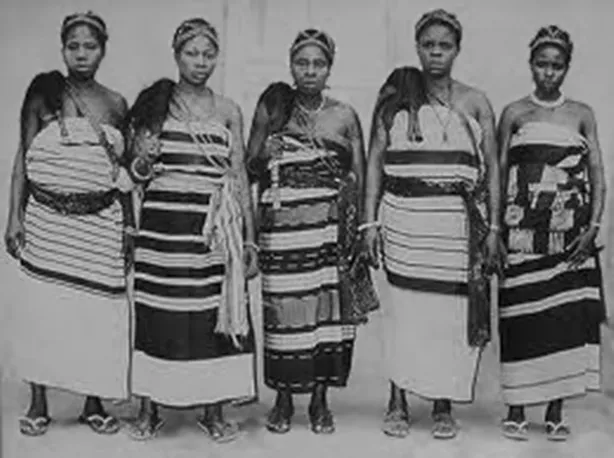
On December 16, 1929, a trader named Adiaha Edem Udo Udoma stood before an armed colonial officer in Ikot Abasi. She had no uniform, no title, and no weapon. What she had was the collective anger of thousands of women whose economic lives were under threat, leading to what became known as the Women’s War of 1929.
In the chaos that followed, Udo Udoma did something that passed into legend: she reportedly seized the officer’s rifle, a symbol of colonial force, and broke it in two.
The context of the Women’s War of 1929: A system built on flawed assumptions
This single act of defiance, which cost Udo Udoma her life, was not an isolated incident. It was the boiling point of a widespread revolt against a system of governance that fundamentally misunderstood the people it sought to rule.
The story of the 1929 Women’s War is not just about a riot; it’s a lesson in how flawed policy, when it strikes at the economic heart of a community, can provoke a powerful and organized response from those the state assumes are powerless.
To understand the fire of 1929, one must first understand the structure of British colonial rule in southeastern Nigeria. The administration governed through a system of “indirect rule,” appointing local “Warrant Chiefs” to enforce its policies, collect taxes, and preside over Native Courts.
The British assumed these men held traditional authority, but in many Igbo and Ibibio communities, power was more diffuse and consensual. These appointed chiefs, often lacking genuine legitimacy, became symbols of a foreign and oppressive government.
This system created deep resentment, laying the groundwork for conflict. The Warrant Chiefs were often seen as corrupt, using their colonial backing to seize property and imprison people unjustly. This structure was one of many colonial institutions that created rivalry and undermined existing social orders.
The colonial government was not just an abstract entity; its power was felt directly through the actions of these local agents.
Into this fragile environment, the British introduced direct taxation for men, which was already a source of friction. In 1929, rumours began to circulate that the policy would be extended to women. For the women of southeastern Nigeria, this was not merely a new tax. It was a direct assault on their economic autonomy.
In these societies, women were formidable economic actors—traders, farmers, and leaders of powerful market networks. They enjoyed a degree of independence built on commerce, and the market was the centre of their social and political world.
The prospect of colonial officials counting their livestock and taxing their trade was an existential threat. The issue was not just money, but authority. Who had the right to enter their homes, assess their property, and demand a share of their livelihood?
The women saw the policy for what it was: an attempt by a distant, unaccountable government to assert control over their lives and labours. Their response would show the colonial administration the severe limits of its power.
The decision: A policy of extraction meets organised resistance
The British colonial administration’s decision to explore the taxation of women was driven by a simple logic: the need for revenue to fund the colonial state. From their perspective in administrative centres, it was a bureaucratic exercise in expanding the tax base. They failed to appreciate that they were not writing on a blank slate.
They were intervening in a complex, self-regulating economic and social system that they did not control.
The women’s decision to resist was not a spontaneous outburst of anger. It was a coordinated political action that leveraged their existing networks. News of protests travelled swiftly from one market to another.
Women organised mass demonstrations, using traditional methods of protest like sitting on a man’s property, singing songs of ridicule, and demanding the surrender of the Warrant Chiefs’ caps, the symbol of their colonial-derived authority. What officials saw as “riots,” the women themselves called a “war”—a term reflecting the seriousness of their purpose.
The movement spread rapidly across the region, from Owerri to Aba and Calabar provinces. At Ikot Abasi, then known as Egwanga Opobo, the confrontation reached its deadliest point. On December 15, women had already destroyed the local Native Court building. The following day, thousands gathered to confront the District Officer, A. R.
Whitman, and a detachment of troops under Captain J. Hill. They came to make their demands known, not to incite violence.
The colonial officials, however, saw an unruly mob challenging the authority of the British Empire. The meeting collapsed into chaos. The decision that followed was made not with words, but with weapons. Colonial troops opened fire on the protesting women.
It was in this moment of state-sanctioned violence that Udo Udoma, a successful trader in soap and kerosene, made her final stand, transforming from a market leader into an enduring symbol of resistance.
The consequence: A massacre and a forced reckoning
The immediate consequence of colonial troops opening fire was a massacre. Colonial troops shot into the crowd of unarmed women. When the firing stopped, 31 women and one man lay dead on the grounds and waterfront at Ikot Abasi; another 31 women were wounded. Udo Udoma was among those killed. Her act of defiance was her last.
The violence at Ikot Abasi and other locations sent shockwaves through the colonial administration. The scale and organisation of the Women’s War were something the British had not anticipated. They had fundamentally underestimated the political capacity of women they had excluded from all formal structures of power. The uprising was a bloody and undeniable demonstration that governance by force and flawed assumptions was unsustainable.
In the aftermath, London was forced to act. A formal Commission of Inquiry was established in 1930. The commission’s report was a stunning indictment of the colonial government’s own system. It documented the deep-seated grievances against the Warrant Chiefs and acknowledged the women’s legitimate fears over taxation.
The historical narrative preserved in colonial records and official reports, while often biased, could not hide the administrative failure.
The most significant consequence was a change in policy. The plan to tax women was abandoned. The government also began a process of administrative reform, attempting to restructure local governance to be more aligned with traditional institutions.
The Women’s War forced the colonial state to look beyond its handpicked chiefs and recognise that real power also lay in the markets, farms, and women’s associations it had ignored.
The insight: Economic autonomy is the root of political power
The story of the 1929 Women’s War teaches a clear lesson about governance: political power does not flow exclusively from the state and its formal institutions. It often emerges from the organized defence of economic life.
The women who marched on Ikot Abasi were not simply rioting against a tax; they were asserting their right to exist as independent economic actors, free from the arbitrary interference of a government they did not choose.
Udo Udoma was not a political radical in the modern sense. She was a business owner. Her power came from her success as a trader and her standing in the community that her trade supported.
When the colonial government’s policy threatened the foundation of that economic life, she and thousands like her translated their economic influence into political force. They demonstrated that a government that fails to understand or respect the economic foundations of its people’s lives will eventually face their organized resistance.
This dynamic remains true today. When policies are made in distant capitals without regard for the livelihoods of those they affect, they invite instability. The Women’s War is a powerful reminder that any system of governance, whether colonial or independent, ultimately rests on the consent of the governed.
And that consent is often withdrawn the moment the state threatens the people’s ability to provide for themselves and their communities.
