



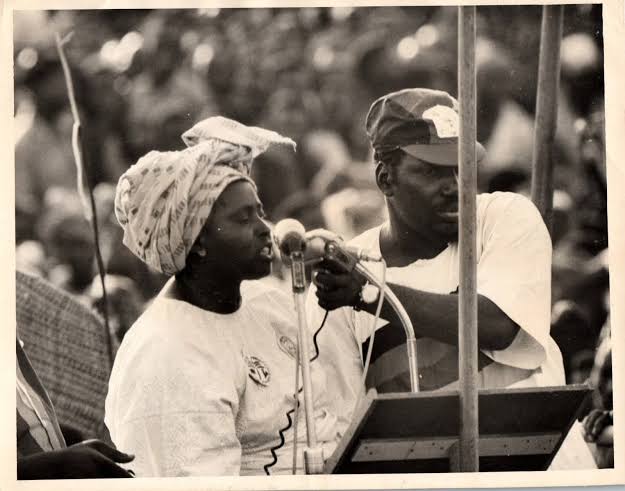
In 1964, as Nigeria’s First Republic teetered, Hannah Idowu Dideolu Awolowo stepped into the tumultuous political arena.
This audacious plan unfolded against a backdrop of deep national division, revealing the often-hidden mechanisms of power and influence during a national crisis. It also underscored the significant, albeit often unacknowledged, role women played in sustaining political movements when their male counterparts were sidelined.
Hannah Awolowo political strategy and her partner
Before the crisis that engulfed her family, Hannah Idowu Dideolu Awolowo had already established herself as a formidable presence. Born on November 25, 1915, in Ikenne, present-day Ogun State, she was a successful businesswoman.
Her ventures included being the first Nigerian distributor for the Nigerian Tobacco Company in 1957, alongside her pioneering work in textiles and lace importation. These commercial successes provided crucial financial stability, granting Obafemi Awolowo the freedom to pursue his political and intellectual ambitions.
Obafemi Awolowo, whom she married on December 26, 1937, was a political colossus. He had served as the first Premier of the Western Region from 1952 to 1959 and later became the Leader of the Opposition in the federal parliament.
His political vehicle, the Action Group, was a dominant force, championing regional autonomy and progressive policies. Their partnership was unique; while Obafemi commanded the formal political stage, Hannah cultivated vital community networks and provided access to less visible social resources, a division of labour historian Insa Nolte has noted.
An Audacious Plan to Restore Influence
The political landscape dramatically shifted in 1962 when the relationship between Obafemi Awolowo and Samuel Ladoke Akintola, then Premier of the Western Region, fractured. This internal strife within the Action Group escalated into a full-blown crisis. The federal government declared a state of emergency in the Western Region, leading to the arrest and prosecution of Awolowo and other party leaders.
On September 11, 1963, Obafemi Awolowo was convicted of treasonable felony and sentenced to ten years in prison, effectively removing him from active political life. It was in this vacuum that Hannah Awolowo conceived her extraordinary plan.
The idea was simple yet radical: she would contest the federal parliamentary seat in Remo, her husband’s traditional political base. Should she win, she would then resign, triggering a by-election that, under more favourable circumstances, could allow Obafemi Awolowo to reclaim his seat upon release.
This was not merely an act of spousal loyalty but a calculated political manoeuvre to keep his legacy alive and maintain a foothold in the political structure.
Her candidacy was a direct challenge to the forces that had imprisoned her husband. It served as a rallying point for the Awolowo loyalists, who had coalesced with other opposition groups to form the United Progressive Grand Alliance (UPGA). This alliance, which included the National Council of Nigeria and the Cameroons (NCNC) led by Dr.
Michael Okpara, stood against the Nigerian National Alliance (NNA), which comprised the Northern People’s Congress and Akintola’s Nigerian National Democratic Party.
The Tumultuous 1964 Election and Its Fallout
Hannah Awolowo’s campaign for the Remo federal parliamentary seat was set against the backdrop of the deeply polarised 1964 federal election. Her opponent was Prince Adeleke Adedoyin, a prominent Remo politician and lawyer representing the NNA. The contest was fierce, bringing together two powerful political networks in a local battle that reflected the broader national struggle for power.
However, the election was anything but conventional. The UPGA, to which Hannah Awolowo was allied, called for a nationwide boycott of the December 30, 1964, election, citing unacceptable electoral conditions. This placed Hannah in a precarious position. While her name was on the ballot, accounts vary on the extent of her direct participation.
Some argue she honoured the boycott, not campaigning in the traditional sense, while others portray her as the UPGA candidate in direct contest. The complexities of the boycott made it difficult to gauge true voter support.
Ultimately, Prince Adeleke Adedoyin was declared the winner of the Remo parliamentary contest. The Awolowo camp immediately rejected the legitimacy of the process, with family accounts suggesting Hannah Awolowo’s votes were suppressed and not properly counted. Oluwole Awolowo, her son, later affirmed the family’s belief that she had indeed won.
Regardless of the true popular sentiment, the official outcome dashed the hopes of securing a direct parliamentary route back for Obafemi Awolowo.
The result had implications far beyond a single parliamentary seat. It intensified the already fraught political dynamics in Remo, where local identity and traditional authority intertwined with party loyalties. The broader political instability continued, culminating in the violent Western Region election of 1965, which further destabilised the First Republic and ultimately contributed to its collapse with the military coup of January 15, 1966.
Insight: Sustaining Power Beyond the Walls of Office
Hannah Awolowo’s attempt to secure a parliamentary seat for her imprisoned husband, Obafemi Awolowo, offers a stark lesson: political power in Nigeria, particularly during crises, extends far beyond formal constitutional offices. It demonstrates that when direct access to governing structures is denied, influence can be sustained and even projected through dedicated proxies.
Her actions revealed the critical role of informal networks, family support, and community engagement in maintaining a political movement’s vitality, even when its leader is absent.
In Nigeria today, where political landscapes shift rapidly, the ability to activate and leverage such proxy influence remains a potent, if often unseen, force in shaping outcomes and ensuring legacies endure.
