




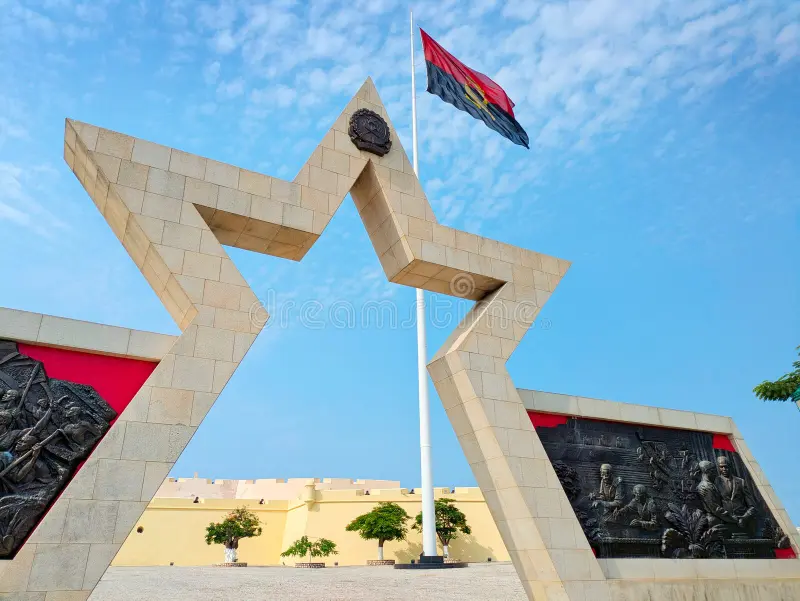
Perched high above Luanda Bay, Fortaleza de São Miguel stands as a monument to the Transatlantic Slave Trade, a history acknowledged but confronted in its full, devastating scale.
While European concentration camps are widely recognised symbols of human atrocity, the names of African slave forts remain largely unknown to many, obscuring a critical dimension of this global crime. Yet, in March 2026, the United Nations (UN) formally recognised the Transatlantic Slave Trade as the gravest crime against humanity, a long-overdue acknowledgement that underscores the profound, lasting impact of sites like São Miguel.
Ambition and the Founding of Fortaleza de São Miguel
The story of Fortaleza de São Miguel begins with Paulo Dias de Novais, the first Captain-Governor of Portuguese Angola and grandson of the renowned explorer Bartolomeu Dias.
Novais arrived in what is now Angola on February 11, 1575, leading an expedition of some 700 people with a clear mandate from the Portuguese crown: establish a colony, secure resources, and crucially, locate the fabled silver mines of Cambambe.
His ambition was not merely territorial; it was economic. The fort, initially named Fortaleza de São Paulo and constructed from rammed earth and adobe in 1576, quickly became the cornerstone of Portuguese colonial power in Central Africa. It offered a strategic vantage point over Luanda Bay, essential for controlling maritime traffic and defending against both rival European powers and local African kingdoms.
By 1627, the fort, then known as Fortaleza de São Paulo, had solidified its role as the administrative heart of the Portuguese colony, a testament to its strategic significance. Major reconstruction efforts began in 1638, replacing less durable construction with stone masonry, a project completed in 1689 under D. João de Lencastre.
After the Portuguese recaptured Luanda in 1648, Salvador Correia de Sá renamed it Fortaleza de São Miguel, further entrenching it as a symbol of colonial might and a central mechanism for resource extraction, including human beings.
The Engine of Enslavement
From the late 1500s through the mid-1800s, Fortaleza de São Miguel became an indispensable node in the vast, brutal network of the transatlantic slave trade. It wasn’t just a military outpost; it was a processing centre for human beings, an industrial-scale operation designed for colonial profit.
Captives, forcibly marched from deep within the interior of Africa, were funnelled towards Luanda. These were people from diverse ethnic groups including the Kongo, Ndongo, Mbundu, Ovimbundu, Lunda, and Chokwe. Their journeys often followed inland routes, such as the infamous Cuanza River corridor, passing through smaller forts like Massangano and Muxima, before reaching the coast.
At São Miguel, these men, women, and children faced registration, taxation, and imprisonment within the fort’s formidable walls. They were reduced to commodities, their identities stripped away before being loaded onto ships bound predominantly for Brazil, particularly the bustling ports of Bahia and Rio de Janeiro.
Governors resided within São Miguel’s ramparts, directing colonial policy and overseeing the horrific enterprise that transformed human lives into cargo manifests. African trade dynamics across the continent were irrevocably altered by this new, brutal commerce.
This systematic operation was immense. Between the 16th and 19th centuries, an estimated 2.8 million Africans departed from Luanda alone. From 1701 to 1800, specifically, some 899,707 Africans embarked from this port. During the latter half of the 18th century, Luanda averaged between 8,000 to 10,000 enslaved people shipped out annually, illustrating the relentless pace of this human trafficking.
The Unquantifiable Human Cost
The financial gains for the Portuguese crown and its merchants were immense, but the true cost of Fortaleza de São Miguel’s operation was paid in human lives and the fractured societies of Africa. Over “15 millions” African lives were claimed by the Transatlantic Slave Trade, though even this staggering figure is widely considered an underestimate by historians who point to its devastating demographic impact.
The fort symbolised not only Portuguese dominance but also the relentless, systematic dehumanisation of an entire continent. Among the most frequently traded ethnic groups were the Mbundu and Ndongo peoples, who faced constant raids and forced migration. Their resilience, however, was epitomised by figures like Queen Nzingha of Angola, who waged a near-century-long battle against Portuguese enslavement, demonstrating a fierce and enduring resistance.
The long-term consequences of this forced exodus are still palpable across Africa. Societies were destabilised, communities were torn apart, and generations of human capital were lost, severely impeding the continent’s development. This immense tragedy fuelled the economic engines of the New World, particularly in Brazil, while simultaneously creating deep scars in the collective memory and socio-economic fabric of Angola.
Despite the official abolition of the slave trade from Portuguese African possessions in 1836, the illicit trade persisted from alternative ports like Cabinda, Ambriz, and Loango well into the late 1860s. Slavery itself remained legal within the Portuguese empire until 1875, extending the shadow of this inhumane practice for decades beyond its supposed end.
Legacy and Lasting Insight
Today, Fortaleza de São Miguel stands transformed. After Angola gained its independence in 1975, the fort was converted into the Museum of the Armed Forces, or the National Museum of Military History. It houses exhibits documenting Angola’s colonial wars, its struggle for independence, and the devastating Angolan civil war, alongside displays of national heroes and military history.
Visiting this site in Luanda is to confront a past that is both painful and profoundly instructional. It is a space that bears witness to tears, exploitation, and immense suffering, but also to an enduring determination, strength, and resilience that shaped the Angolan nation.
The fort, recognized as a national monument in 1938 and included on UNESCO’s Indicative List of World Heritage in 1996, serves as a crucial reminder.
The enduring legacy of overlooked African slave forts like Fortaleza de São Miguel reveals a stark truth about how power operates. The scale and mechanics of the Transatlantic Slave Trade weren’t arbitrary; they were shaped by specific power structures and colonial ambitions, driven by economic incentives that ruthlessly commodified human lives.
Understanding this history, not as a distant relic, but as an active force that shaped societies and continues to influence contemporary narratives of accountability and reparations, is vital.
This Angolan fort offers a clear learning: historical amnesia regarding the immense human cost of colonial exploitation does not heal the past; it merely perpetuates its shadows. By reclaiming and confronting these difficult histories, we begin to understand the true price of ambition untethered from humanity, and the enduring strength of those who resisted its grasp.
