




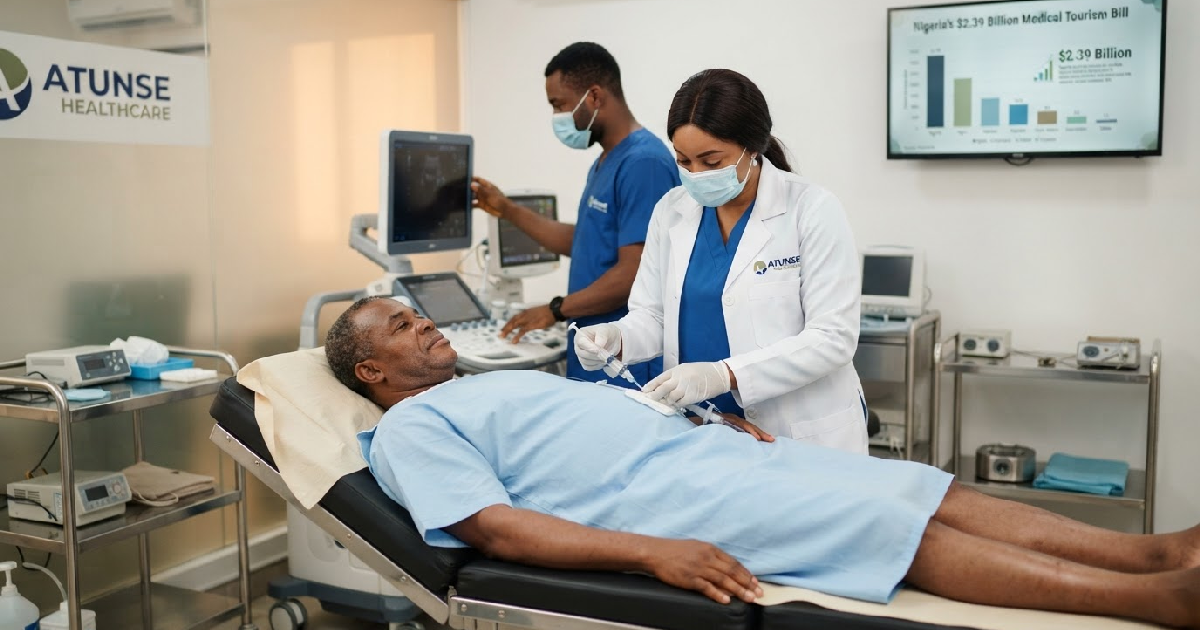
Lagos, Nigeria – On Friday, August 7, 2026, Atunse Healthcare officially launched its operations in Lagos, unveiling an ambitious strategy to reorient Nigeria’s healthcare system and drastically reduce the nation’s staggering $2.39 billion annual medical tourism bill.
This new venture, a partnership between the United States-based KweHealth, LLC and Nigeria’s Tri-State Healthcare System, aims to bring advanced regenerative medicine, manufacturing capabilities, and specialist expertise directly to Nigerian patients.
The deep economic cost of seeking care abroad
The company, Nigerian-domiciled and Nigerian-based, positions itself not merely as another clinic, but as a critical component in a wider effort to reverse decades of dependence on foreign hospitals and imported medical technologies. For Kamar T. Adeleke, the President and Chairman of Atunse Healthcare, the launch marks a pivotal moment. He believes Atunse was created to change the entire direction of medical care across Africa.
For too long, Nigeria has watched billions of dollars flow out of its economy as citizens travel overseas for medical treatment. The Central Bank of Nigeria estimates the nation lost more than $11 billion to overseas medical and educational services over the last decade alone.
Nearly 60 percent of this medical exodus is driven by just four critical specialties: oncology, cardiology, nephrology, and orthopedic surgery. This outbound journey isn’t just a financial drain; it represents a deeper forfeiture of healthcare demand, investment, and specialized expertise that could otherwise invigorate the local health sector, Adeleke explains.
Beyond the dollar drain: the human and intellectual capital leaving Nigeria
“What Nigeria loses is not only money,” Adeleke observed. “It is the demand, the capital and the clinical talent. That is not a shortage of resources, it is an absence of capability. We intend to build it here: the treatment, the manufacturing, the distribution, and the people who will run all three.”
The numbers bear out his concern. In the last five years, over 16,000 doctors have left Nigeria, each representing an estimated public training subsidy of $51,000, or N78.5 million. This exodus of skilled professionals highlights the systemic challenge of retaining talent when local infrastructure struggles to meet advanced medical needs.
Building medical sovereignty after global crises
The COVID-19 pandemic served as a stark reminder of the perils of depending on other nations for essential healthcare. Fatima Aliko Dangote, Group Executive Director of Commercial Operations for Oil & Gas at Dangote Industries, emphasized this vulnerability, noting how every country prioritized its own needs during the crisis.
“Dependence is a vulnerability,” Dangote stated. “When a crisis comes, every country first looks after itself, and we saw what happened with vaccines, diagnostics, medicines and other essential health technologies. So, for us in Africa, medical sovereignty cannot just be a slogan.”
Her words underscore a growing consensus: healthcare capacity is inextricably linked to national economic security. Producing less than one percent of its own vaccine supply leaves Africa exposed to global supply chain disruptions, making local manufacturing a strategic imperative.
Lagos State’s push for local talent and digital health infrastructure
The Lagos State government sees initiatives like Atunse Healthcare as vital to addressing its own critical healthcare workforce gaps. Akin Abayomi, the Lagos State Commissioner for Health, who represented Governor Babajide Sanwo-Olu at the launch, spoke about the urgent need to attract Nigerian medical professionals back home.
“We need our own experienced specialists back to do this,” Sanwo-Olu said. “When we start seeing initiatives like this, it starts to encourage our own experienced specialists to come back home.” Regenerative medicine, he added, represents an exciting frontier, but requires a foundational ecosystem of science, people, and systems.
Governor Sanwo-Olu highlighted the state’s commitment to digital transformation in healthcare, referencing the Smart Health Information Platform (SHIP) launched to digitalise public health facilities. He urged the private sector to integrate with this system, stressing that a responsive health system combines data, technology, specialists, and private investment.
Atunse’s integrated approach: from treatment to manufacturing
Atunse Healthcare’s ambition stretches far beyond providing just clinical treatment. It aims to develop a comprehensive, integrated ecosystem spanning treatment, manufacturing, and distribution, designed to serve Nigeria initially, and eventually the broader African market.
Atunse Healthcare frames this integrated approach as a vital opportunity to retain economic and human value within Nigeria. This move echoes broader national efforts to revive local vaccine manufacturing after a three-decade hiatus.
The company has outlined several core capabilities and offerings to achieve this:
- Clinical delivery
- Advanced biomanufacturing
- Research and clinical translation
- Regulatory capability
- Focus on Advanced Regenerative Biologics manufacturing and distribution
- Establishment of a flagship African Regenerative Medicine Center, part of the KIARMA initiative
- Longevity & Vitality Program, integrating IV exosome infusions, precision nutrition, and structured lifestyle optimization
- Men’s Intimate Wellness Program, utilizing Focused Shockwave + Exosome Therapy
- Regeneration at the Surface, a specific service offering
- Extensive Workforce Development, focusing on biomanufacturing, quality assurance, regulatory science, and clinical research.
Establishing regulatory foundations for advanced medicine
The emergence of advanced medical technologies, particularly in biologics, regenerative medicine, and stem-cell therapies, introduces complex regulatory questions. Khadijah Ade-Abolade, Director of the Vaccines, Biologics and Medical Devices Registration Directorate, representing Mojisola Adeyeye, the Director-General of the National Agency for Food and Drug Administration and Control (NAFDAC), confirmed the agency’s restructuring to meet these demands.
NAFDAC acknowledges the need to encourage innovation while maintaining stringent standards for safety, quality, and effectiveness. Ade-Abolade also cautioned against unverified claims by wellness centers and online vendors marketing unapproved stem-cell products, emphasizing the critical distinction between legitimate scientific advances and unproven therapies that could endanger patients.
The wider ecosystem for medical innovation
For Frederick A. Kweh, Chief Science and Technology Officer at Atunse Healthcare, Africa’s role must evolve from being a consumer to a contributor in global medical research. “The science does not become African by being applied here. It becomes African when it is made here, studied here, and taught here,” Kweh asserted, highlighting the deep integration required.
This vision extends beyond private enterprise. Building an effective infrastructure for advanced medicine demands a supportive regulatory environment, robust research institutions, a skilled professional workforce, reliable infrastructure, adequate financing, and stronger connections between universities, hospitals, and industry.
A new economic frontier for Nigeria
Atunse Healthcare’s launch frames Nigeria’s long-standing medical tourism problem within a much larger economic narrative. Each patient who seeks treatment abroad not only depletes foreign exchange reserves but also diverts crucial demand from domestic hospitals, laboratories, and pharmaceutical manufacturers.
Developing these capabilities locally promises an economic ripple effect far beyond patient treatment. It could cultivate new markets for medical research, specialist training, biotechnology, and healthcare technology. Crucially, it could also help Nigeria retain its highly trained professionals who might otherwise seek opportunities overseas, contributing to national self-reliance.
The company’s immediate base is Lagos, but its stated ambition stretches across the continent: to forge an African platform capable of producing, studying, and delivering advanced medicine locally. This kind of economic transformation offers a powerful vision for Nigeria’s future.
The ultimate test: accessibility and affordability
The central question, however, remains whether Atunse Healthcare’s grand ambition can translate into treatments that are both safe and affordable, reaching beyond Nigeria’s wealthiest patients. Its success will not only be measured by the foreign exchange saved but by the broader accessibility it brings to advanced medical care.
If successful, Atunse would do more than just compete with foreign hospitals for Nigerian patients. It would establish a fundamental piece of infrastructure, making medical tourism less of a necessity and transforming how Nigerians access vital, advanced healthcare at home.
