




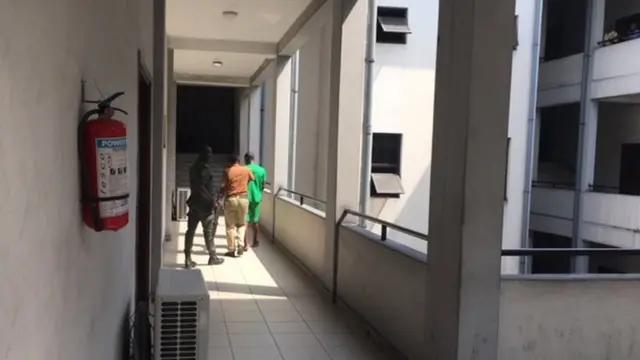
On September 12, 2019, a routine security camera at Helena Hotel in Port Harcourt recorded something extraordinary. The footage showed a man entering with a female guest, only to leave the premises later without her. This seemingly simple observation became the critical visual evidence that finally unmasked Gracious David-West, the infamous Port Harcourt serial killer.
For weeks, a terrifying pattern of murders had gripped the city, with bodies of women found in hotel rooms across Rivers State. Investigators were grappling with limited leads and increasing public fear. The anonymous killer seemed untouchable, leaving behind a trail of suspicion but no concrete identification.
The Port Harcourt Serial Killer Unmasked
Before that pivotal night, police had little beyond fragments of eyewitness accounts and mounting concern. The killer’s modus operandi, luring women to hotels before strangling them and stealing their belongings, left few clues outside the closed doors of the hotel rooms.
The breakthrough arrived when diligent monitoring of the Helena Hotel’s security feed highlighted an anomaly. A man, later identified as Gracious David-West, checked in with a woman but departed alone. This discrepancy, captured in pixelated detail, offered the first tangible link between the hotel deaths and a specific individual.
The hotel promptly circulated the image, and it began to spread with unprecedented speed across social media platforms. Suddenly, the abstract fear of an invisible killer gained a chillingly clear face. This marked a profound shift in the investigation, turning it from a search for a pattern into a focused hunt for a person.
A Mandate for Vigilance
This crucial CCTV footage was not a mere stroke of luck. It was the direct result of proactive measures implemented by the Rivers State authorities. As public outrage mounted, the Rivers State Commissioner of Police, Mustapha Dandaura, issued a directive in August 2019.
He mandated all hotels and guest houses in Port Harcourt to install CCTV cameras at reception and along corridors, and to check guests against real IDs. This policy was designed to counter the inherent privacy of hotel rooms, which had previously obscured the killer’s movements.
While cameras couldn’t peer into guest rooms, they could track arrivals and departures, making the perimeters of hotels significantly less anonymous. One hotel’s adherence to this new security requirement proved instrumental.
That single compliant hotel, monitoring its cameras diligently, recognised the man in the footage as the suspect investigators desperately sought. It demonstrated how a simple regulatory push could transform routine surveillance into vital intelligence, adding a new layer of security to public spaces.
The Digital Pursuit Begins
The image of Gracious David-West, initially a static frame, became a dynamic tool for law enforcement. Police Commissioner Mustapha Dandaura confirmed that the Helena Hotel not only provided the footage but also a telephone number associated with the suspect. Investigators now had a powerful combination of visual identification, location, and potential contact information.
The widespread sharing of David-West’s image on social media amplified its reach far beyond official channels. This public dissemination meant police officers on routine patrol operations had a high chance of encountering and recognising the suspect. The digital footprint extended the investigative net dramatically.
Precisely two days after the CCTV capture, officers intercepted a commercial bus en route to Akwa Ibom. During a stop and search operation on the East-West Road, police officers recognised a passenger whose appearance and clothing matched the circulating images. That passenger was Gracious David-West.
His arrest on September 19, 2019, marked the end of a terrifying spree. The camera hadn’t physically apprehended him, but it provided the essential “face” that travelled across the state, guiding officers to their target. The roadblock became an extension of the hotel’s surveillance system, completing the critical chain of evidence.
The telephone number provided by the hotel further solidified the police’s trail. By tracking David-West’s movements through his phone, investigators could corroborate the visual evidence and confirm his flight path from Port Harcourt. This blend of traditional police work with emerging digital clues proved decisive in his capture.
From Screen to Courtroom
While the CCTV footage was pivotal in identifying and apprehending Gracious David-West, it was just one piece of a larger puzzle for the legal process. His confession, reportedly detailing the killings of approximately 15 women across several states, became a central component of the prosecution’s case.
David-West was specifically charged with the murder of 11 women and the attempted murder of one, Benita Etim.
During the trial at the Rivers State High Court, presided over by Justice Adolphus Enebeli, David-West initially denied being the man in the footage. He claimed the image was unclear and that he had committed no offense.
However, the prosecution meticulously presented a wealth of evidence, including David-West’s own voluntary statements and the very CCTV footage that led to his arrest.
On October 9, 2020, Justice Enebeli delivered a damning verdict, finding Gracious David-West guilty and sentencing him to death by hanging.
The court explicitly relied on the combination of his confession, witness testimonies, and the irrefutable digital evidence from the Helena Hotel camera. This conviction underscored the transformative power of well-preserved digital evidence in modern criminal justice.
The journey of that initial hotel recording from a security measure to a viral image, an investigative lead, and finally, crucial courtroom evidence is remarkable.
It demonstrates how seemingly ordinary technology, when properly deployed and connected to other investigative efforts, can dramatically alter the course of high-stakes criminal investigations. It proved that accountability can be found even in the darkest corners.
Lessons from a Lens
The Port Harcourt serial killings case stands as a potent example of how an ordinary piece of security equipment can achieve extraordinary results. It highlighted the limitations of investigations that rely solely on human witness accounts or traditional forensics, especially when crimes occur behind closed doors. The camera offered an objective, unwavering record.
This case spurred a critical re-evaluation of security protocols in public accommodations across Nigeria. It underscored the necessity for hotels to not only install CCTV cameras but also ensure they are functional, monitored, and that recordings are retained and accessible to law enforcement. The simple act of recording movement proved invaluable.
The synergy between mandated CCTV installation, active monitoring by hotel staff, the rapid dissemination of digital evidence via social media, and astute police work coalesced into a successful apprehension.
Had any single link in this chain failed, the investigation could have languished, leaving a killer at large and a city in fear. This case demonstrated the undeniable impact of digital trails in solving complex crimes and serves as a blueprint for future investigations.
What this means for Nigeria is a stark reminder that technology, even in its most basic forms, can be a powerful ally in the pursuit of justice. The anonymity that once shielded criminals in places like hotels is increasingly eroded by pervasive surveillance.
The Port Harcourt case teaches that even a single, unblinking lens can be the most crucial witness when no human eye can see.
